Rhinoplasty in Korea for Foreigners? Cost, Reviews, Days
Is rhinoplasty in Korea for foreigners realistic when you have about two weeks off, one round-trip ticket, and nobody at home who knows anything about your surgery?
By the end of this guide, your questions about rhinoplasty should turn into a clear next step.
Send 5 photos (front, 45-degree and side) on WhatsApp and we will reply in English with a free first assessment: the likely scope of surgery and how the estimate is worked out.
Send my photos on WhatsAppRead this before you book the flight.
You'll know how many nights to plan, what decides the cost, what reviews get right and wrong, and which methods fit which nose, so you can choose dates and a plan that suit your nose and your budget.
Hello, I'm Dr. Choi Hang-seok, Head Surgeon at TIANA Plastic Surgery in Gangnam, Seoul, and a board-certified plastic surgeon in Korea.
TIANA does rhinoplasty and revision rhinoplasty, nothing else. I see you 1:1 from consultation to surgery and aftercare, I manage the anesthesia myself, and before surgery 3D-CT imaging maps your bone and nasal structure. You can consult in English on WhatsApp.
I wrote this because many people lock in their flight dates first and fit the healing in afterwards, then find the return flight leaves before the splint comes off.
Rhinoplasty in Korea for foreigners is mostly a calendar question. Plan on about 7 to 14 nights in Seoul, never fewer than 7, because the splint and outer stitches come off around day 7 and the inner stitches around day 14.
If you're not sure how long your own nose would need, send one front photo and one side photo on WhatsApp and ask the question that decides your trip: seven nights or fourteen for my nose? Asking with your own photos keeps the first answer about your face, not an average.
How many nights in Seoul do foreigners need for rhinoplasty?
Seven nights is the floor and fourteen is the comfortable version. Around day 7 the splint and outer stitches come off. Around day 14 the inner stitches come out. The exact timing shifts a little from nose to nose and is confirmed at surgery, so leave a spare day on either side if your ticket allows it.

If seven nights is all you have, you can fly home on day 7. You leave with a referral letter and a surgery certificate. Those two papers are what a doctor at home needs to see you without guessing what was done.
Then check the clinic calendar against your flights. TIANA is open 10:00 to 19:00 on weekdays and 10:00 to 16:00 on Saturdays, and closed on Sundays and public holidays. Korea's long holidays, Lunar New Year and Chuseok, close several days in a row, so look them up before you pay for anything. Ask at booking whether your consultation and surgery fall on the same day or on separate days, and add that to your count.
| Point in the trip | What happens | What it means for you |
|---|---|---|
| Consultation | Exam with 3D-CT imaging | Weekday or Saturday only |
| Around day 7 | Splint and outer stitches off | Earliest day to fly home |
| Around day 14 | Inner stitches out | Stay this long if you can |
For a feel of the first week itself, there's a separate post on a stay from cast-off to the flight home. If your nose needs several steps at once, such as a hump plus a wide tip, this week-by-week plan for a bigger nose walks through a longer stay.
Flying home with a nose that is still healing
The long flight is the part of rhinoplasty in Korea for foreigners that people plan least, and it deserves a plan of its own. Expect your nose to feel blocked on the plane. That's swelling inside the nose, and in the first weeks it is expected. Surgeons generally ask you not to blow your nose, to keep your head raised when you rest, and to avoid bumping the nose, so an aisle seat and a neck pillow are worth more than legroom.
The U.S. CDC's guidance on medical tourism makes points I'd repeat to anyone flying in for surgery: see a doctor at home before you go, carry copies of your records, plan your follow-up care for after you return, and know that flying soon after surgery raises the risk of blood clots. On a long-haul flight, get up and walk the aisle, and keep drinking water.
Before you leave home, find one local doctor (a GP, an ENT or a plastic surgeon) who is willing to see you after you get back. Put the referral letter and surgery certificate in your hand luggage, not your checked bag.
Say you teach English in Ho Chi Minh City, your school break is twelve days, and your nose needs a low bridge raised and the tip supported. I'd plan to arrive a day before the consultation, keep the seven-night minimum after surgery, and book the flight home for day 8, so a splint removal that runs a few hours late doesn't cost you the flight. The inner stitches would then be the reason to have that local doctor lined up. Twelve days is workable for that plan; ten would be tight.
If your dates look like that kind of squeeze, send your planned departure date and the city you fly back to on WhatsApp, and mention any nose surgery you've had before. Ask whether the plan your nose needs fits inside that window. A real departure date is far easier to plan around than "sometime next spring".
Wondering which type your nose is?
Share your profile and front photos — the surgeon will tell you which procedures your nose would actually need. No cost, no obligation.
Ask which procedure fits meWhich methods come up for which nose?
The method follows the nose, so start with what bothers you when you look in the mirror.
- A low or flat bridge: full rhinoplasty, with a bridge implant plus tip support from septal, own or donor cartilage, designed as one profile.
- A round, heavy tip: bulbous tip refinement, bringing the tip cartilage together so the tip looks slimmer from the front and the side.
- A tip that needs only a light change: minimal-incision tip work, including tip surgery without an implant. Minimal-incision procedures tend to recover faster, which matters on a short trip.
- A hump or a wide bony bridge: hump reduction and osteotomy.
- A short or upturned nose: septal extension and columella work to bring the tip down.
- A nose from a previous surgery: revision rhinoplasty, including contracture cases.
The bridge material is chosen before surgery. The options are a silicone implant or your own tissue: ear, septal or rib cartilage (or donor rib cartilage), dermis and fascia. Each has its strengths and limits, and your skin thickness and what you want both weigh into the choice. The English overview of TIANA's nose procedures lays out the nose types side by side.
Doctor's note
A nose changes a face through very small differences, which is why I only operate on noses. Raising the tip alone tends to make it look stuck on, so I design the bridge and tip together. If you bring a reference photo, I compare it with your anatomy and tell you which parts can be reached without forcing it. Trends change; your bone structure doesn't.
What decides the cost of rhinoplasty in Korea for foreigners?
TIANA doesn't publish a fixed menu price, because two noses that look alike in a photo can need very different surgery. For a foreign patient, these are the things that move the figure:
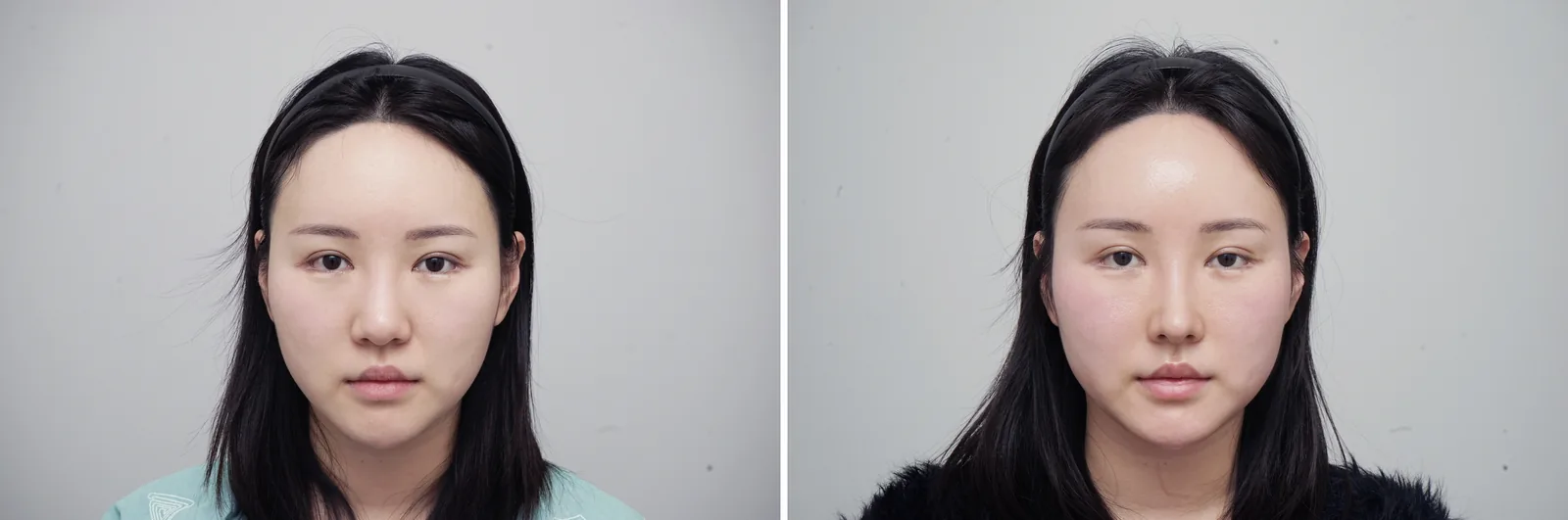
Example case (removal of old filler or implant): front view before surgery (left) and 2 weeks after (right). Procedures: silicone bridge implant, tip with septal and donor rib cartilage, hump reduction, bulbous tip refinement, drooping-tip correction, columella and nasolabial angle adjustment. Results vary between individuals; swelling, bruising, asymmetry and infection are possible risks. Shared with the patient's consent.
- Scope. Tip only, bridge plus tip, or adding osteotomy for a hump or a wide bony bridge.
- Your own nose. How much septal cartilage there is to work with, and how thick the skin is.
- Material. A silicone implant, your own ear or septal cartilage, or rib or donor rib cartilage.
- Whether it's a revision. Rebuilding after surgery elsewhere usually takes more work than a first operation.
- Your nights in Seoul. The clinic fee is one part; the hotel and meals for seven versus fourteen nights are yours to budget.
One thing I'd ask you to weigh: a plan that looks low-priced can end up costing more if it needs a revision, both in money and in extra trips to Korea. The final fee is confirmed after the examination in Seoul. For a working figure for your own case, ask on WhatsApp what it would cost for your nose, with five photos: front, 45-degree and side views.
What do rhinoplasty reviews from foreigners get right and wrong?
Forum threads and review sites are full of trip reports. Some of what they repeat holds up medically, and some of it doesn't.
“You'll look normal by day 10.” Partly true. For many people most bruising fades within the first two weeks, and with the splint off you can usually be out in public. The tip is another matter. The American Society of Plastic Surgeons notes that initial swelling goes down within a few weeks, while the final contour of the nose can take up to a year to refine. A photo at day 10 is not your result.
“Korean clinics give everyone the same nose.” A careful surgeon sets the height and tip shape from your face and bone structure, which is why two people holding the same reference photo can leave with different plans.
“The language barrier is the hard part.” At TIANA you can consult in English on WhatsApp, and the reply comes in English. What reviews mention far less often is day 20, back home, when something feels odd. That's the part to plan for.
If you want to read the threads with a sharper eye, I've written about reading PurseForum rhinoplasty threads before you ask anything and about the questions worth asking beyond the names forums repeat.
If you want to see how real noses changed and how many months after surgery each photo was taken, browse TIANA's rhinoplasty case gallery before your consultation.
Risks and side effects to know
Swelling, bruising around the eyes, a blocked nose and a numb tip are common after rhinoplasty. Bruising usually fades over one to two weeks, the blocked feeling eases as the inside of the nose settles over the first weeks, and feeling in the tip often takes a few months to return. The American Society of Plastic Surgeons lists the less common risks: infection, bleeding, difficulty breathing, a hole in the septum, poor wound healing or scarring, lasting numbness, and an appearance you're not happy with, which can lead to revision surgery.
As general medicine, some people should wait or rethink:
- an active skin infection or inflammation on or around the nose
- pregnancy or breastfeeding
- a bleeding disorder, or blood-thinning medication you can't safely pause with your own doctor's agreement
- a nose operated on recently, where the tissue hasn't settled yet
- a goal that depends on looking like one specific person
Whether you're a candidate, and for which method, is decided at the in-person exam.
If something appears after you fly home, act early. For a fever, redness or pain that gets worse instead of better, bleeding that won't stop with gentle pressure, or a sudden change in shape after a knock, see your local doctor with the referral letter and surgery certificate, and send photos to TIANA on WhatsApp. Calf pain, a swollen leg or shortness of breath after the flight needs emergency care straight away, because those can be signs of a blood clot.
Before you book anything, send five photos (front, 45-degree and side) on WhatsApp with your travel dates and one question, for example: which method does my nose likely need, and does it fit these dates? One clear photo set is enough to start, and you can ask before you commit to a flight. When you come to Seoul, I examine your nose with 3D-CT and recommend the plan that fits your face and the time you have.
Frequently Asked Questions
Q1Do I need to speak Korean to have rhinoplasty at TIANA?
No. You can consult in English on WhatsApp, and the reply comes in English. Send your photos and questions in English from the start.
Q2Can I combine other procedures with my nose surgery at TIANA?
TIANA performs rhinoplasty and revision rhinoplasty only, so the trip is planned around your nose alone.
Q3What should I bring from home?
A list of any medication you take, notes on any previous nose surgery, and the contact of a local doctor who can see you after you return. Keep the referral letter and surgery certificate you receive in Seoul in your hand luggage.
Q4Can I sightsee in Seoul while I recover?
Gentle walking is usually fine once the first heavy days of swelling pass. Avoid crowds where the nose could be bumped, heavy exercise and saunas, and plan quiet days around the splint removal.
Q5Can a nose operated on at another clinic be corrected?
Yes. TIANA performs revision rhinoplasty after surgery elsewhere, including difficult cases such as contracture. Include details of the previous surgery when you send your photos.
Thank you for reading to the end.
Send 5 photos (front, 45-degree and side) on WhatsApp for a free photo consultation. We reply in English with the likely scope of surgery and how the estimate is worked out.
Send my photos on WhatsAppThis article is general information about elective cosmetic surgery and is not a diagnosis. Results and recovery vary between individuals. Before-and-after photos are published with patient consent; surgery carries risks such as swelling and bruising and requires downtime. Final procedures and fees are decided after examination.