
Asian Rhinoplasty Recovery Timeline in Seoul | TIANA
By the end of this guide, your questions about rhinoplasty should turn into a clear next step.
Send 5 photos (front, 45-degree and side) on WhatsApp and we will reply in English with a free first assessment: the likely scope of surgery and how the estimate is worked out.
Send my photos on WhatsAppAsian rhinoplasty recovery timeline: what happens in Seoul
Planning your leave around rhinoplasty in Seoul and unsure which part of the Asian rhinoplasty recovery timeline has to happen in Korea, and which part can happen at your desk back home?

The Seoul part is 7 to 14 nights, depending on the procedure and the individual. Here is how the stay is laid out:
- Day 1: consultation and surgery.
- The day after: the gauze inside the nose comes out, and I check the swelling.
- Around day 7: the cast and outer stitches come off.
- Around day 14: the stitches inside the nose come out. If you fly home on day 7, I give you a referral letter and a surgery certificate so a doctor at home can remove them.
How quickly swelling settles differs from person to person, so I don't give one fixed number of days. I go through your progress photos with you one by one.
Hello, I'm Dr. Choi Hang-seok, Head Surgeon at Tiana Plastic Surgery in Gangnam, Seoul.
I operate only on noses and stay with you one-to-one from consultation through surgery and aftercare, so the surgeon checking your nose when the cast comes off is the one who operated.
For more on nose surgery, see the Asian rhinoplasty topic hub.
Why does the tip take longer in many Asian noses?
Most rhinoplasty in East Asian noses adds structure rather than removing it. A 2014 review of Asian rhinoplasty by Ishii in Plastic and Reconstructive Surgery Global Open describes the usual goals as building up a low bridge and giving a soft tip more projection and support, often with an implant and cartilage grafts, under skin that is often thicker.
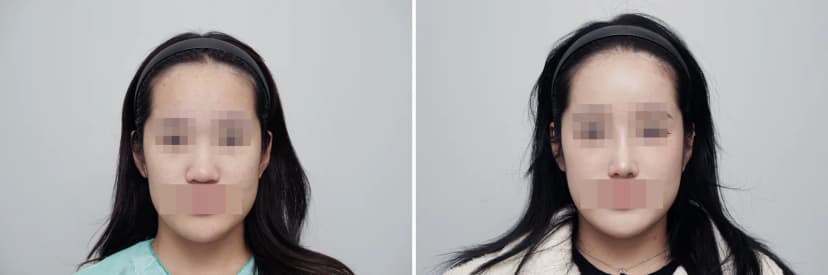
Example case (hump nose, bulbous tip): front view before surgery (left) and 2 weeks after (right). Procedures: silicone bridge implant, tip with septal and donor rib cartilage, hump reduction, bulbous tip refinement, drooping-tip correction, columella and nasolabial angle adjustment. Results vary between individuals; swelling, bruising, asymmetry and infection are possible risks. Shared with the patient's consent; eyes and mouth are pixelated for privacy.

That combination sets the clock. The bridge, where skin is thinner and lies over a firm implant or bone, usually looks settled first. The tip, with thicker skin and more soft tissue over new cartilage, holds fluid longest. This is the main reason the Asian rhinoplasty recovery timeline runs longer at the tip than at the bridge, and why the post on how skin sets the limit for a bulbous Asian tip is worth reading if your tip is wide and fleshy.
Wondering which type your nose is?
Share your front, 45-degree and side photos — the surgeon will tell you which procedures your nose would actually need. No cost, no obligation.
Ask which procedure fits meThe first 14 days, and where each one happens
The rows follow the clinic's stay plan; the swelling notes are general medicine.
| When | Where you'll be | What's happening |
|---|---|---|
| Days 1–6 | Hotel, with checkups | Gauze removed, swelling checked, prescriptions and aftercare guidance; swelling and eye bruising build, then ease |
| Day 7 | Clinic | Cast and outer stitches off, timing confirmed at surgery |
| Days 8–13 | Seoul or home | Bruising fading; inner stitches still in |
| Day 14 | Clinic, or a doctor at home | Inner stitches out; at home with the referral letter and surgery certificate |
| Day 15 to week 6 | Home | Eye bruising can last about 3 weeks; strenuous exercise at 4 to 6 weeks (NHS) |
| Week 7 to month 12 | Home | Swelling comes and goes, worse in the mornings; contour refines for up to a year (ASPS) |
Risks and side effects to know
For many people, swelling and bruising peak around the second or third day, which is why those are the days to have nothing planned except sleep with your head raised on two pillows. The first nights themselves, from the recovery room to the hotel bed, are covered in what recovery in Seoul looks like hour by hour.
The step people forget is at the other end. If you'll fly home on day 7, book the GP or ENT who will take out your inner stitches before you leave home, not after you land.
Should you book the flight for day 7 or day 14?
Both work. Flying on day 7 saves a week of hotel nights and leave, and hands the day-14 step to a doctor at home. Staying to day 14 means every step, including the inner stitches, happens with the surgeon who operated.
Say you're 34, you work in Sydney, you have ten working days, and you'd like to be back at your desk without a cast. I'd suggest surgery at the start of your leave, a flight home after the day-7 visit, the stitch appointment at home already booked, and the second week for bruising to fade on your own sofa. If you need rib cartilage, or this is a second operation, I'd lean toward the full 14 nights; the rib cartilage recovery timeline, nose and chest and tip revision recovery, day by day explain why those heal on their own schedules.
The five-photo set and the way a first consultation works are laid out on Tiana's English page.
When you write, add the return flights you're considering, with departure times, and ask which one leaves room for the day-7 visit.
What can you do back at work in weeks 3 to 6?
Desk work is usually fine by then; the NHS suggests up to two weeks off in total. The visible part, bruising around the eyes, can last about three weeks, so a video call in week three may still show a yellow tinge under the eyes.
Running, the gym and contact sports wait until four to six weeks, and anything that could knock the nose waits longer.
When does the tip stop changing?
In short, this is the stretch of the Asian rhinoplasty recovery timeline that tests patience most. The NHS says it can be several months before you see the full effect and up to six months for the swelling to go completely; the American Society of Plastic Surgeons says the contour may take up to a year to fully refine, and that swelling may come and go and be worse in the mornings during that first year. Under thick tip skin, expect to be nearer the long end.
A practical way to track it: take one photo a month, same window, same time of day, and do it in the evening, because the morning puffiness will mislead you. Compare month to month, never day to day.
Doctor's note
I don't give one downtime number, because a tip under thick skin and a bridge-only change don't heal on the same clock. Swelling settles at a different pace in every nose, so I guide each person from their own progress photos instead. If you look at your tip at month two and feel it's too full, send the photo before you worry; that fullness is usually the part still settling.
Bleeding, blockage or one-sided swelling: what to watch at home
The expected part is a blocked nose for the first week or two, swelling, bruising around the eyes, and some light oozing in the first days. How long each phase lasts varies from person to person, which is why the table gives windows instead of fixed dates.
As general medicine, it's worth waiting if you have an active sinus infection or a heavy cold, a health condition that isn't yet under control, blood-thinning medication you haven't discussed with a doctor, or you're pregnant.
Once home, swelling that keeps growing on one side, bleeding that won't stop with gentle pressure, a fever, or pain and redness that get worse instead of better need a local doctor or emergency department the same day.
If you want to see how real noses changed and how many months after surgery each photo was taken, browse TIANA's rhinoplasty case gallery before your consultation.
Your first message, if your leave is the constraint
Three lines are enough: the days your leave starts and ends, the city you'd fly home to, and the five photos. The question worth asking is whether your nose, as it looks in those photos, points toward a 7-night or a 14-night plan. You can ask that before booking anything. On day 7, with the cast off, your tip will look fuller than it will at month six; that's expected, and it's a moment I'd rather go through with you in Seoul than have you meet alone in a mirror at home.
Frequently asked questions
Q1Can I fly with a blocked nose on day 7?
Usually, yes. Cabin pressure changes can make the nose feel fuller during descent, so drink water, don't blow your nose, and ask at the day-7 visit what you can use to keep the inside moist on the flight.
Q2Does the non-incision tip method shorten the timeline?
It tends to recover relatively faster, because incisions are kept to a minimum. The tip still has to settle, and how many nights you need depends on the scope of the surgery, so it changes the early days more than the months that follow.
Q3When can I wear glasses again?
Ask at your day-7 visit. Many surgeons ask you to keep the weight of frames off the bridge for several weeks; lightweight frames or taping them to the forehead are common workarounds in the meantime.
Q4My nose is puffier in the morning at month four. Is that a bad sign?
On its own, no. The American Society of Plastic Surgeons describes swelling that comes and goes and is worse in the mornings during the first year. Swelling that is growing, painful, red or on one side only is different and needs a doctor.
Q5Will people at work notice in week three?
The bruising around the eyes can last about three weeks, so a faint tinge may still show. The fullness at the tip is often more obvious to you in the mirror than to colleagues across a desk.
Thank you for reading to the end.
Send 5 photos (front, 45-degree and side) on WhatsApp for a free photo consultation. We reply in English with the likely scope of surgery and how the estimate is worked out.
Send my photos on WhatsAppThis article is general information about elective cosmetic surgery and is not a diagnosis. Results and recovery vary between individuals. Before-and-after photos are published with patient consent; surgery carries risks such as swelling and bruising and requires downtime. Final procedures and fees are decided after examination.