Seoul Rhinoplasty Recovery Cost: 7 Nights or 14?
Worried that your Seoul rhinoplasty recovery cost will keep growing once you add hotel nights, a changed flight and stitches still inside your nose?
By the end of this guide, your questions about rhinoplasty should turn into a clear next step.
Send 5 photos (front, 45-degree and side) on WhatsApp and we will reply in English with a free first assessment: the likely scope of surgery and how the estimate is worked out.
Send my photos on WhatsAppThree things move it: how much of the nose is operated on, what your own nose needs (cartilage, skin thickness, whether it has been operated on before), and how many nights you stay, which is 7 to 14. The recovery side is mostly nights, and it can stop at 7 if a doctor at home removes the inner stitches.
Hello, I'm Dr. Choi Hang-seok, Head Surgeon at TIANA Plastic Surgery in Seoul.
I only operate on noses, and I see you one to one from the first consultation through surgery and aftercare, so the scope you are quoted comes from the surgeon who will operate. An anesthesiologist is on staff, and a medical interpreter for your language is provided at no extra charge, so nothing about the plan or the bill has to be guessed at in a second language.
If you want to know which of those three things applies to you, send five photos on WhatsApp (front, both oblique angles, both side profiles) with the dates you could travel, and ask what it would cost for your case. The question is then about your nose instead of a forum average.
What decides the price of the surgery itself?
Scope comes first. Refining a round tip is a smaller operation than full rhinoplasty, where the bridge is raised with an implant and the tip is rebuilt with cartilage. Your own nose comes second: how much cartilage you have, how thick the skin is, and whether someone has operated on it before.

Here is how those factors usually sort themselves:
- Tip only. Bulbous tip refinement brings the tip cartilages closer together. There is also a tip option that keeps incisions to a minimum, for people who want a lighter recovery.
- Bridge and tip together. Full rhinoplasty pairs a silicone implant on the bridge with tip work using septal, ear or donor cartilage.
- A hump or wide nasal bones. Shaving the hump and narrowing the bones (osteotomy) adds work on the bony part of the nose.
- A revision. When earlier surgery has used up the septal cartilage, or the nose has contracted, rib cartilage is often needed. That adds a second surgical site, covered in rib cartilage rhinoplasty recovery, day by day.
Scope is also where quotes surprise people. Raising only the tip tends to make it look detached from the rest of the face, so with a low bridge, a tip-only plan may not reach the nose in your reference photo. I compare the photo you bring with your anatomy and set only the range that can be reached, and I check it at the exam so you don't discover after the flight that the scope fell short.
The other direction matters too. A plan that looks cheaper can end up costing more if it leads to a revision, because a revision means another quote and another trip to Seoul. That is the part of a Seoul rhinoplasty recovery cost that rarely makes it into anyone's spreadsheet.
The final plan is set in Seoul after 3D-CT and an exam with me. When you ask for a quote, also ask what it covers: the surgery, anesthesia, medication and the follow-up visits during your stay.
The recovery side of the bill is mostly nights in Seoul
The stay I recommend is 7 to 14 nights. Here is what each stretch of it is for, and what it adds to your trip.
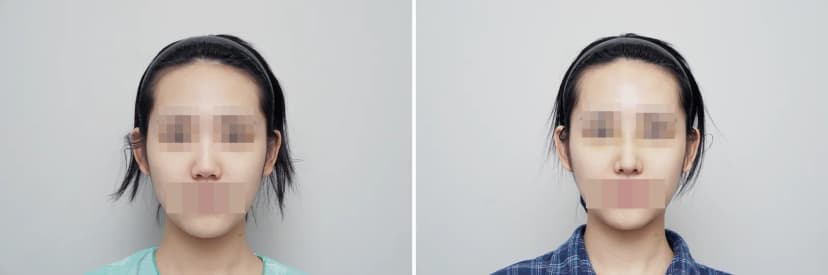
Example case (hump nose, bulbous tip): front view before surgery (left) and 2 weeks after (right). Procedures: silicone bridge implant, tip with septal and donor rib cartilage, hump reduction, bulbous tip refinement, short-nose correction, osteotomy. Results vary between individuals; swelling, bruising, asymmetry and infection are possible risks. Shared with the patient's consent; eyes and mouth are pixelated for privacy.
| Day | What happens | What it adds to your trip |
|---|---|---|
| Day 1 | Consultation, any tests needed, design and cost confirmed, then surgery | Your first night in Seoul |
| Days 2–6 | From the next day: gauze removed from inside the nose, swelling checked, prescription and aftercare instructions; rest between visits | Hotel nights within easy reach of the clinic |
| Day 7 | After a check, the cast and outer stitches come off | The earliest point to fly home |
| Days 8–13 | Swelling keeps settling; no fixed clinic step | Optional nights |
| Day 14 | Inner stitches removed | Or done at home with a referral letter |
Risks and side effects to know
The day-7 step is confirmed after a check and can move with how you heal; it is explained again around the time of surgery. The clinic also has high-concentration oxygen care, which is used to support recovery from swelling and puffiness after surgery.
One planning detail saves real money. The clinic is open weekdays 10:00–19:00 and Saturdays 10:00–16:00, and closed on Sundays and public holidays. Before you book flights, count forward from your surgery date on a calendar. If your day 7 lands on a Sunday or a Korean public holiday, the cast step shifts, and so does the flight. Adding one night in advance is easier than rebooking a ticket from a hotel room with a cast on your nose.
The clinic is at 108 Bongeunsa-ro, Gangnam-gu, so a hotel a short taxi ride away keeps the visit days easy. What those first nights actually feel like is described in rhinoplasty recovery in Seoul, from recovery room to hotel room.
Wondering which type your nose is?
Share your front, 45-degree and side photos — the surgeon will tell you which procedures your nose would actually need. No cost, no obligation.
Ask which procedure fits meDo you have to stay for the day-14 stitches?
No. If you fly home on day 7, you leave with a referral letter and a surgery certificate, and a doctor at home removes the inner stitches. That is the biggest single lever on the recovery side of the trip: it is the difference between 7 nights and 14.
The trade is one appointment you have to arrange yourself. Arrange it before you fly to Seoul. Ask your family doctor, an ENT or a local plastic surgeon whether they will remove internal nasal stitches for someone operated on abroad, and book a slot for about a week after you land. Some practices are reluctant to take on another surgeon's patient at short notice, and you don't want to be phoning around with stitches due out.
Doctor's note
The more of the nose that is rebuilt, the more I want to see it again before you leave. For a tip refinement, flying on day 7 is often reasonable. For a revision with rib cartilage, I would plan extra nights, because the chest site and the nose both need checking. Tip revisions follow their own timing, which is laid out in tip revision rhinoplasty: your recovery, day by day.
Say you have two weeks of leave and a low bridge with a round tip
Say you live in Toronto, you have two weeks off, and your bridge is low with a round tip. Full rhinoplasty is the likely category, since lifting the tip alone would leave it sitting apart from a flat bridge. Two weeks of leave includes a long flight each way, so 14 nights in Seoul doesn't fit.
The plan I would sketch: surgery early in the week, cast and outer stitches off on day 7, one spare night in case that step moves, then home. The inner stitches come out at home around day 14 with the referral letter. Your recovery budget becomes 8 or 9 nights plus one local appointment, and you go back to work with some swelling still visible, which is usually fine for desk work and can feel early for anything on camera.
If your leave is fixed, put three things in one WhatsApp message: the day you could land, the day you must be back at work, and whether your nose has had surgery before. Then ask whether a day-7 or a day-14 departure fits your plan.
Swelling, bleeding, a shifted implant: what can go wrong once you're home
The common reactions are temporary: swelling, bruising around the eyes, a blocked nose and a numb tip. Most of the visible swelling fades over the first weeks, but the American Society of Plastic Surgeons notes that the final contour can keep refining for up to a year. How quickly swelling settles varies from person to person, which is why I don't give one fixed recovery period and instead guide each patient from progress photos.
Less common problems include nosebleeds, infection, asymmetry, trouble breathing through the nose and, with implants, an implant that shifts or a nose that contracts over time. These are the costs no quote covers, because they can mean a revision and another trip. I'm set up to handle revisions, and I would rather plan a scope that lowers the chance of one.
As general medicine, it is usually wiser to wait if you have an active sinus or skin infection, a cold at the time of surgery, are pregnant, take blood-thinning medication or supplements without your doctor's approval, or smoke and can't stop around surgery. Your exam is where your own suitability is decided.
If something feels wrong after you're home, act on it locally first. Heavy bleeding that won't stop, fever, spreading redness or worsening pain needs a doctor near you that day; take the surgery certificate with you. Then send progress photos on WhatsApp so I can see how the swelling is moving. The NHS also advises thinking through aftercare before having cosmetic surgery abroad. For what the first days feel like, read does rhinoplasty hurt? pain by day, recovery and risks.
If you want to see how real noses changed and how many months after surgery each photo was taken, browse TIANA's rhinoplasty case gallery before your consultation.
How do you get a figure for your own nose?
Ask on WhatsApp what it would cost for your case, with the five photos. Take them in daylight, at eye level, with no filter and your hair off your face. For a revision, add the year of the first surgery and what was used, if you know (an implant, ear cartilage, rib). The angles are also shown on TIANA's English consultation page.
Deposit and payment method are settled after the consultation, so once you know your scope, ask about both in the same thread.
One message is enough to start: the five photos, your travel window, and one question, such as whether your nose can be done as tip only or needs the bridge too. That answer moves the total more than anything else on this page. In Seoul, the 3D-CT shows me the bony framework and the inside of your nose, and that is where I look at whether the support your tip needs can come from your own septum.
Frequently asked questions
Q1Can I sightsee in Seoul while I'm recovering?
Light walking is usually fine after the first few days. Most surgeons ask you to avoid crowds where your nose could be bumped, bending over, heavy lifting and resting glasses on the bridge in the early weeks, so plan museums and cafés rather than packed markets.
Q2Is a revision priced the same way as a first rhinoplasty?
It is priced on the same factors, but a revision often needs more: scar tissue to work through, and sometimes rib cartilage when the septal cartilage has already been used. That changes both the operation and how many nights it is sensible to stay.
Q3Does the minimal-incision tip option shorten my stay?
Procedures without a full incision tend to recover a little faster, but the number of nights still follows the day-7 and day-14 steps. Ask about it together with your dates so the plan matches your leave.
Q4Can I do the whole thing in English?
Yes. The photo consultation on WhatsApp runs in English, and for the visit itself a medical interpreter for your language is provided at no extra charge.
Q5When will I look normal enough for work photos or video calls?
Visible swelling usually eases over the first weeks, while the tip is often the last part to settle. If you have a fixed date, such as a wedding or a presentation, give it when you message so the surgery date can be planned backward from it.
Thank you for reading to the end.
Send 5 photos (front, 45-degree and side) on WhatsApp for a free photo consultation. We reply in English with the likely scope of surgery and how the estimate is worked out.
Send my photos on WhatsAppThis article is general information about elective cosmetic surgery and is not a diagnosis. Results and recovery vary between individuals. Before-and-after photos are published with patient consent; surgery carries risks such as swelling and bruising and requires downtime. Final procedures and fees are decided after examination.