Rhinoplasty Revision Cost Korea? Reviews, Methods
Unhappy with how your first nose surgery turned out, and stuck on the rhinoplasty revision cost Korea question: what will fixing it actually take, in money and in trips to Seoul?
By the end of this guide, your questions about rhinoplasty should turn into a clear next step.
Send 5 photos (front, 45-degree and side) on WhatsApp and we will reply in English with a free first assessment: the likely scope of surgery and how the estimate is worked out.
Send my photos on WhatsAppRead this before you send photos anywhere or book a flight.
By the end, you'll know what sets the cost of a second surgery, what reviews get right and wrong about revisions, which methods are on the table, and how recovery is different the second time. With that, you can judge which plan fits your nose and your budget.
Hello, I'm Dr. Choi Hang-seok, Head Surgeon at TIANA Plastic Surgery in Gangnam, Seoul.
TIANA does only rhinoplasty and revision rhinoplasty. That includes surgery after another clinic, including contracture. Before surgery, 3D-CT maps the bone and nasal structure. The same specialist handles you from consultation through aftercare.
I wrote this because many people budget a revision from a first-rhinoplasty figure they found online, and a revision is usually a bigger, less predictable operation than the first one.
A revision at TIANA has no menu price. The figure is set by what your first surgery left behind (the implant, how much cartilage remains, the scar tissue and your skin) and by how much has to be rebuilt.
If you'd like a first read on your own case, send five photos of your nose as it looks today (front, 45-degree and side) on WhatsApp, along with the year of your first surgery and whether an implant was used. Ask one thing: what would a revision involve for my nose? That way the answer you get is about your nose, not a forum average.
Why a revision costs differently from a first rhinoplasty
In a first rhinoplasty, the surgeon works with untouched tissue. The septum usually still has cartilage to borrow, the skin moves freely over the framework, and the anatomy is where you'd expect it. In a revision, any of those can be different.

Scar tissue binds the skin to the structure underneath, and it has to be released carefully. Septal cartilage may have been used up the first time. An old implant may need to come out, and the space it leaves needs support. When contracture has pulled the tip upward, rebuilding it usually takes a larger, stronger graft than a used septum can give. That's why revisions after contracture are often rebuilt with rib cartilage.
This is what gets missed when people compare quotes. Two noses that look alike in a selfie can need very different surgery once you know what's inside them, and very different costs.
Doctor's note
A nose changes the whole face with very small differences, and that is why I operate only on noses. In a revision, I don't aim for a dramatic new nose. I'd rather rebuild support that blends in with your face, because a third surgery costs you more in every sense than a careful second one.
Rhinoplasty revision cost Korea: the factors that move it
Five things set the figure for a revision. The first two usually move it the most.
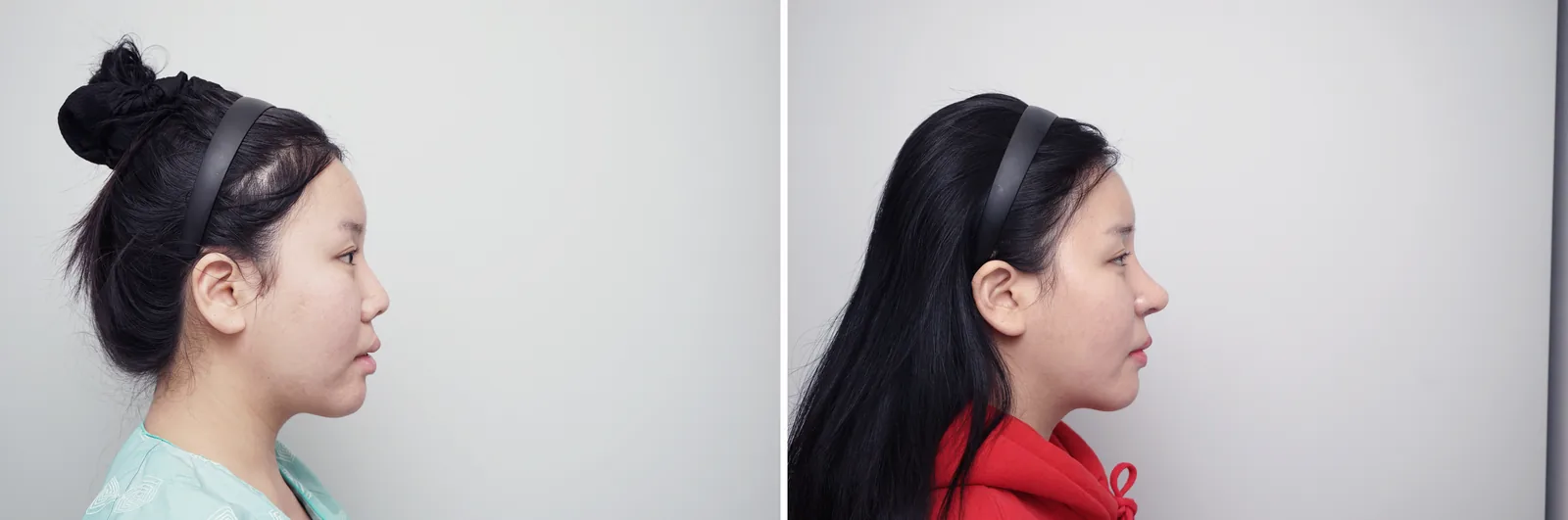
Example case (revision rhinoplasty): side view before surgery (left) and 2 weeks after (right). Procedures: revision rhinoplasty, silicone bridge implant, tip with septal and donor rib cartilage, bulbous tip refinement, short-nose correction, osteotomy. Results vary between individuals; swelling, bruising, asymmetry and infection are possible risks. Shared with the patient's consent.
| Factor | Why it matters |
|---|---|
| Scope | Tip only, bridge only, or the whole nose rebuilt |
| Graft source | Septal or ear cartilage, your own rib, or donor rib cartilage |
| Implant | Whether an old implant comes out, is replaced, or gives way to your own tissue |
| Scar and contracture | How much tissue must be released before rebuilding |
| Your stay | Nights in Seoul, set by when the splint and stitches come off |
Rib cartilage adds a second surgical site on the chest. As a rule in surgery, that means more operating time and a second place to heal. A whole-nose rebuild also takes longer under anesthesia than a small correction to the bridge.
There's also a cost that never shows on a quote. A plan chosen because its figure looked low can end up costing more, in money and in trips to Seoul, if it has to be corrected again. That's why there's no single answer to “rhinoplasty revision cost Korea”. The number has to start from your nose. TIANA's English rhinoplasty page also explains how quotes are worked out.
Say you have an implant from years ago
Say your first surgery was eight years ago, with a silicone implant on the bridge. Over the last two years, the tip has started to look shorter and turned up, and the skin over it feels tight. I would read those as possible signs of contracture. I'd want the 3D-CT to see the bone and structure, and I'd expect us to talk about taking the implant out and rebuilding tip support, likely with rib cartilage, your own or donor. That's a full revision, with a longer operation and at least a week in Seoul.
Now say your only complaint is a bridge that sits slightly off-center. The tip looks fine and the skin moves freely. That conversation is much narrower: the implant position, possibly a replacement, and leaving the tip alone. Both are called a revision, but the plans are very different.
To get the figure for your own case, ask on WhatsApp what a revision would cost for your nose. If you have them, add a daylight side photo from before your first surgery and any operative note or implant card from that clinic. Then ask whether your case looks closer to the first example or the second. Old records help you ask a sharper question.
Wondering which type your nose is?
Share your profile and front photos — the surgeon will tell you which procedures your nose would actually need. No cost, no obligation.
Ask which procedure fits meWhich revision methods are on the table?
The methods themselves aren't exotic. What matters is which combination your nose needs. Which one fits comes down to your bone structure and what's bothering you, not to what's popular.
- Implant removal or replacement. This applies when an implant has shifted, shows through, or sits under thinning skin. The bridge can be rebuilt with a silicone implant or with your own tissue, such as dermis or fascia.
- Rebuilding tip support. Septal extension sets the tip's length and angle. If your septum was used the first time, the cartilage comes from the ear or the rib.
- Contracture release with rib cartilage. Scar tissue is freed so the tip can come back down. It is then held in place with a strong graft, your own rib or donor rib cartilage.
- Bone work. If the bony bridge is wide or uneven after the first surgery, osteotomy can narrow and straighten it.
A 2014 review of Asian rhinoplasty in Plastic and Reconstructive Surgery Global Open discusses how surgeons weigh implants against the patient's own cartilage. Each has strengths and limits, and in a revision that trade-off is usually the core of the plan.
What do reviews of revision rhinoplasty in Korea get right?
Revision threads repeat a handful of claims. Some hold up medically and some don't. If you want to read reviews well, it helps to see how to read Korea rhinoplasty reviews before a consultation.
“A revision is just the first surgery again.” Not true. Scar tissue, missing cartilage and an old implant make it a different operation, and that's the main reason it costs differently.
“Every revision needs rib cartilage.” Partly true. It's common when the tip has contracted or there's little septum left. A small correction to the bridge may need nothing of the kind.
“Swelling lasts longer the second time.” Generally true. Scarred skin is thicker and less elastic, so the tip often takes longer to settle. The American Society of Plastic Surgeons notes that the early swelling of rhinoplasty goes down within weeks, but the final contour can take up to a year to refine.
“Wait a year before a revision.” A reasonable rule of thumb. Many surgeons prefer to let swelling settle and scar tissue mature for about a year. An implant problem such as exposure or infection is the exception, and it needs attention sooner.
How is recovery different the second time?
Plan on about 7 to 14 nights in Seoul, and at least 7. The splint and outer stitches usually come off around day 7 and the inner stitches around day 14. The exact timing is confirmed at surgery. If you fly home on day 7, you leave with a referral letter and a surgery certificate.
If rib cartilage is used, your chest heals alongside your nose, so expect some soreness when you take a deep breath or lift your arms in the first days. The clinic is closed on Sundays and public holidays. If you land on a Saturday evening, your consultation can't be until Monday.
You can see what a review usually skips about day one after surgery and tip revision recovery, day by day. For the nights-and-follow-up side of the trip, read how foreigners plan nights in Seoul and follow-up at home.
Who should wait, and what can go wrong?
Risks and side effects to know
After a revision, swelling, bruising around the eyes, a blocked nose and a numb tip are common for the first weeks. A rib graft adds chest soreness. The American Society of Plastic Surgeons lists the risks of rhinoplasty as including anesthesia risks, infection, poor wound healing, difficulty breathing through the nose, numbness, an appearance you're unhappy with, and the possibility of further surgery. In a revision, scar tissue makes some of these more likely, and results vary from person to person.
As general medicine, you should usually wait or rethink the timing if:
- your first surgery was less than about a year ago and there's no implant problem
- the skin over an implant is red, thinning or broken, which needs local care first
- you're pregnant or breastfeeding
- you take blood-thinning medication you haven't discussed with your doctor
Whether a revision is right for you, and in what scope, is confirmed when I examine you in Seoul.
If something feels wrong after you fly home, such as a fever, redness that spreads, discharge or sudden pain, see a doctor where you live and bring the referral letter and surgery certificate. Then send photos of your nose on WhatsApp. The US Centers for Disease Control and Prevention advises people who travel for treatment to keep copies of their medical records and plan follow-up care before leaving. That applies to a revision as much as anything.
Doctor's note
The nose you bring to a revision has already been through one surgery, so I plan only the scope it actually needs. I compare your reference photo with your anatomy and set a range we can reach without forcing it. Asking for less change is often what keeps the result stable.
If you want to see how real noses changed and how many months after surgery each photo was taken, browse TIANA's rhinoplasty case gallery before your consultation.
Your first message
Start with what you already have: the five photos of your nose today and the dates you could travel. Send them on WhatsApp with one question: what would a revision cost for my nose, and how many nights should I plan? One set of photos is enough to begin, and you can ask before booking anything. When you come to Seoul, I examine your nose with 3D-CT and recommend only the scope it needs.
Frequently Asked Questions
Q1Can I get a cost figure before I fly to Seoul?
You can get an estimate first. TIANA's English site says the WhatsApp reply explains the likely scope of surgery and how the estimate is worked out. The final fee is confirmed after examination in Seoul.
Q2Does a revision always need rib cartilage?
No. Rib cartilage is common when the tip has contracted or the septum was used up in the first surgery. A smaller correction may use septal or ear cartilage, or no graft at all.
Q3How long after my first rhinoplasty should I wait before a revision?
Many surgeons prefer to wait about a year so swelling settles and scar tissue matures. An implant that is exposed or infected is an exception and needs attention sooner, starting with a doctor near you.
Q4Should I bring records from my first surgery?
Yes, if you can get them. An operative note, implant card or photos from before the first surgery show what was done, and that is useful when the revision is planned.
Q5How many nights should I plan in Seoul for a revision?
Plan on about 7 to 14 nights, and at least 7. The splint and outer stitches come off around day 7 and the inner stitches around day 14. If you fly home on day 7, you get a referral letter and a surgery certificate.
Thank you for reading to the end.
Send 5 photos (front, 45-degree and side) on WhatsApp for a free photo consultation. We reply in English with the likely scope of surgery and how the estimate is worked out.
Send my photos on WhatsAppThis article is general information about elective cosmetic surgery and is not a diagnosis. Results and recovery vary between individuals. Before-and-after photos are published with patient consent; surgery carries risks such as swelling and bruising and requires downtime. Final procedures and fees are decided after examination.