Rib Cartilage Rhinoplasty Korea Cost? Results and Risks
Is the rib cartilage rhinoplasty Korea cost you keep reading about actually the price of your nose, and is a scar on your chest worth it?
By the end of this guide, your questions about rhinoplasty should turn into a clear next step.
Send 5 photos (front, 45-degree and side) on WhatsApp and we will reply in English with a free first assessment: the likely scope of surgery and how the estimate is worked out.
Send my photos on WhatsAppRead this before you start lining up quotes.
You'll know what rib cartilage does inside a nose, who really needs it, what decides the cost, and which results, risks and review claims to take seriously. That way you can tell whether rib belongs in your plan, and in your budget, at all.
Hello, I'm Dr. Choi Hang-seok, Head Surgeon at TIANA Plastic Surgery in Seoul.
TIANA does rhinoplasty and revision rhinoplasty only. The same surgeon handles you one-to-one from consultation to surgery and aftercare. Before surgery, 3D-CT maps the bone and nasal structure, and revisions after surgery elsewhere, including contracture, are often rebuilt with rib cartilage.
I wrote this because rib cartilage often gets treated as an upgrade you pay extra for. In reality it's a material chosen for a specific problem, and many noses don't have that problem.
There's no single rib cartilage price. The cost follows the scope of surgery, whether it's a revision, how much cartilage your nose already has, and whether your own rib or donor rib is used.
If you're not sure which of those applies to you, send five photos (front, both 45-degree angles and both sides) on WhatsApp and ask one thing: does my nose need rib, or would septal cartilage be enough? Once you know that, you know which kind of surgery you're actually pricing.
What rib cartilage does that other cartilage can't
Most rhinoplasty uses cartilage from inside the nose, the septum. It's close by, and for a modest tip change there's often enough of it. The trouble starts when the job needs more: a tip that has to project against thick skin, a short nose that needs a long strut to bring the tip down, or a nose where an earlier surgery already used up the septum.

Rib is the largest supply of cartilage in the body. It comes in longer, straighter and stiffer pieces than ear cartilage, which is small and curved. That stiffness is the whole point. It can hold a tip in position when skin and scar tissue are pushing back.
At TIANA, tip support can be built with septal cartilage, ear cartilage, rib cartilage or donor rib cartilage, as well as your own dermis and fascia. Which one suits you depends on your nose and any previous surgery. A review of Asian rhinoplasty in Plastic and Reconstructive Surgery Global Open discusses rib (costal) cartilage as the option when more graft material is needed, with warping as its known concern.
Who actually needs rib cartilage, and who doesn't?
Rib usually comes into the conversation in three situations. The first is a revision, especially a contracted nose where scar tissue has pulled the tip up and tightened the skin. The second is a short or upturned nose that needs septal extension when the septum itself is too small to supply the strut. The third is thick skin over a weak tip, where softer grafts may not hold a defined shape.
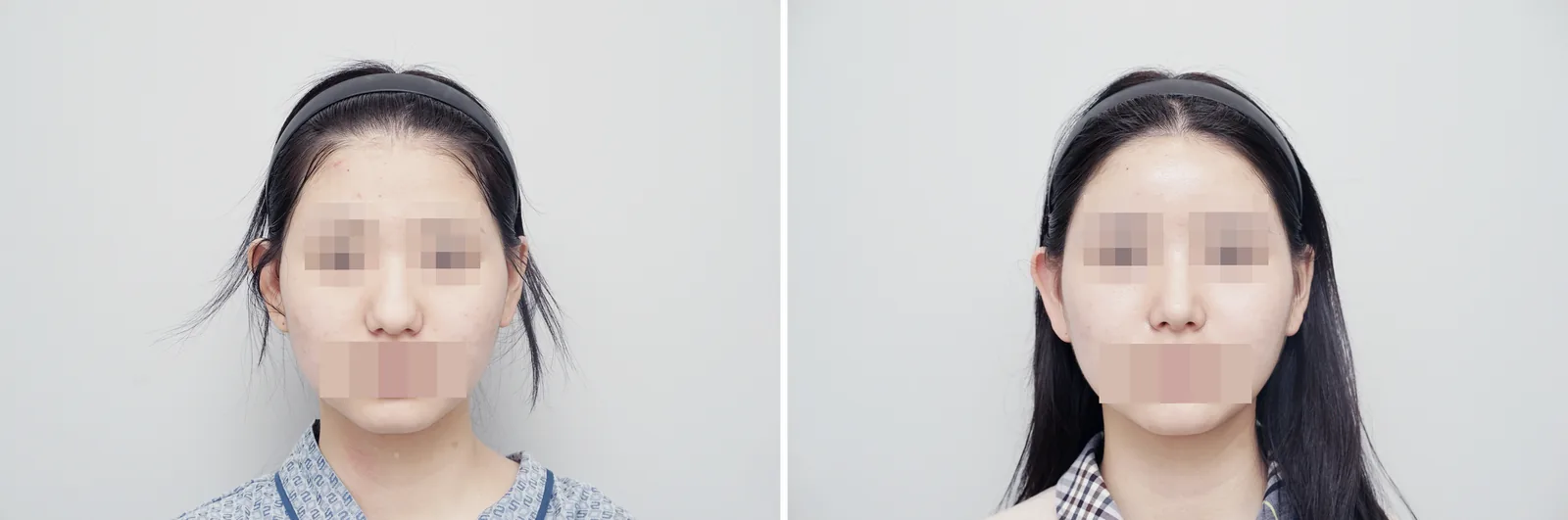
Example case (hump nose, bulbous tip): front view before surgery (left) and 2 weeks after (right). Procedures: silicone bridge implant, tip with septal and donor rib cartilage, hump reduction, bulbous tip refinement, osteotomy, crooked-nose correction. Results vary between individuals; swelling, bruising, asymmetry and infection are possible risks. Shared with the patient's consent; eyes and mouth are pixelated for privacy.
It usually isn't needed for a light tip refinement, a hump reduction, or a low bridge raised with an implant plus modest tip support from your own septum.
Which option fits is decided by bone structure and the concern you came with, not by trend. Raising only the tip makes it look like it's floating off the face, so even when rib goes into the tip, I design the bridge and tip as one profile. Larger structural grafts usually need an open approach, which is one reason closed rhinoplasty has limits in these cases.
Say you had a nose job at home years ago, and your tip has since tightened and turned up so the nostrils show more from the front. The septum may already have been used, and the skin has scarred. That's a pattern where I'd expect rib cartilage to be discussed. Now say instead your nose is low with a round tip and you've never had surgery. Your own septum may well be enough, and adding a rib harvest would give you a second surgical site for no gain.
Thick skin raises its own questions. If you're worried a strong graft is meant to make your nose look like someone else's, read why Black rhinoplasty in Korea should keep your own nose, and how African American rhinoplasty myths compare with what thick skin really limits.
Doctor's note
When someone asks me for rib cartilage by name, I'd rather talk about what they want the nose to do than which material to use. I recommend only the scope a nose needs and confirm it at the examination, because finding out after you fly home that the plan was too small is worse than any extra conversation. Rib is a tool for support. It is not a way to make a nose bigger than the face can carry.
Wondering which type your nose is?
Share your profile and front photos — the surgeon will tell you which procedures your nose would actually need. No cost, no obligation.
Ask which procedure fits meWhat decides the rib cartilage rhinoplasty Korea cost?
TIANA doesn't publish a fixed menu price, because the cost depends on the scope of surgery, your nose (how much cartilage is available and how thick the skin is) and whether it's a revision. For rib cases, these are the factors that move it:
- First surgery or revision. A revision, especially with contracture, means releasing scar tissue before rebuilding, which makes the operation longer.
- How much of the nose is rebuilt. Tip support alone, tip plus septal extension, or the bridge as well.
- Your own rib or donor rib. Your own rib adds a chest incision. Donor rib avoids it. The choice is made with you after examination.
- Other steps in the same operation. Hump reduction or osteotomy for a wide bony bridge, if your nose needs them.
- Your nights in Seoul. Plan on about 7 to 14 nights, so your hotel is part of the real total.
One more factor I'd weigh: a plan that looks cheaper can end up costing more if it needs revising, both in money and in trips back to Seoul. In rib cases, where the nose has often had one surgery already, that matters more.
To get a figure for your own nose, ask on WhatsApp what it would cost for your case. If you'd like to see how consultations in English work first, TIANA's English rhinoplasty page shows the process.
What results can rib cartilage give, and when do they show?
What rib cartilage does well is hold. A tip supported by rib is usually firmer to the touch than before and keeps its projection against tight or thick skin. The trade is a stiffer, less mobile tip, which some people notice when they smile or press on it.
Swelling settles at a different pace for everyone. Thick skin and revision noses usually take longer to show their final shape, and the American Society of Plastic Surgeons notes that a rhinoplasty can take up to a year to fully refine.
For your trip, plan on about 7 to 14 nights in Seoul, with at least 7. The splint and outer stitches come off around day 7 and the inner stitches around day 14. The timing varies and is confirmed at surgery. If you fly home on day 7, you get a referral letter and a surgery certificate. The nose and chest heal on different schedules, and rib cartilage rhinoplasty recovery, day by day walks through both.
Rib cartilage rhinoplasty side effects and the chest scar
Risks and side effects to know
The common reactions are temporary: swelling and bruising around the nose and eyes, a blocked nose for the first weeks, numbness at the tip, and chest soreness when you breathe deeply, cough or laugh if your own rib was used. These usually ease over weeks, though tip swelling lasts longer.
The risks specific to rib are worth knowing before you choose it. A rib graft can warp, changing shape slightly over the following months. Under thin skin, a graft edge can sometimes be seen or felt. The chest scar is usually a short incision, but how it heals varies, and it can thicken in people who tend to form keloids. Rarely, harvesting rib can injure the lining around the lung. Rib also tends to calcify with age, which can make it harder to carve in older patients. On top of that come the general rhinoplasty risks the ASPS lists: infection, poor wound healing, breathing difficulty, asymmetry and the possibility of revision surgery.
In general medicine, these are reasons to wait or rethink:
- an active infection or skin problem on the nose
- pregnancy or breastfeeding
- smoking you can't stop around the surgery, since it slows healing
- a history of keloids, which is worth raising before choosing your own rib over donor rib
- a recent injury to the nose that hasn't settled
If something feels wrong after you're home, don't wait it out. One-sided swelling that suddenly gets worse, fever, spreading redness or discharge at the nose or chest, or shortness of breath means seeing a local doctor promptly, with your referral letter and surgery certificate in hand. Results and healing differ from person to person, and that applies to every point above.
If the chest scar is what's holding you back, mention on WhatsApp whether you've ever had a keloid or a thick scar, and ask whether donor rib could work for your nose. That one detail shapes which rib makes sense for you.
What do rib cartilage rhinoplasty reviews get right?
Forum threads about rib cartilage repeat a handful of claims. Some hold up and some don't.
"Rib noses feel hard." Mostly true. Stiffness is why rib is used, and a firmer tip is the usual result. Whether that bothers you is a fair thing to decide before surgery, not after.
"Rib always warps." It's a known risk, not a certainty. Surgeons carve and shape grafts in ways meant to reduce it, but no one can promise it won't happen.
"Rib gives the biggest change." No. Rib gives support. How much a nose changes depends on the plan and on what your skin can stretch over, and a bigger graft in a nose that doesn't need it only adds risk.
"Donor rib just gets absorbed." Absorption of donor cartilage is discussed in the medical literature as a possibility, which is one reason the choice between your own rib and donor rib is made nose by nose.
If you want to see how real noses changed and how many months after surgery each photo was taken, browse TIANA's rhinoplasty case gallery before your consultation.
Before you book a flight
Send five photos on WhatsApp (front, both 45-degree angles and both sides) with a line on any previous nose surgery, and ask: does my nose need rib, and what would it cost for my case? You can write in English, and you can ask before booking anything. When you come to Seoul, I examine your nose with 3D-CT and recommend the scope that fits your face.
Frequently Asked Questions
Q1Can ear cartilage be used for the nose bridge instead of rib?
Ear cartilage is small and curved, so it's generally more useful for the tip or for smoothing small areas than for building a long, straight bridge. TIANA can use septal, ear, rib or donor rib cartilage, as well as your own dermis and fascia. Which suits your bridge depends on your nose and is decided after examination.
Q2Can donor rib cartilage be used instead of my own rib?
Yes. TIANA's options include donor rib cartilage, which avoids a chest incision. Your own rib and donor rib each have trade-offs, so the choice is made with you after examination.
Q3Is rib cartilage only used in revision rhinoplasty?
No. Revisions, especially contracture, are the most common reason, but a first rhinoplasty may also need rib when the septum is too small for the support the plan requires, for example in septal extension or with thick skin.
Q4How many nights should I stay in Seoul after rib cartilage rhinoplasty?
Plan on about 7 to 14 nights, with at least 7. The splint and outer stitches come off around day 7 and the inner stitches around day 14. Timing varies and is confirmed at surgery.
Q5Can I ask about my cost before booking flights?
Yes. Message on WhatsApp in English with photos of your nose and any surgery history, and ask what it would cost for your case. The final fee is confirmed after examination in Seoul.
Thank you for reading to the end.
Send 5 photos (front, 45-degree and side) on WhatsApp for a free photo consultation. We reply in English with the likely scope of surgery and how the estimate is worked out.
Send my photos on WhatsAppThis article is general information about elective cosmetic surgery and is not a diagnosis. Results and recovery vary between individuals. Before-and-after photos are published with patient consent; surgery carries risks such as swelling and bruising and requires downtime. Final procedures and fees are decided after examination.