
Hump Nose Surgery in Korea: When It's Worth Fixing
Do you notice the bump on your nose bridge every time you see your profile in a photo? Are you wondering whether hump nose surgery in Korea is worth it, or whether the bump is fine as it is?
By the end of this guide, your questions about rhinoplasty should turn into a clear next step.
Send 5 photos (front, 45-degree and side) on WhatsApp and we will reply in English with a free first assessment: the likely scope of surgery and how the estimate is worked out.
Send my photos on WhatsAppRead this before you ask a clinic to remove it. Not every hump should go, and how it is removed changes the result.
By the end you'll know what a dorsal hump is, how a mild and a strong hump are treated differently, when a hump can be refined without shaving, and how to decide whether to fix yours.
Hello, I'm Dr. Choi Hang-seok, Head Surgeon at TIANA Plastic Surgery in Gangnam, Seoul.
TIANA performs only rhinoplasty and revision rhinoplasty. I handle each patient one-to-one from consultation through surgery, anesthesia and aftercare. Before surgery, 3D-CT imaging maps your nasal bones and cartilage.
The short answer: a hump is worth fixing when it bothers you and the rest of your nose supports a straighter line. A mild hump can often be smoothed with light rasping, or by raising the areas around it. A strong hump usually needs bone and cartilage removed, followed by an osteotomy so the bridge doesn't look wide.
If you're not sure what kind of hump you have, send five photos on WhatsApp (front, both 45-degree angles and both side profiles) and ask: is my hump mild or strong, and does it need to be removed?
What is a hump nose?

A hump nose has a raised bump along the bridge, called a dorsal hump. It is usually made of the nasal bone at the top and septal cartilage just below it, which is why it shows most clearly in profile.
Many people see it only from the side, which is why most hump nose rhinoplasty consultations start with profile photos. From the front, a hump can make the bridge look wider or uneven, but often it's barely visible.
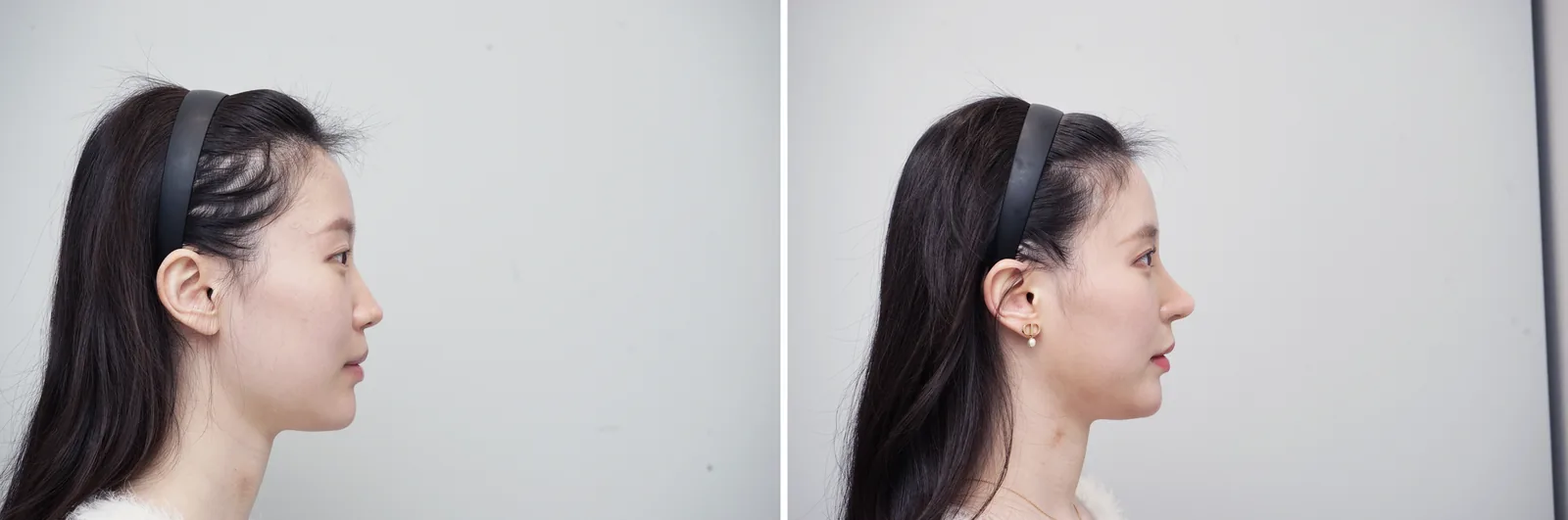
Example case (implant-free rhinoplasty, hump nose): side profile before surgery (left) and 2 weeks after (right). Procedures: implant-free bridge with septal cartilage, tip with septal and donor rib cartilage, hump reduction, osteotomy. Results vary between individuals; swelling, bruising, asymmetry and infection are possible risks. Shared with the patient's consent.
A hump is not a medical problem in itself. Some people like the strong profile it gives, and in parts of Asia a defined bridge with a slight hump has become a look people ask for. So the first question in a consultation isn't how to remove it. It's whether you want it gone.
Should you fix a hump nose? How to decide
I ask patients four questions before suggesting any surgery.
| Question | If yes | If no |
|---|---|---|
| Does the hump bother you in photos or the mirror? | Surgery may be worth discussing | Leaving it is a reasonable choice |
| Is the hump visible from the front as well as the side? | It likely affects bridge width too | Profile work alone may be enough |
| Does the tip droop or sit low? | The tip may be making the hump look bigger | The hump itself is the main issue |
| Is the bridge above the hump low? | Raising it may blend the hump in | Removal is more likely |
Doctor's note
A hump often looks bigger than it is because the tip below it droops. When I lift and support the tip, some patients need much less removed from the bridge than they expected.
Wondering which type your nose is?
Share your front, 45-degree and side photos — the surgeon will tell you which procedures your nose would actually need. No cost, no obligation.
Ask which procedure fits meHump nose surgery in Korea: three approaches
How hump nose surgery is done depends on the size of the hump and what surrounds it. I explain the same choices in my video on when a hump nose needs fixing (the video is in Korean).
1. Light rasping for a mild hump
For a small bony hump, the bone can be filed down a little with a rasp. Because very little is removed, the bridge usually stays narrow and no osteotomy is needed.
2. Removal and osteotomy for a strong hump
A large hump needs bone and cartilage removed together. Taking it off can leave a flat, open top on the bridge, which looks wide from the front. To close it, the nasal bones are cut and brought together. This is called an osteotomy.
This is the approach most people imagine when they search for dorsal hump reduction. It gives the biggest change in profile, but it also has the longest recovery of the three.
3. Refining without shaving
If the hump is mild and the area above it is low, the hump may look prominent only by comparison. Raising the upper bridge, or lifting a drooping tip, can make the line look straight without removing much bone.
This works only for mild humps. If the hump is large, adding height around it makes the whole nose too big, so removal is the better choice.

Example case (implant-free rhinoplasty, hump nose): oblique view before surgery (left) and 2 weeks after (right). Procedures: implant-free bridge with septal cartilage, tip with septal and donor rib cartilage, hump reduction, osteotomy. Results vary between individuals; swelling, bruising, asymmetry and infection are possible risks. Shared with the patient's consent.
Common mistakes with nose hump removal
The most common problem I see in revision consultations is a hump removed too aggressively. The bridge ends up scooped, which can look unnatural in profile and is harder to correct than a hump left slightly in place.
The second is a hump removed without dealing with the width. The profile is straighter, but the bridge looks wide and flat from the front.
The third is ignoring the tip. If the tip droops and only the hump is removed, the nose can still look hooked at the end.
The American Society of Plastic Surgeons lists swelling, bruising, asymmetry, infection and the possible need for revision among rhinoplasty risks. Taking a conservative amount, planned with the tip and bridge together, keeps those risks lower. More hump and hooked nose articles are in all hooked nose articles.
Recovery after hump nose surgery in Korea
Plan on about 7 to 14 nights in Seoul, and at least 7.
| Milestone | Usual timing |
|---|---|
| Splint off and outer stitches out | Around day 7 |
| Inner stitches out | Around day 14 |
| Major swelling settles | 1 to 2 weeks |
| Looks natural to others | Around 3 to 4 weeks (osteotomy often a little longer) |
Bruising around the eyes is more common when an osteotomy is done. After surgery, high-concentration oxygen care is used to help swelling settle. Recovery differs between people.
If you fly home around day 7, you leave with a referral letter and a surgery certificate so a local doctor can remove the inner stitches. More on planning is in how long to stay in Seoul for rhinoplasty. If you're comparing clinics, how to choose a rhinoplasty surgeon in Korea covers the questions worth asking. How I plan the bridge as a whole is on the Korean nose bridge page, and how the bridge, tip and nostrils fit together is on TIANA's English rhinoplasty page.
Summary
- A dorsal hump doesn't have to be removed. Fix it if it bothers you and the rest of the nose supports a straighter line.
- A mild hump can be rasped lightly, or blended in by raising the areas around it.
- A strong hump needs removal, usually with an osteotomy so the bridge doesn't look wide.
- Removing too much leaves a scooped bridge, so a conservative amount is safer.
- If you plan hump nose surgery in Korea, allow 7 to 14 nights in Seoul, and at least 7.
Send five photos on WhatsApp (front, both 45-degree angles and both side profiles) and ask whether your hump is mild or strong. You'll get a reply in English about the likely scope and how the quote is worked out. When you come to Seoul, I examine your nose, 3D-CT maps the bone and cartilage, and we decide together how much to change.
Frequently asked questions
Q1Does every nose hump need to be removed?
No. A small hump that only shows at one angle often suits the face, and some people like the character it gives the profile. Surgery makes sense when the hump bothers you in photos and the rest of the nose supports a straighter line.
Q2Will hump removal make my nose look wider?
It can if nothing else is done. Removing a large hump can leave a flat, open top on the bridge, so the nasal bones are often brought together with an osteotomy. I decide this from the 3D-CT and the size of the hump.
Q3Can a hump be fixed without shaving the bone?
Sometimes. If the hump is small and the area above it or the tip sits low, raising those parts can make the line look straight without removing much bone. This only works when the hump itself is mild.
Q4How long is recovery after hump nose surgery?
The splint usually comes off around day 7 and the inner stitches around day 14. Major swelling tends to settle in 1 to 2 weeks and the nose looks natural at around 3 to 4 weeks, with osteotomy often taking a little longer. Recovery differs between people.
Q5How many nights should I stay in Seoul?
Plan about 7 to 14 nights, and at least 7. If you fly home around day 7, you leave with a referral letter and a surgery certificate so a local doctor can remove the inner stitches.
Thank you for reading to the end.
Send 5 photos (front, 45-degree and side) on WhatsApp for a free photo consultation. We reply in English with the likely scope of surgery and how the estimate is worked out.
Send my photos on WhatsAppThis article is general information about elective cosmetic surgery and is not a diagnosis. Results and recovery vary between individuals. Before-and-after photos are published with patient consent; surgery carries risks such as swelling and bruising and requires downtime. Final procedures and fees are decided after examination.