
Korea Rhinoplasty Steps After Surgery: Nights, Stitches, Cost
Comparing Korea rhinoplasty clinics on WhatClinic and worried about who looks after your nose once you've flown home?
By the end of this guide, your questions about rhinoplasty should turn into a clear next step.
Send 5 photos (front, 45-degree and side) on WhatsApp and we will reply in English with a free first assessment: the likely scope of surgery and how the estimate is worked out.
Send my photos on WhatsAppRead this before you book the return flight.
You'll know what decides the cost, what reviews get right and wrong, and what recovery asks of your calendar, so you can choose between leaving around day 7 and staying until day 14.
Hello, I'm Dr. Choi Hang-seok, Head Surgeon at TIANA Plastic Surgery in Seoul.
TIANA performs only rhinoplasty and revision rhinoplasty. I handle you 1:1 from consultation to surgery and aftercare, and if you fly home on day 7, you leave with a referral letter and a surgery certificate.
I wrote this because many people plan the trip around the operation and treat the days afterward as rest, yet the return date decides who removes your inner stitches.
Plan on about 7 to 14 nights in Seoul, and at least 7. The splint and outer stitches come off around day 7, the inner stitches around day 14.
If you're trying to fit this into fixed leave, send one side-view photo on WhatsApp with the date you must be back at work, and ask whether your plan points to day 7 or day 14.
Korea rhinoplasty steps after surgery, on one calendar
Four steps matter once the operation is done, and only the first two are certain to happen in Seoul. For the earlier part of the trip, there's a separate walk through the full sequence of trip days and an account of what happens in the operating room.

| When | What happens |
|---|---|
| The days after surgery | Gauze comes out of the nose, swelling is checked, you get prescriptions and post-op instructions |
| Around day 7 | Progress check, then the splint and outer stitches come off |
| Around day 14 | Inner stitches come out, in Seoul or at home with your referral letter |
| Weeks and months later | Swelling keeps settling, and I guide you from your progress photos |
These dates can move a little for each person, and they are confirmed at surgery. The first day is also fuller than many people expect: the in-person consultation, any tests needed, confirming the design and cost, then surgery. So landing the day before gives you a margin if your flight is late.
There's one calendar trap worth checking now. Count the operation as day 1, and a Monday operation puts both day 7 and day 14 on Sundays. We're closed on Sundays and public holidays, open 10:00 to 19:00 on weekdays and 10:00 to 16:00 on Saturdays. Ask for your actual appointment dates before you pay for a return ticket.
Should you fly home on day 7 or stay until day 14?
Day 7 is possible, and day 14 asks less of you once you're home. The choice comes down to whether you have a doctor lined up for the inner stitches and how long your flight is.
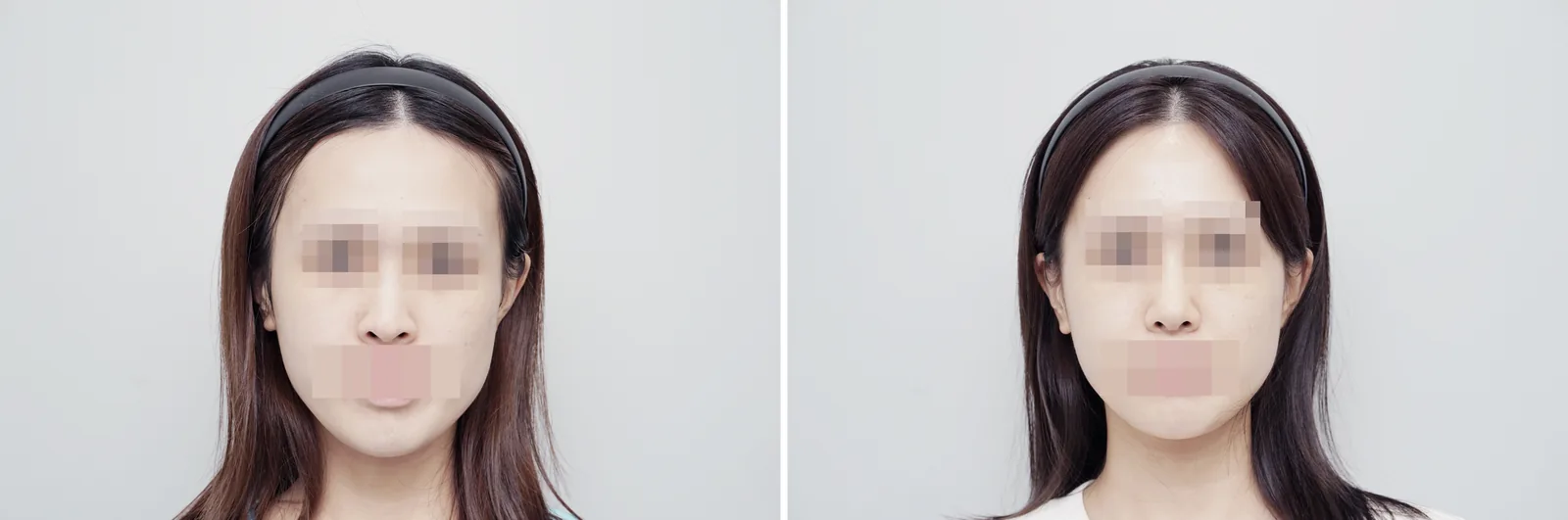
Example case (implant-free rhinoplasty, short nose): front view before surgery (left) and 2 weeks after (right). Procedures: implant-free bridge with septal cartilage, tip with septal and the patient's own rib cartilage, short-nose correction, crooked-nose correction, columella and nasolabial angle adjustment, nostril rim lowering. Results vary between individuals; swelling, bruising, asymmetry and infection are possible risks. Shared with the patient's consent; eyes and mouth are pixelated for privacy.
Risks and side effects to know
The question I'd put to you first is your flight time, because this decision looks different for a two-hour hop and a thirteen-hour one. The CDC's medical tourism guidance warns that flying after surgery can raise the risk of blood clots, and it advises delaying air travel for 10 to 14 days after major surgeries, chest surgery especially. That advice isn't written for nose surgery. It's still a good reason to mention any past clot, hormone treatment or smoking when we talk, since those generally add to clot risk.
Say you're 52, you live in Vancouver, and you have two weeks of leave and a hump that needs osteotomy. Bruising is often heavier when bone is moved, and you'd be sitting on a long flight with a freshly unsplinted nose. In that case I'd lean toward using the whole two weeks in Seoul, since the inner stitches then come out before you leave.
Now say you have only eight days. Leaving around day 7 can still work, as long as you've found the doctor at home before you travel. What I'd avoid is the version where you land with stitches in your nose and start phoning clinics from your sofa.
For the flight itself, pack the instructions you were given and any prescribed medication in your carry-on. Cabin air is dry and a healing nose often feels blocked, so ask before you leave what you may use inside it. If you wear glasses, ask when they can rest on your bridge again.
Doctor's note
Please don't judge your nose on the day the splint comes off. A nose changes a face with tiny differences, which is why I operate only on noses, and at that stage swelling hides those differences. I'd rather you fly home knowing this than spend the flight studying your reflection.
If the day 7 or day 14 choice is still open, message us on WhatsApp with your home city and your flight time, and ask which steps would be left for a doctor there.
Wondering which type your nose is?
Share your profile and front photos — the surgeon will tell you which procedures your nose would actually need. No cost, no obligation.
Ask which procedure fits meWho looks at your nose once you're home?
Two people: a local doctor for anything hands-on, and me through your progress photos for how the swelling is settling. Swelling fades at a different pace for each person, so I don't give one fixed period and guide you individually from those photos.
The hands-on part needs arranging before you travel. Call an ENT or plastic surgeon near you and ask one plain question: would you remove inner stitches from nose surgery done abroad? Some may decline, and it's better to hear that while you still have time to phone another.
Keep these in your carry-on, not your checked bag:
- The referral letter and surgery certificate, if you leave around day 7
- Copies of your medical records, which the CDC advises getting before you return home
- Your prescriptions and a list of your medications
The CDC also points out that follow-up care at home can be costly and may not be covered by your insurance. Check your policy now, while changing the plan is still easy.
What can go wrong after you fly home?
Most of what you'll notice in the first weeks is expected: swelling, bruising and soreness around the eyes, and a stuffy nose. The NHS says bruises and redness may have faded by about 3 weeks, that swelling can take up to 6 months to go completely, and that you may need up to 2 weeks off work. It puts strenuous exercise and contact sports at 4 to 6 weeks.
The less common problems are the ones to know by name. The risks we list are swelling, bruising, infection and asymmetry, and the NHS adds lasting breathing difficulty, damage to the cartilage wall between the nostrils, an altered sense of smell, heavy nosebleeds, blood clots and reactions to anesthetic. Results vary between individuals.
Some people should generally wait or think again: anyone with an active infection in or around the nose, a recent clot or a bleeding disorder, anyone taking blood-thinning medication, and anyone who is pregnant. Tell your surgeon about all of these, and about smoking, before the date is set.
Once you're home, get seen locally the same day for fever, spreading redness, pus, or new trouble breathing through the nose. Heavy bleeding that won't stop, chest pain, sudden breathlessness or a swollen, painful calf need emergency care. Show them your surgery certificate and records, then send us photos on WhatsApp.
If something does need correcting later, TIANA performs revision rhinoplasty, including difficult cases such as contracture. Revision is a separate operation with its own limits, so give the swelling time to settle and discuss it with a surgeon first.
What directory reviews get right and wrong about recovery
People comparing Korea rhinoplasty clinics on WhatClinic tend to meet the same three claims in review threads. There's more on reading directory reviews before a consult and on common myths about surgeons listed in directories. Here, I'll stick to the recovery claims.
"The cast comes off and you're done." Half true. The splint is gone around day 7, but the inner stitches aren't, and the American Society of Plastic Surgeons notes that the contour can take up to a year to fully refine.
"Swelling is gone in two weeks." True for the part other people notice, on many faces. The ASPS says initial swelling subsides within a few weeks, then may come and go and worsen in the morning during the first year.
"Everyone flies home after a week." Plenty of people do, and reviews rarely mention who took out the inner stitches or how the flight felt. A review written on day 8 can't tell you about day 14.
What decides the cost of your surgery and trip?
The surgery fee follows the scope of work on your nose, and the trip costs follow your nights in Seoul. I can't give a useful figure before knowing your nose, and these are the things that move it:
- Scope: tip work alone, a bridge implant plus tip support, or hump reduction with osteotomy
- Material: a silicone implant, or your own tissue such as septal, ear or rib cartilage, or donor rib cartilage
- First surgery or revision: whether earlier surgery has to be rebuilt
- Your nights in Seoul: 7 and 14 nights make for quite different lodging and leave plans
- Follow-up at home: a local visit for the inner stitches, and whether your insurance covers it
I'd also keep scope in mind when you compare quotes. A lower figure means little if a revision later adds another bill and another trip to Seoul. To get the number for your own case, ask on WhatsApp what it would cost, with your photos attached. The English rhinoplasty page on our site sets out how we approach a quote.
If you want to see how real noses changed and how many months after surgery each photo was taken, browse TIANA's rhinoplasty case gallery before your consultation.
Before you book the return flight
Three things can be settled this week: your actual appointment dates, the name of a doctor at home, and what your insurance says about follow-up.
Then message us on WhatsApp in English. One photo is enough to start, five (front, 45-degree and side) show more, and you can ask before booking anything. The question to send with them: "With my nose and these dates, what would it cost, and how many nights should I plan?" When you come, I examine you with 3D-CT imaging and recommend the scope that fits your bone, cartilage and skin.
Frequently Asked Questions
Q1What papers do I get if I leave Seoul on day 7?
If you fly home on day 7, you get a referral letter and a surgery certificate. Ask for copies of your medical records as well, which is what the CDC advises travelers to do before returning home.
Q2Can I consult in English before I travel?
Yes. You can message TIANA in English on WhatsApp and send your photos there before you book a flight.
Q3How long until my nose looks settled?
Swelling fades at a different pace for each person, so I don't give one fixed period. The NHS says swelling can take up to 6 months to go completely, and the American Society of Plastic Surgeons says the contour may take up to a year to fully refine.
Q4When can I exercise again after rhinoplasty?
The NHS puts strenuous exercise and contact sports at about 4 to 6 weeks. Check your own timing with your surgeon, especially if bone was moved during the operation.
Q5What is used to raise the bridge, and does it change the steps afterward?
The bridge is raised with a silicone implant or your own tissue, such as ear, septal or rib cartilage, dermis or fascia. Ask at consultation how your chosen material affects aftercare, since rib cartilage, for example, also leaves a donor site to heal.
Thank you for reading to the end.
Send 5 photos (front, 45-degree and side) on WhatsApp for a free photo consultation. We reply in English with the likely scope of surgery and how the estimate is worked out.
Send my photos on WhatsAppThis article is general information about elective cosmetic surgery and is not a diagnosis. Results and recovery vary between individuals. Before-and-after photos are published with patient consent; surgery carries risks such as swelling and bruising and requires downtime. Final procedures and fees are decided after examination.