
Korea whatclinic rhinoplasty procedure steps in order
Are the Korea whatclinic rhinoplasty procedure steps in order you've pieced together going to fit inside one trip and the leave you actually have?
By the end of this guide, your questions about rhinoplasty should turn into a clear next step.
Send 5 photos (front, 45-degree and side) on WhatsApp and we will reply in English with a free first assessment: the likely scope of surgery and how the estimate is worked out.
Send my photos on WhatsAppGive this ten minutes before you choose a return date.
You'll know the steps in their real sequence, what decides the cost, what reviews get right and wrong, and how recovery affects your flight. That should help you choose a trip length that suits your nose and your budget, and more trip planning is in our travel guide.
Hello, I'm Dr. Choi Hang-seok, Head Surgeon at TIANA Plastic Surgery in Seoul.
TIANA does rhinoplasty and revision rhinoplasty, nothing else. I handle you 1:1 from consultation to surgery and aftercare, and 3D-CT imaging maps your bone and nasal structure before surgery.
I wrote this because people often book the flight first, then learn that the inner stitches run on a later clock than the splint.
The order is consultation and any exams needed, design and cost confirmed, surgery, a next-day check, splint and outer stitches off around day 7, and inner stitches around day 14. Plan on about 7 to 14 nights in Seoul, and at least 7.
If your leave is the tight part, send your possible dates on WhatsApp and ask one thing: "Which steps would fall inside these dates?" The reply comes in English.
Korea whatclinic rhinoplasty procedure steps in order, on a calendar
In short, this is the schedule TIANA gives for a stay in Seoul, with the planning point each step creates. The timing varies from person to person and is confirmed at surgery.

| When | What happens | What to plan |
|---|---|---|
| Day 1 | In-person consultation, exams if needed, design and cost confirmed, then surgery | Don't arrive on an overnight flight |
| Next day onward | Nasal gauze removed, swelling checked, prescription, aftercare guidance | Stay close to the clinic in Gangnam |
| Around day 7 | Splint and outer stitches off | Earliest point to consider flying home |
| Around day 14 | Inner stitches out | In Seoul, or with a doctor at home |
One detail rarely makes it into a trip plan: the clinic is open 10:00 to 19:00 on weekdays and 10:00 to 16:00 on Saturdays, and closed on Sundays and public holidays. Count it out and a Monday surgery puts day 7 and day 14 on Sundays. A Tuesday start puts both on a Monday. Check your dates against the Korean holiday calendar too, and ask at booking how any clash would be handled.
That table covers the calendar. If you want to know what goes on during the operation, I've written separately about the rhinoplasty steps inside the operating room.
What your nose can change in the plan
The type of nose sets the scope. A low bridge usually points to full rhinoplasty, with a bridge implant plus tip support. A hump points to hump reduction and osteotomy. A short or upturned nose points to septal extension. Surgery from another clinic means revision rhinoplasty. Minimal-incision tip work tends to recover faster, but it only suits a nose that needs a light refinement, and where closed surgery reaches its limits is a separate question.
Doctor's note
I choose a procedure by bone structure and the concern you bring, and trends don't enter into it. Raising only the tip tends to look out of place on the face, so I design the bridge and tip together. I would rather confirm the scope you need at the exam than have you discover, after travelling all this way, that the plan you pictured was too small for your nose.
How many nights do you need in Seoul?
About 7 to 14, and the choice comes down to where you want the inner stitches removed. Fourteen nights keeps every step in Seoul. Seven nights costs less leave and fewer hotel nights, but it moves the last step to a doctor at home.
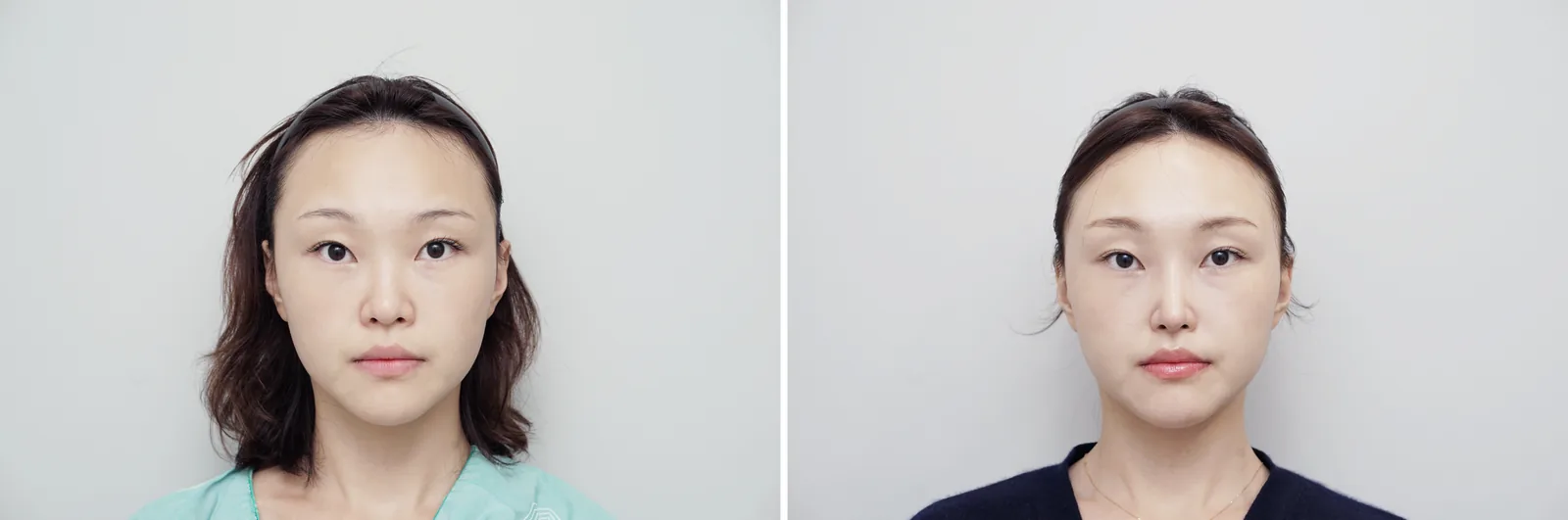
Example case (hump nose, bulbous tip): front view before surgery (left) and 1 month after (right). Procedures: silicone bridge implant, tip with septal and donor rib cartilage, hump reduction, bulbous tip refinement, short-nose correction, columella and nasolabial angle adjustment. Results vary between individuals; swelling, bruising, asymmetry and infection are possible risks. Shared with the patient's consent.
Say you have a low bridge, a round tip and ten days off work, and you live a short flight from Seoul. I would reason it this way. Ten days covers the splint removal with a few days of margin in case day 7 shifts, but it doesn't reach day 14. So you'd go home with the inner stitches still in, and you'd want a doctor lined up for them before you leave home.
Now change one thing: your flight home is 12 hours and you've had a blood clot before. Then I'd want that history discussed well before you book, and I'd lean toward the longer stay.
Wondering which type your nose is?
Share your profile and front photos — the surgeon will tell you which procedures your nose would actually need. No cost, no obligation.
Ask which procedure fits meWhat happens if you fly home on day 7?
You go home with a referral letter and a surgery certificate, and the inner stitches still have to come out around day 14. That handover is what to organize before you leave. Find a doctor at home who is willing to do it, and ask them while you still have time to change your plans.
The flight itself deserves a thought. The US Centers for Disease Control and Prevention says flying after surgery can increase the risk of blood clots, including deep vein thrombosis, and it suggests waiting 10 to 14 days after major surgeries, particularly chest surgery. It doesn't give a figure for nose surgery, so treat day 7 as the earliest point in the schedule and raise your flight length and medical history with your surgeon.
The same CDC page advises getting copies of all your medical records before you return home, having them translated if needed, and making sure you can get follow-up care. Those three things are worth putting on your packing list next to the referral letter.
If a day 7 return is the only one your budget allows, say so in your first WhatsApp message and add your home city. The question to ask with it: "What should I arrange with a doctor at home?"
How does recovery change the plan?
The splint date is on the calendar. Swelling isn't, and TIANA doesn't quote one fixed downtime period, because it settles at a different pace for everyone. I guide each person individually from their progress photos.
The American Society of Plastic Surgeons says initial swelling subsides within a few weeks, that it can come and go and worsen in the morning during the first year, and that the contour may take up to a year to fully refine. In planning terms, don't schedule a wedding or a job photo for the week you get home. Leave room in the return date too, because the walk through the airport on day 7 will probably feel more tiring than you expect.
What decides the cost of the trip?
Four things move it most for a traveler on one budget:
- Scope. Tip work alone and a bridge, tip and osteotomy plan are different operations.
- Material and your own tissue. The bridge can be raised with a silicone implant or your own tissue, and your cartilage and skin thickness shape the plan.
- First surgery or revision. Revision means rebuilding what's already there.
- Your nights in Seoul. Hotel and flights sit outside the surgery fee, so a 7-night and a 14-night trip are different budgets.
I'd also warn against choosing on the lowest-looking number alone. If a plan needs correcting later, both the cost and the number of trips to Korea go up.
To get a figure for your own nose, send photos on WhatsApp and ask for a first estimate, plus what that estimate includes. You can also read about how the English consultation works on the TIANA page.
What do reviews get right and wrong?
Three claims turn up often in rhinoplasty reviews and forum threads, and they deserve different answers.
"You can fly home after a week." Often possible, as the schedule shows. What that sentence leaves out is the inner stitches and the doctor you'll need for them.
"The swelling was gone in two weeks." That can describe how the nose looked in a mirror to that person. Contour can keep refining for up to a year, so an early review says little about the final shape.
"I got exactly the nose in my photo." Your reference photo is useful, but I compare it with your anatomy and set the range that can be reached. Someone else's result doesn't tell you what your skin and bone allow. I've gone through this in more depth in how to read Korea whatclinic rhinoplasty reviews before a consult, and a companion piece looks at common myths about choosing a surgeon.
Risks and side effects to know
Swelling and skin discoloration are the common temporary effects. The American Society of Plastic Surgeons also lists these risks: anesthesia risks, changes in skin sensation such as numbness or pain, difficulty breathing, infection, poor wound healing or scarring, a hole in the nasal septum, an appearance you're unhappy with, and the possibility of revision surgery. Results vary between individuals.
As general medicine, you'd usually wait or get specific advice if you are pregnant, have an infection in or around the nose, have an unmanaged medical condition, or have a history of blood clots. Whether surgery suits you is confirmed at the in-person exam.
If you're home and you develop a fever, spreading redness, worsening pain, heavy bleeding or trouble breathing, see a local doctor or emergency department promptly and bring your referral letter and surgery certificate. Chest pain or sudden shortness of breath after a flight is an emergency. Plan for this now: once the Korea whatclinic rhinoplasty procedure steps in order are on your calendar, add the name of your local doctor to the same page.
If you want to see how real noses changed and how many months after surgery each photo was taken, browse TIANA's rhinoplasty case gallery before your consultation.
Your first message
Send five photos on WhatsApp (front, 45-degree and side), which is enough to start, and you can ask before booking anything. Add one question: "What would this cost for my nose, and which procedure would it likely need?" When you come to Seoul, I'll examine you and recommend the plan that fits your nose.
Frequently Asked Questions
Q1Can I consult in English before I travel?
Yes. Message TIANA in English on WhatsApp and send your photos. The reply comes in English.
Q2Does surgery really happen on my first day at the clinic?
The schedule TIANA gives has the in-person consultation, any exams needed, the design and cost confirmation, and surgery on day 1. Confirm the timing for your case when you book, and avoid arriving straight off an overnight flight.
Q3How is the final fee set?
It depends on the scope of surgery, your cartilage and skin thickness, and whether it is a revision. Photos on WhatsApp get you a first estimate, and the final fee is confirmed after examination.
Q4Can I sightsee while I wait for the splint to come off?
Many people manage light walking, but avoid crowds where your nose could get knocked, and leave open the days around your checks. Ask your surgeon when you can resume normal activity and exercise, because that varies with the scope of surgery.
Q5Who operates, and who do I see afterward?
The same nose specialist, Dr. Choi Hang-seok, handles your consultation, surgery and aftercare.
Thank you for reading to the end.
Send 5 photos (front, 45-degree and side) on WhatsApp for a free photo consultation. We reply in English with the likely scope of surgery and how the estimate is worked out.
Send my photos on WhatsAppThis article is general information about elective cosmetic surgery and is not a diagnosis. Results and recovery vary between individuals. Before-and-after photos are published with patient consent; surgery carries risks such as swelling and bruising and requires downtime. Final procedures and fees are decided after examination.