Rhinoplasty procedure steps in the operating room
The rhinoplasty procedure steps follow six stages: a final design check, anesthesia, incision, cartilage harvest, shaping of the bridge and tip, and closing with a splint. Knowing what happens during rhinoplasty, while you are asleep, takes much of the fear out of surgery day.
By the end of this guide, your questions about rhinoplasty should turn into a clear next step.
Send 5 photos (front, 45-degree and side) on WhatsApp and we will reply in English with a free first assessment: the likely scope of surgery and how the estimate is worked out.
Send my photos on WhatsApp"I'm scared because I don't know what is being done while I'm under" is something we hear often in consultations. TIANA Plastic Surgery operates only on noses, rhinoplasty and revision rhinoplasty, and Dr. Choi Hang-seok handles each patient 1:1 from consultation through surgery, anesthesia and aftercare. This post walks through the operating room in order.
If you want to know which of these steps your own nose needs, send 5 photos (front, 45-degree and side) on WhatsApp with one line about what bothers you most. We reply in English.
Rhinoplasty procedure steps: six stages in the operating room
On rhinoplasty surgery day, the operating room usually runs in this order. Depending on your nose and the scope of surgery, a step may be skipped or added.
| Order | Step | What it decides |
|---|---|---|
| 1 | Final design check | What changes, and by how much |
| 2 | Anesthesia | Safety and pain control during surgery |
| 3 | Incision and dissection | Whether bone and cartilage can be seen directly |
| 4 | Cartilage harvest | Whether there is enough material to support the tip |
| 5 | Shaping the bridge and tip | Balance of height, angle and length |
| 6 | Closing and splint | Holding the new shape while it settles |

If you would rather watch the flow, see the video that shows the rhinoplasty steps in order (a simulated surgery, in Korean with auto-translated captions). The trip from arrival to flying home is laid out in how long to stay for Korean rhinoplasty, and more posts are in the Korean rhinoplasty guide.
Before surgery: the final design and material check
The design agreed at the consultation is checked once more right before surgery. Using the 3D-CT images of your bone structure and nasal passages, plus front and profile photos, the surgeon confirms the bridge height, the tip angle and the angle between nose and lip, one by one.
The materials are confirmed at this stage too. TIANA works with silicone, ear cartilage, septal cartilage, rib cartilage or donor rib cartilage, your own dermis and fascia. Which one is used depends on skin thickness, how much support is needed and any previous surgery, not on preference. Rib cartilage is covered in more detail in rib cartilage rhinoplasty recovery.
A note from Dr. Choi
If doubts remain before surgery, I think it is better not to operate that day. A design should be settled before you walk into the operating room. If there is anything you forgot to ask, this final check is the time to say it.
Wondering which type your nose is?
Share your profile and front photos — the surgeon will tell you which procedures your nose would actually need. No cost, no obligation.
Ask which procedure fits meWho manages rhinoplasty anesthesia?
At TIANA, rhinoplasty anesthesia is managed by the director personally. The doctor who consulted with you, the doctor who operates and the doctor who manages anesthesia are the same person, so the health and medication details you shared at the consultation carry straight into decisions in the operating room.
The method is chosen for your nose and the scope of surgery, and it is explained before the operation. Tell us at the consultation about any medical conditions, medicines you take, or past bad reactions to anesthesia.
Incision and dissection: seeing the bone and cartilage directly
The incision is usually made inside the nostrils or across the columella, the small pillar between the nostrils. Where it goes depends on how finely the tip needs to be reshaped.
The skin is then lifted carefully off the cartilage, so the nasal bone and cartilage can be seen directly. Whether a bend or asymmetry comes from the shape of the cartilage, its position or the bone can be checked at this point.
Septal cartilage harvest: taking the material that supports the tip
Raising the tip or changing its angle or length needs cartilage for support. Septal cartilage harvest means taking what is needed from the cartilage inside the wall that divides the two nostrils.
The surgeon leaves the part of the septum the nose needs for support. How much can be taken differs between people, and ear or rib cartilage is added when it is not enough. If the septum is bent, it may be straightened during this step as well.
Shaping the bridge and tip: height, angle and length
The harvested cartilage or an implant is used to set the bridge height, the tip height and angle, and the length of the nose. A raised tip alone can look stuck on, so the surgeon keeps checking how it joins the bridge, the width from the front and the nose-lip angle in profile.
There are several ways to support the tip, including septal extension and a columellar strut. What tip work involves on its own is explained in what tip plasty involves.
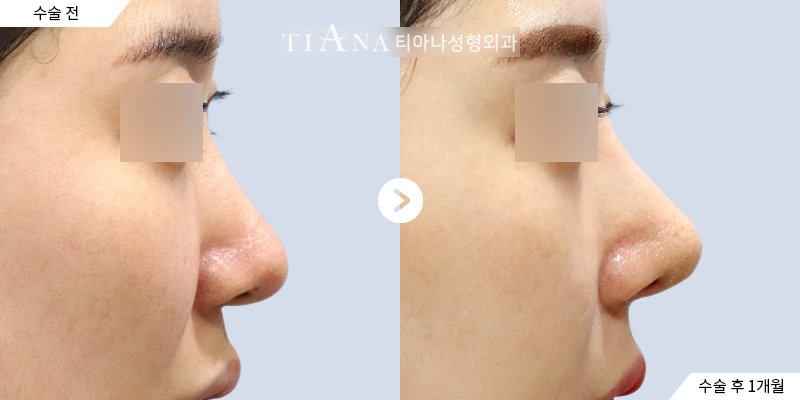
This profile shows one patient one month after the bridge and tip were shaped together. Results vary between people, depending on skin thickness, cartilage and the scope of surgery.

Closing, the splint, and after surgery
Once the shape is set, the incisions are closed and a splint holds the nose in place. From the next day, the surgeon checks how you are doing and explains aftercare and medication.
Plan on 7 to 14 nights in Seoul, with 7 nights as the minimum. The splint and outer stitches usually come off around day 7, and the inner stitches around day 14. If you fly home around day 7, you receive a referral letter and a surgery certificate so the inner stitches can be removed at home. Timing varies between people and is confirmed again at surgery.
Risks to know about
The American Society of Plastic Surgeons lists risks of rhinoplasty such as infection, bleeding, asymmetry, difficulty breathing and revision surgery when the result is not what you hoped. Swelling and bruising are common for a while after surgery, and how fast they fade varies. Whether you are a candidate is decided after an exam.
Clinic address: TIANA Plastic Surgery, 108 Bongeunsa-ro, Gangnam-gu, Seoul (closed on Sundays and public holidays). You can read more about the surgeon on Dr. Choi's profile or the English home page.
Summary
- The rhinoplasty procedure steps are design check, anesthesia, incision and dissection, cartilage harvest, shaping, and closing with a splint
- The design and materials are checked once more right before surgery
- At TIANA, the director also manages anesthesia personally
- Septal cartilage is taken while keeping what the nose needs for support; ear or rib cartilage is added if needed
- Stitches come out around day 7 and day 14, and patients flying home get a referral letter and a surgery certificate
To find out which steps your nose needs, send 5 photos (front, 45-degree and side) on WhatsApp with the one thing you most want to know, such as "what does my tip need for support?". We reply in English with the likely scope of surgery.
Frequently Asked Questions
Q1Will I wake up or feel pain during rhinoplasty?
At TIANA, the director who consults with you and performs the surgery also manages the anesthesia personally. The method is chosen for your nose and the scope of surgery, and it is explained before the operation. Raise any worry about anesthesia at the consultation.
Q2What if I want to change the design right before surgery?
The design is checked once more just before surgery. If you still have doubts, the surgery does not go ahead with them unresolved. Sometimes the scope is changed after talking it through, and that conversation happens before you enter the operating room.
Q3Does taking septal cartilage weaken the nose?
Septal cartilage is taken while leaving the part the nose needs for support. How much can be harvested differs from person to person, and when it is not enough, ear cartilage or rib cartilage may be combined with it.
Q4Is an interpreter with me on surgery day?
The interpreter joins you on the consultation day, not in the operating room. Everything about the surgery is explained and confirmed with you in English at the consultation, so you go into surgery day knowing the plan.
Q5Can I have my stitches removed at home?
Yes. The splint and outer stitches usually come off around day 7, and the inner stitches around day 14. If you fly home around day 7, you receive a referral letter and a surgery certificate so a local clinic can remove the inner stitches. Timing varies between people and is confirmed again at surgery.
Thank you for reading to the end.
Send 5 photos (front, 45-degree and side) on WhatsApp for a free photo consultation. We reply in English with the likely scope of surgery and how the estimate is worked out.
Send my photos on WhatsAppThis article is general information about elective cosmetic surgery and is not a diagnosis. Results and recovery vary between individuals. Before-and-after photos are published with patient consent; surgery carries risks such as swelling and bruising and requires downtime. Final procedures and fees are decided after examination.