Seoul Nose Tip After Rhinoplasty? Healing, Cost, Reviews
Worried your Seoul nose tip after rhinoplasty will still look puffy, stiff or too turned-up when you walk back into the office?
By the end of this guide, your questions about rhinoplasty should turn into a clear next step.
Send 5 photos (front, 45-degree and side) on WhatsApp and we will reply in English with a free first assessment: the likely scope of surgery and how the estimate is worked out.
Send my photos on WhatsAppGive this ten minutes before you put in your leave request.
You'll come away knowing what the tip goes through in the first 14 days, how many nights to stay, which tip methods change the healing, what decides the cost and which review claims hold up, so you can match the plan to the leave you have.
Hello, I'm Dr. Choi Hang-seok, Head Surgeon at TIANA Plastic Surgery in Gangnam, Seoul.
I operate only on noses: first-time rhinoplasty and revision.
I wrote this because the tip is the last part of the nose to settle, and a swollen tip in week two is often mistaken for the final shape.
Around day 7 the splint and outer stitches come off, which is the earliest you can fly home, and around day 14 the inner stitches come out. The tip keeps refining for months after that, so plan on 7 to 14 nights in Seoul and judge the tip much later.
If your leave is already fixed, send those dates on WhatsApp with a side photo of your nose taken in daylight, and ask one thing: which tip method your nose would likely need, and whether it fits that window. With your own dates on the table, the answer is about your calendar.
Why does the nose tip take the longest to settle?
On most noses the tip is where the skin is thickest, with the most oil glands, and it sits at the end of the line for fluid to drain. Surgery disrupts the small lymph channels that carry swelling away, and they take time to reconnect. The bridge, where skin is thin and lies close to bone, shows its shape early; the tip lags behind.
The American Society of Plastic Surgeons describes initial swelling going down within a few weeks, while the final contour can take up to a year to refine.
Thick skin stretches that timeline further. If your skin is thick and oily, the tip can look fuller for longer, and there is a limit to how fine it can become however the cartilage is shaped. I've written more on that in how skin sets the limit for a bulbous tip.
The tip also feels firm. When cartilage grafts support or lengthen the tip, as in septal extension, the tip moves less than before and can feel hard to the touch for months. For many people the firmness softens gradually, though a tip built on a strong graft usually stays less mobile than an unoperated one.
Doctor's note
A tip in week two tells you about swelling, not about design. What's worth looking at then is the line: does the bridge run into the tip as one profile, or does the tip sit on its own? Raising only the tip makes it look stuck on, which is why I plan the bridge and tip together even when the tip is your only concern. Size keeps coming down for months; the line is set at surgery.
Seoul nose tip after rhinoplasty: the first 14 days
In short, this is how a Seoul nose tip after rhinoplasty usually changes over the stay. The exact timing shifts a little from nose to nose, and the splint and stitch removal days are confirmed at surgery.
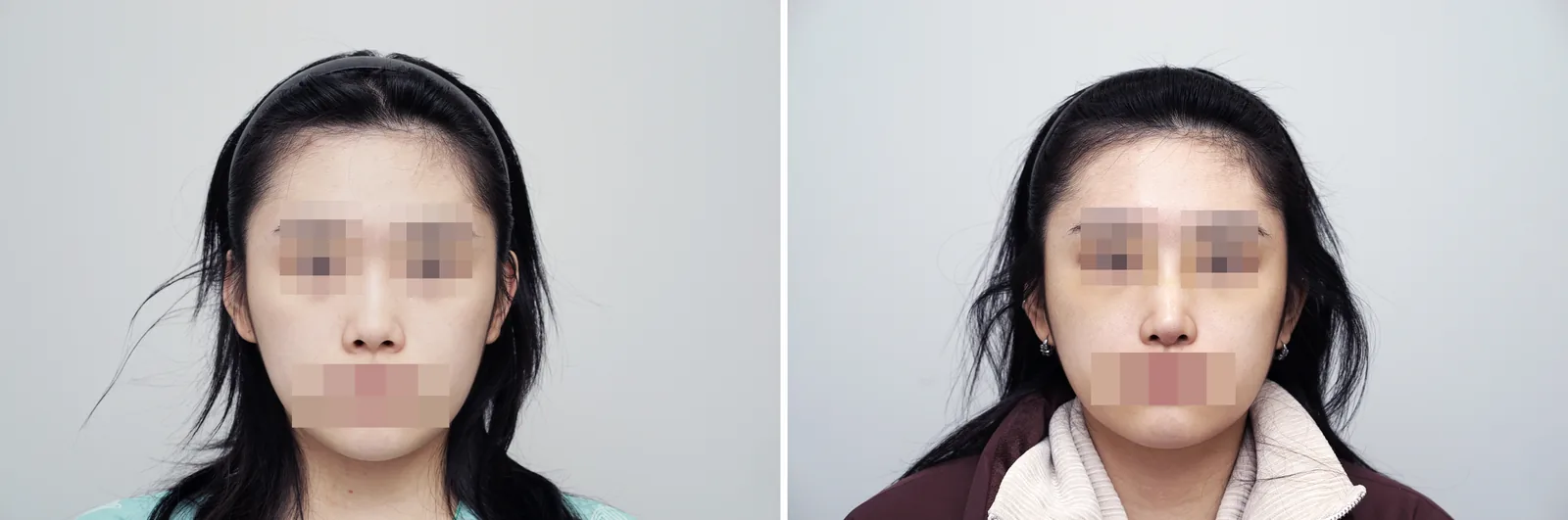
Example case (hump nose, bulbous tip): front view before surgery (left) and 2 weeks after (right). Procedures: silicone bridge implant, tip with septal and donor rib cartilage, hump reduction, bulbous tip refinement, short-nose correction, columella and nasolabial angle adjustment. Results vary between individuals; swelling, bruising, asymmetry and infection are possible risks. Shared with the patient's consent; eyes and mouth are pixelated for privacy.
| Days | What the tip is doing | What you can plan |
|---|---|---|
| 0 to 3 | Swelling and bruising build, nose blocked | Rest, head raised |
| 4 to 6 | Bruises fade, tip tight under the splint | Short walks, quiet cafés |
| Around 7 | Splint and outer stitches off | Earliest day to fly home |
| 8 to 14 | Tip looks fuller and higher than it will | Gentle sightseeing, no heavy exercise |
| Around 14 | Inner stitches out | Fly home after this if you can |
The first three days are the heaviest. Swelling and bruising usually peak around day two or three, and breathing through the nose is hard because the inside is swollen too. Surgeons generally ask you to keep your head raised, avoid blowing your nose, and keep cold packs on the cheeks and around the eyes, never pressed on the nose itself.
On days four to six, bruises turn yellow-green and fade. The splint holds the tip, and the skin underneath feels tight.
Around day 7 the splint and outer stitches come off. This is when people take their first photo, and when to be careful how you read it. The tip will look fuller, a little higher and often more turned-up than where it will settle. If the surgery used an open approach, the small scar across the columella is pink at this stage.
From day eight to fourteen you can walk around Seoul. Avoid heavy exercise, saunas and crowds where the nose could be knocked. If your bridge was worked on too, surgeons commonly advise keeping glasses off it for a while. Around day 14 the inner stitches come out. For where to spend those days, see the recovery room and your hotel room in Seoul.
Wondering which type your nose is?
Share your profile and front photos — the surgeon will tell you which procedures your nose would actually need. No cost, no obligation.
Ask which procedure fits meHow many nights should you stay if your leave is fixed?
Seven nights is the minimum; fourteen covers both stitch removals in Seoul. If you fly home on day 7, you leave with a referral letter and a surgery certificate for the doctor you'll see at home.
Then fit it to the calendar. TIANA is open 10:00 to 19:00 on weekdays and 10:00 to 16:00 on Saturdays, and closed on Sundays and public holidays. Ask at booking whether your consultation and surgery are on the same day or on separate days, and count that in.
Say you manage projects in Chicago, you have two weeks of leave plus the weekends either side, and your tip is short and turned up, the kind of nose septal extension is used for. I'd fly in so the consultation lands on a weekday, keep the full fourteen nights so both stitch removals happen in Seoul, and leave a few days between landing at home and your first day back at work.
If you had only eight or nine days in total, the seven-night minimum would leave no margin at all, and I'd suggest saving the tip for a longer stretch of leave.
When you write, include your exact leave dates and the city you're flying back to, and mention any nose surgery you've had before. A previous operation changes how much septal cartilage is left to work with, so it's the detail worth giving up front. Then ask whether seven or fourteen nights suits the tip plan your nose needs.
Which tip methods change how you heal?
The method decides how much of the tip is rebuilt, and that shapes the healing.
- Septal extension and columella work bring a short or upturned tip down and set its angle. A review in Archives of Plastic Surgery describes the septal extension graft as a way to control tip projection and rotation with firm support. My post on what causes an upturned nose and how septal extension helps goes further.
- Bulbous tip refinement brings the tip cartilage together so a round tip looks slimmer. This is where swelling interacts most with skin thickness.
- Minimal-incision tip work, including tip surgery without an implant, suits a light refinement. Minimal-incision procedures tend to recover faster.
- Full rhinoplasty, with a bridge implant plus tip support, comes in when the bridge is also low.
Tip support can use septal, ear or rib cartilage, donor rib cartilage, or your own dermis and fascia. Before surgery, 3D-CT imaging maps your bone and nasal structure. The TIANA English page shows how each nose type is matched to a procedure.
What decides the cost of tip surgery in Seoul?
There's no fixed menu price, because the tip work your nose needs can be small or extensive. These are the factors:
- Scope: the tip alone, or tip and bridge together.
- Cartilage source: septal cartilage if there's enough, otherwise ear, rib or donor rib cartilage.
- Skin thickness, which affects how much refinement the tip needs.
- Revision: a tip rebuilt after previous surgery usually takes more work.
- Your nights in Seoul, which are your own hotel and living budget.
The final fee is confirmed after examination. For a figure tied to your nose, ask on WhatsApp what tip surgery would cost for your case, with five photos: front, 45-degree and side.
What reviews say about the tip, and how much of it is true
“My tip looked too turned-up at two weeks, so the surgery failed.” Often this is swelling, since an early tip usually sits higher and fuller than its settled shape. A tip that is clearly off-center or seems to be collapsing is a different matter, and it's worth photos and a question.
“The tip stays hard forever.” For many people the firmness eases over months. After septal extension, though, the tip usually stays less mobile than before surgery, because that support is what holds it in place.
“The numbness never goes away.” Tip numbness is common after rhinoplasty, and for many people feeling comes back gradually over months. If nothing has changed after several months, raise it at follow-up.
Reviews rarely say whether the plan suited the person's nose in the first place. That question is the subject of whether Seoul rhinoplasty works for your nose.
If you want to see how real noses changed and how many months after surgery each photo was taken, browse TIANA's rhinoplasty case gallery before your consultation.
Risks and side effects to know
Swelling, bruising, a blocked nose, a numb tip and a firm tip are the common temporary effects. Bruising usually fades within one to two weeks; tip swelling and firmness ease over months. The American Society of Plastic Surgeons lists the less common risks of rhinoplasty: infection, bleeding, difficulty breathing, a hole in the septum, poor wound healing or scarring, lasting numbness, and an appearance you're not happy with, which can lead to revision.
With septal extension, a stiffer tip and a slight tilt of the tip are the specific points to discuss before surgery.
As general medicine, it's wiser to wait if you have:
- an infection, active acne or inflammation on the nose
- pregnancy or breastfeeding
- a bleeding disorder, or blood thinners your own doctor hasn't cleared you to pause
- a recent nose operation whose tissue is still settling
The right method for your tip is decided at the in-person exam.
If a reaction appears after you fly home, don't wait it out. Fever, spreading redness, pain that worsens day by day, bleeding that gentle pressure won't stop, or a tip that suddenly changes shape after a knock: see a local doctor with your referral letter and surgery certificate, and send photos to TIANA on WhatsApp. Leg pain, a swollen calf or breathlessness after the flight needs emergency care at once.
Send five photos (front, 45-degree and side) and your leave dates on WhatsApp, with the one question about your tip you most need answered, such as “will my tip still look swollen when I fly home?” One photo set is enough to begin, and you can ask before you book anything. When you come to Seoul, I examine your nose with 3D-CT and recommend the tip plan that fits your face and your leave.
Frequently Asked Questions
Q1Can I wear glasses after nose tip surgery?
If only the tip was operated on, glasses usually sit on the bridge without pressing the tip. If the bridge was raised or the bones were narrowed, surgeons commonly advise keeping glasses off the bridge for a while, so ask about your own case at surgery.
Q2When can I go back to running or the gym?
Heavy exercise raises blood pressure and swelling, so surgeons generally ask you to wait several weeks. Walking is fine during your stay. Ask for your own timing before you fly home.
Q3Will my tip come down as the swelling goes?
An early tip usually looks higher and fuller than its settled shape, so some change as swelling resolves is expected. The angle set by septal extension is held by the graft, which is why the tip doesn't simply drop back.
Q4How are the inner stitches handled if I fly home on day 7?
If you fly home on day 7, you leave with a referral letter and a surgery certificate for the doctor who will see you at home.
Q5Can a tip operated on at another clinic be revised?
Yes. TIANA performs revision rhinoplasty after surgery elsewhere, including contracture. Mention the previous surgery and send current photos.
Thank you for reading to the end.
Send 5 photos (front, 45-degree and side) on WhatsApp for a free photo consultation. We reply in English with the likely scope of surgery and how the estimate is worked out.
Send my photos on WhatsAppThis article is general information about elective cosmetic surgery and is not a diagnosis. Results and recovery vary between individuals. Before-and-after photos are published with patient consent; surgery carries risks such as swelling and bruising and requires downtime. Final procedures and fees are decided after examination.