Korea Bulbous Tip Side Effects and Benefits? Cost, Days
Weighing Korea bulbous tip side effects and benefits, and unsure a slimmer tip is worth the bruising on a short break from work?
By the end of this guide, your questions about rhinoplasty should turn into a clear next step.
Send 5 photos (front, 45-degree and side) on WhatsApp and we will reply in English with a free first assessment: the likely scope of surgery and how the estimate is worked out.
Send my photos on WhatsAppRead this before you book the flight.
You'll know what the surgery can change, what each side effect does to your calendar, what decides the cost and how many nights to plan, so you can judge the trade for your own tip and budget.
Hello, I'm Dr. Choi Hang-seok, Head Surgeon at TIANA Plastic Surgery in Gangnam, Seoul.
TIANA does rhinoplasty and revision rhinoplasty, nothing else. The same surgeon handles you from consultation to surgery and aftercare, and 3D-CT imaging maps your bone and nasal structure before surgery.
I wrote this because people tend to weigh the benefit against the worst story they've read, when the side effects most of them will live with are a matter of timing.
The benefit is a slimmer tip from the front and the side, made by bringing the tip cartilage together. The usual side effects are swelling, bruising, soreness and numbness that settle over weeks, with rarer risks such as infection, breathing difficulty or a second operation.
If a round tip is the worry, send one front photo and one side photo on WhatsApp with this question: how much of my tip's width looks like cartilage, and how much looks like skin? The rest of this page turns on that question.
What are the real benefits of bulbous tip surgery?
The main one is proportion. A round tip can make the whole nose look heavier than it is, so a narrower tip can change how the nose reads from the front and in profile. A nose changes a face through very small differences, which is why I operate only on noses.
The limit is skin. Surgery reshapes the cartilage underneath, and in general thick skin hides more of that change than thin skin does. Two tips of the same width can respond differently for this reason, and why a tip looks bulbous in the first place comes down to that mix of cartilage and skin.
Doctor's note
The first thing I want to know is what you hope to see in the mirror once the swelling has gone. If your photo shows a very fine tip and your skin is thick, I would rather lower the target now than have you fly home expecting it. A nose that suits your face matters more to me than the largest possible change.
Which methods change the side-effect list?
For a light refinement, TIANA offers minimal-incision tip work and tip surgery without an implant, and minimal-incision procedures tend to recover faster. If the tip needs support, cartilage comes into it: septal, ear, rib or donor rib cartilage. Taking your own ear or rib cartilage generally adds a second healing site, so that choice belongs in your trade-off too.
A wide tip also isn't always a tip-only problem. If the bridge is low, slimming the tip alone can leave the two out of balance, and full rhinoplasty may be suggested instead. How the surgery narrows a round tip covers the technique in more depth.
Side effects by date, not by severity
The common side effects arrive on a rough timetable. The first and third rows below are clinic timing, which can shift and is confirmed at surgery. The others come from the NHS guide to nose reshaping and the American Society of Plastic Surgeons recovery page.
| When | What you may notice | What it means for you |
|---|---|---|
| Around day 7 | Splint and outer stitches come off | The earliest point to think about flying |
| Up to 2 weeks | Tiredness, soreness, visible swelling | Time off work may be needed |
| Around day 14 | Inner stitches come off | The reason some people stay longer |
| About 3 weeks | Bruising and redness may have faded | Close-up video calls get easier |
| 4 to 6 weeks | Strenuous exercise usually possible again | Gym plans can restart |
| Up to a year | Swelling comes and goes, often worse in the morning | The tip keeps refining |
That last row surprises people. You'll look like yourself to colleagues long before you're looking at your final tip, and a thick-skinned tip is often the slowest part of the nose to define. I don't give one fixed recovery period, because swelling settles at a different pace for everyone.
Wondering which type your nose is?
Share your front, 45-degree and side photos — the surgeon will tell you which procedures your nose would actually need. No cost, no obligation.
Ask which procedure fits meHow many nights does this trade-off need?
Plan on about 7 to 14 nights in Seoul, with 7 as the minimum. That range exists because of the two stitch dates in the table. If you fly home around day 7, you get a referral letter and a surgery certificate to take with you.
Say you teach in Asia and have ten days over a school break, with thick skin and a wide tip. I'd reason like this: ten nights covers the splint coming off, but you might go back to class with some swelling and fading bruises. If that bothers you, the longer break is the better one. If it doesn't, ten nights can work, provided you know where your inner stitches will come out.
Check the calendar as well. The clinic is open 10:00 to 19:00 on weekdays and 10:00 to 16:00 on Saturdays, and closed on Sundays and public holidays, so see where your day 7 lands. The CDC's medical tourism advice also notes that flying after surgery can increase the risk of blood clots, so raise the flight home with your surgeon. If you want the order of events, read the bulbous tip procedure steps.
Put your possible dates and your home city in a WhatsApp message, and ask this: if I leave on this date, where would my inner stitches come out?
What can go wrong, and who should hold off?
Common and temporary: swelling, bruising around the eyes, soreness and a changed sensation in the skin of the tip. A stuffy nose is also common while the swelling is up. These usually ease over the weeks shown above, though the pace differs from person to person.
Less common: the American Society of Plastic Surgeons lists these rhinoplasty risks: anesthesia risks, infection, poor wound healing or scarring, difficulty breathing, a rare hole in the septum, an appearance you're unhappy with, and the possibility of revision surgery. The NHS adds heavy nosebleeds and an altered sense of smell. Our longer look at when side effects show up goes through timing in detail.
As general medicine, these are reasons to hold off and raise it with a surgeon first:
- A skin infection or inflammation on or around the nose
- Pregnancy or breastfeeding
- A bleeding disorder, or medication that thins the blood
- A recent nose injury or recent surgery on the nose
- A goal that surgery can't reach given your skin and cartilage
If something changes after you're home, contact your surgeon with clear photos, and take your referral letter and surgery certificate to a local doctor. Heavy bleeding, fever, spreading redness, trouble breathing, or a swollen, painful leg or chest pain after the flight need urgent local care. The CDC also advises getting copies of all your medical records before you leave the destination.
What decides the cost of bulbous tip surgery?
TIANA doesn't publish a fixed menu price, because two similar-looking tips can need very different surgery. These are the things that move the cost:
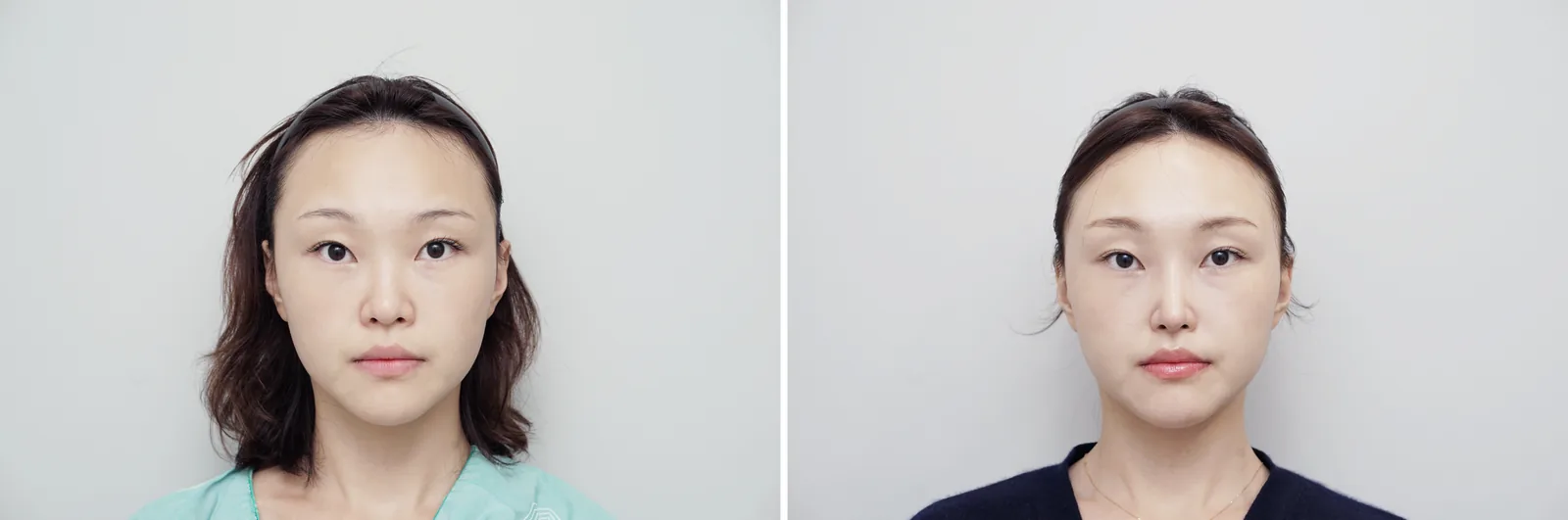
Example case (bulbous tip): front view before surgery (left) and 1 month after (right). Procedures: silicone bridge implant, tip with septal and donor rib cartilage, hump reduction, bulbous tip refinement, short-nose correction, columella and nasolabial angle adjustment. Results vary between individuals; swelling, bruising, asymmetry and infection are possible risks. Shared with the patient's consent.
- Scope: tip alone, or tip plus bridge
- Your nose: how much cartilage is available and how thick the skin is
- Tissue: whether extra cartilage or dermis is needed
- History: whether this is a revision
- Nights in Seoul: your own accommodation and flights sit on top of the surgical fee
A plan that looks cheaper can end up costing more if it needs correcting, in money and in trips to Korea. That's why I'd compare scope first when you look at Korea bulbous tip side effects and benefits. To get the figure for your case, ask on WhatsApp what it would cost, with a photo attached. The final fee is confirmed after examination.
Reviews: three claims worth checking
Reviews and forum threads repeat a few lines about tip surgery. Here's how they hold up against general medicine.
"The swelling is gone in two weeks." Partly true. Visible puffiness often drops quickly, but the tip can keep changing for many months, as the ASPS timeline shows.
"A numb tip means nerve damage." Usually not. Numbness after tip work is common and tends to improve over time. Numbness that doesn't improve is still worth raising with your surgeon.
"Thick skin means surgery is pointless." Too blunt. Thick skin limits how fine the tip can look, but a change in shape can still be worthwhile for some people. The useful question is how much change your skin will show, and the English overview of TIANA's rhinoplasty lays out the range of noses the clinic treats.
If you want to see how real noses changed and how many months after surgery each photo was taken, browse TIANA's rhinoplasty case gallery before your consultation.
Your next step before you book
When you add up Korea bulbous tip side effects and benefits for yourself, the numbers that matter are your skin, your scope and your dates. Send 5 photos (front, 45-degree and side) on WhatsApp and ask what it would cost for your case and how many nights you should plan. The photo consultation reply comes in English and explains the likely scope and how the estimate is worked out. A deposit is only discussed once you decide to book surgery, so it's fine to just ask questions first.
When you come to Seoul, I'll examine your nose with 3D-CT and recommend the scope that fits it.
Frequently asked questions
Q1Do the benefits of tip surgery last for years?
Reshaped cartilage generally holds its new position for the long term, and the tip keeps refining for up to a year. Skin and tissue still change with age, so the nose will age along with the rest of your face.
Q2Will my nose tip feel numb?
Often, for a while. A changed sensation in the skin is a listed rhinoplasty risk, and tip numbness usually improves over time. Tell your surgeon if it isn't improving.
Q3Can tip surgery make breathing harder?
A blocked feeling is common while swelling is up. Lasting difficulty breathing is a known but less common risk, so mention any existing breathing problems before surgery.
Q4Does the tip look narrower right away?
Not fully. Swelling hides much of the change at first, and the splint covers the nose until around day 7. The shape keeps becoming clearer over many months.
Q5Is 7 nights enough for bulbous tip surgery?
It's the minimum. The splint and outer stitches come off around day 7, though timing varies and is confirmed at surgery. If you fly then, you get a referral letter and surgery certificate, and it's worth asking where the inner stitches will come out.
Thank you for reading to the end.
Send 5 photos (front, 45-degree and side) on WhatsApp for a free photo consultation. We reply in English with the likely scope of surgery and how the estimate is worked out.
Send my photos on WhatsAppThis article is general information about elective cosmetic surgery and is not a diagnosis. Results and recovery vary between individuals. Before-and-after photos are published with patient consent; surgery carries risks such as swelling and bruising and requires downtime. Final procedures and fees are decided after examination.