Korea Bulbous Tip Side Effects in Humans? Cost, Reviews
Worried about Korea bulbous tip side effects in humans, meaning what tip surgery does to a real nose after you've flown home?
By the end of this guide, your questions about rhinoplasty should turn into a clear next step.
Send 5 photos (front, 45-degree and side) on WhatsApp and we will reply in English with a free first assessment: the likely scope of surgery and how the estimate is worked out.
Send my photos on WhatsAppRead this before you book a flight or settle on a method.
You'll know which side effects usually fade and which can stay, what decides the cost, what reviews get right and wrong, and which methods suit which tip. That should help you judge whether surgery makes sense for your nose and your budget.
Hello, I'm Dr. Choi Hang-seok, Head Surgeon at TIANA Plastic Surgery in Seoul.
TIANA does only rhinoplasty and revision rhinoplasty. I handle you 1:1 from consultation through surgery and aftercare, and 3D-CT imaging maps your bone and nasal structure before surgery.
I wrote this because a round tip often gets treated as a small fix, when its skin and cartilage set hard limits on what surgery can do.
The usual side effects are swelling, bruising, a stiff tip and numbness, and they tend to ease over months. The ones to plan around are infection, asymmetry, breathing trouble, and a result that needs revision. For some noses, those risks are a good reason to say no.
If one of those worries you most, send 5 photos (front, 45-degree and side) on WhatsApp and ask, "Which side effect should I plan for with this tip?" With your own photos attached, the question stays about your nose.
What tip surgery actually changes inside your nose
A bulbous tip usually comes from wide cartilage, thick skin, or both. Surgery reshapes or trims the cartilage, often adds sutures or a small graft for support, and sometimes removes soft tissue under the skin. The skin then has to settle over a smaller framework, and that is the slowest part of the whole process.
Most side effects trace back to this. The tip tends to hold swelling longer than the bridge, and thick, oily skin shrinks less than thin skin. So the limit on narrowing often sits in the skin. A review of Asian rhinoplasty in Plastic and Reconstructive Surgery Global Open discusses thick skin and weak tip cartilage as recurring surgical challenges, which is why a surgeon at home may have called your tip difficult.
Which side effects are common, and how long do they last?
When people look up Korea bulbous tip side effects in humans, these five are what most of them will actually meet. The timing below is general medicine, and your own course may differ.
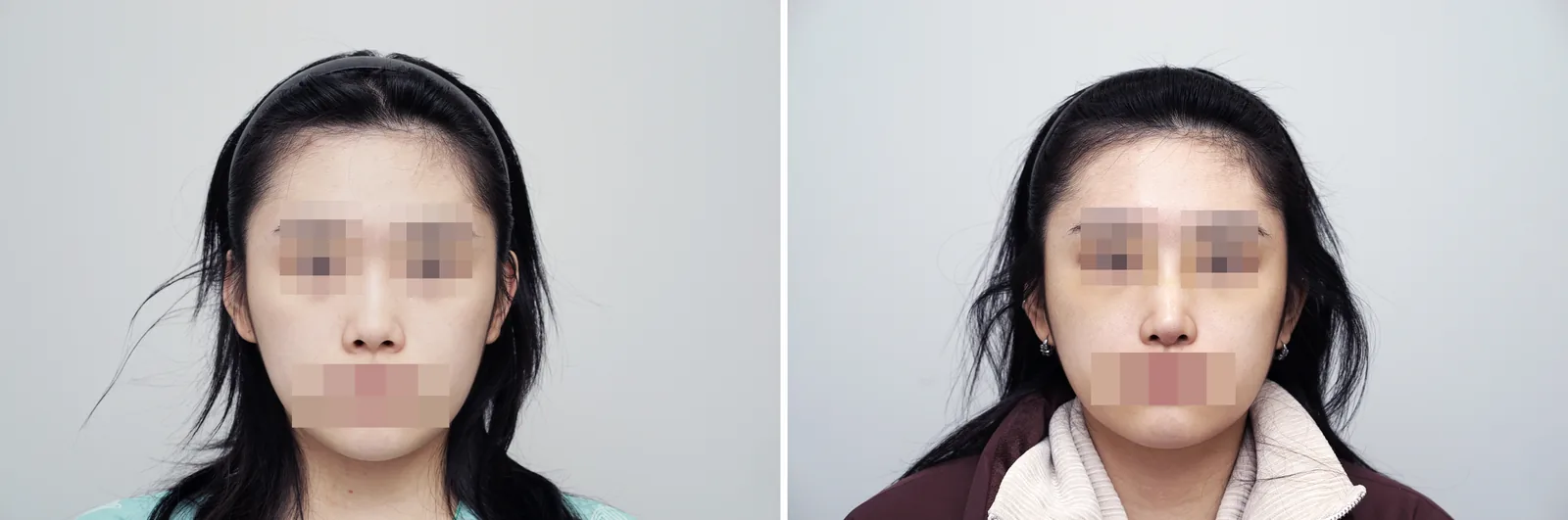
Example case (bulbous tip): front view before surgery (left) and 2 weeks after (right). Procedures: silicone bridge implant, tip with septal and donor rib cartilage, hump reduction, bulbous tip refinement, short-nose correction, columella and nasolabial angle adjustment. Results vary between individuals; swelling, bruising, asymmetry and infection are possible risks. Shared with the patient's consent; eyes and mouth are pixelated for privacy.
| Side effect | What you'd notice | Usual course |
|---|---|---|
| Swelling | Tip looks wider, often worse in the morning | Falls over the first weeks, then slowly |
| Stiffness | Tip feels firm and moves less | Tends to soften over months |
| Numbness | Dull feeling at the tip or upper lip | Usually returns over months, sometimes lingers |
| Blocked nose | Mouth breathing for the first nights | Improves as swelling drops |
The American Society of Plastic Surgeons says initial swelling settles within a few weeks, but the contour can take up to a year to fully refine. A tip that looks too wide at week three is usually telling you about swelling. It's too early to judge the shape.
Wondering which type your nose is?
Share your profile and front photos — the surgeon will tell you which procedures your nose would actually need. No cost, no obligation.
Ask which procedure fits meRarer problems that deserve a straight answer
The ASPS risk list includes anesthesia risks, infection, bleeding, poor wound healing, difficulty breathing, lasting numbness, a hole in the septum, skin discoloration, and an unsatisfactory result that may need revision.
Two more are specific to the tip:
- Over-reduction. Removing too much cartilage can weaken support, so the tip may look pinched or collapse slowly as scar tissue contracts. Breathing can suffer too.
- Asymmetry. Noses are rarely symmetrical to begin with, and healing can make a small difference more visible.
If cartilage is taken from the ear or rib for support, that site has its own soreness and scar. Results vary between individuals, and no method removes these risks.
When would I tell you not to have it?
In short, these are general reasons to pause or skip tip surgery, and any careful surgeon would raise them:
- You have a skin infection or active inflammation on the nose.
- You had nose surgery recently and the swelling hasn't settled.
- You're pregnant or breastfeeding.
- You take blood thinners or have a bleeding disorder that isn't under control.
- You smoke and can't stop around surgery, since smoking slows wound healing.
- You see a flaw that others can't, and no earlier change has eased that distress.
The last reason on my own list is anatomy against the goal. Say you have thick, oily tip skin, soft cartilage, and a reference photo of a very narrow, sharp tip. Cutting more cartilage won't thin the skin, and it can leave you with less support under the same heavy envelope. I would turn that goal down and talk about what your tip can reach, such as better definition and support. If you'd only be happy with the photo, surgery is the wrong decision.
Doctor's note
A nose changes a face with very small differences, which is why I operate only on noses. I also choose by bone structure and the concern in front of me, and I don't follow trends. Raising or narrowing the tip alone can make it look out of place on the face, so I look at the bridge and tip together and recommend only the scope you need.
What if something goes wrong after you fly home?
Put simply, this is the fear that matters most when you live far from Seoul. Plan about 7 to 14 nights, at least 7. The splint and outer stitches come off around day 7 and the inner stitches around day 14, with timing confirmed at surgery. If you fly home on day 7, you get a referral letter and surgery certificate to show a doctor at home. For how those days fit together, see the steps of a bulbous tip trip.
Get care at home the same day for fever, spreading redness, pain that worsens on one side, pus, heavy bleeding, or sudden trouble breathing. Severe calf pain, chest pain or shortness of breath after a flight is an emergency. The CDC's medical tourism guidance also advises planning follow-up care before you leave and keeping copies of your records, so find a local plastic surgeon or ENT doctor in advance.
For slower questions, such as swelling that looks uneven, TIANA guides you individually from your progress photos. There's more on that stage in this guide to recovery after bulbous tip surgery.
Before you commit, add a daylight side photo and your home city to your WhatsApp message, then ask, "If my tip swells or reddens at home, what should I do first?" You'll have that answer saved on your phone if it ever comes up late at night.
Which methods suit which tip?
The method changes the side-effect profile, though it doesn't erase it.
- Bulbous tip refinement reshapes a round, heavy tip so it looks slimmer from the front and side. Thick skin limits how far this goes, as this piece on how tip surgery narrows a round tip explains.
- Minimal-incision tip work or tip surgery without an implant can be enough for a light refinement, and minimal-incision procedures tend to recover faster. Swelling and asymmetry remain possible.
- Tip support with cartilage uses septal, ear or rib cartilage, or donor rib cartilage. It helps a low or weak tip, with a donor site to heal if your own ear or rib is used.
- Full rhinoplasty comes up when the bridge is low too, with a bridge implant plus tip support designed as one profile. A bigger scope means more tissue to heal. You can see how the clinic lays out these options on TIANA's rhinoplasty in Korea page.
What reviews get right and wrong about tip surgery
Threads about Korea bulbous tip side effects in humans tend to repeat a few claims.
"My tip stayed hard for months" is common and usually fits normal healing. Firmness that worsens, or a tip that starts pulling upward, deserves an exam. "The swelling is gone in two weeks" holds for bruising and some visible puffiness, but fine tip definition takes much longer. "Thick skin can't be helped" is half true: skin can't be made thin by surgery, yet stronger support can still improve definition for many people.
What decides the cost for your tip
Five things move the figure: the scope of surgery, how much cartilage is available and which source is needed, your skin thickness, whether this is a revision, and how many nights you stay in Seoul. A plan that looks lower-priced can end up costing more money and another trip if a revision follows, so compare scope first. What to ask when you book a bulbous tip consultation covers the booking side. To get the figure for your own case, ask on WhatsApp what it would cost, with your 5 photos attached.
If you want to see how real noses changed and how many months after surgery each photo was taken, browse TIANA's rhinoplasty case gallery before your consultation.
The one message to send next
On WhatsApp, send your 5 photos, your reference photo if you have one, and any past nose surgery, with this question: "Which side effect is most likely for my tip, and what would it cost for my case?" One message is enough, and it's fine to just ask questions before booking anything. When you come to Seoul, I examine your nose with 3D-CT and recommend the plan that fits your tip.
Frequently Asked Questions
Q1Can a bulbous tip come back after surgery?
The cartilage changes are meant to last, but a tip can look rounder again if support weakens, scar tissue builds, or thick skin holds on to swelling. An early wide look is usually swelling, so give it months before judging.
Q2Will tip surgery leave a visible scar?
With an open approach there is a small scar across the base of the nose between the nostrils, and it usually fades over time. Tip surgery done through incisions inside the nose leaves no outside scar. Healing differs with your skin.
Q3Can tip surgery affect my breathing?
It can. A blocked feeling is normal in the first days. Lasting trouble is less common and can follow weakened support or scarring, so tell your surgeon about any breathing problem you already have before surgery.
Q4Does tip surgery without an implant avoid side effects?
It avoids problems tied to an implant, and minimal-incision procedures tend to recover faster. Swelling, numbness, asymmetry and the chance of revision remain, so it lowers some risks and leaves others in place.
Q5Can TIANA correct a tip problem from surgery at another clinic?
Yes, TIANA performs revision rhinoplasty after surgery elsewhere, including difficult cases such as contracture. Share your current photos and what you know about the first operation on WhatsApp.
Thank you for reading to the end.
Send 5 photos (front, 45-degree and side) on WhatsApp for a free photo consultation. We reply in English with the likely scope of surgery and how the estimate is worked out.
Send my photos on WhatsAppThis article is general information about elective cosmetic surgery and is not a diagnosis. Results and recovery vary between individuals. Before-and-after photos are published with patient consent; surgery carries risks such as swelling and bruising and requires downtime. Final procedures and fees are decided after examination.