Nose Implant in Korea: Lifespan, Risks, Who It Suits
Thinking about a nose implant in Korea, but wondering what it will look like in ten or twenty years? Many people who message us have read forum threads about implants that moved or showed through the skin, and they want to know whether that is likely to happen to them.
By the end of this guide, your questions about rhinoplasty should turn into a clear next step.
Send 5 photos (front, 45-degree and side) on WhatsApp and we will reply in English with a free first assessment: the likely scope of surgery and how the estimate is worked out.
Send my photos on WhatsAppThis guide explains what a nose implant actually is in Korean rhinoplasty, who it suits and who is better off with cartilage only, how it changes over the years, the risks, and what removal or replacement involves.
Hello, I'm Dr. Choi Hang-seok, Head Surgeon at TIANA Plastic Surgery in Gangnam, Seoul.
TIANA performs only rhinoplasty and revision rhinoplasty. I handle each patient one-to-one from consultation through surgery, anesthesia and aftercare, and every nose is mapped with 3D-CT imaging before surgery.
The short answer: in Korean rhinoplasty, a nose implant usually means a silicone implant along the bridge, while the tip is shaped and supported with cartilage. It suits a low bridge with enough soft tissue to cover it. It is a poor fit for very thin skin, for a tip-only change, or for a nose that has already reacted badly to an implant.
What a nose implant means in Korean rhinoplasty

Many people picture one piece of material that does everything. In practice the bridge and the tip are two separate jobs, and they are built with different materials.
- Bridge: a silicone implant, carved for your nose, sits over the bone and cartilage under the soft tissue. It gives an even line from between the eyes down towards the tip. Surgeons call this a dorsal implant.
- Tip: height and shape come from cartilage, such as septal, ear or rib cartilage. An implant is not pushed into the tip, because pressure on the thin tip skin is one of the main ways implants cause trouble.
So when a Korean clinic or forum talks about a silicone nose implant, it nearly always means a bridge implant combined with cartilage tip work. You can read how TIANA combines a silicone bridge implant with cartilage tip support on our procedure page.
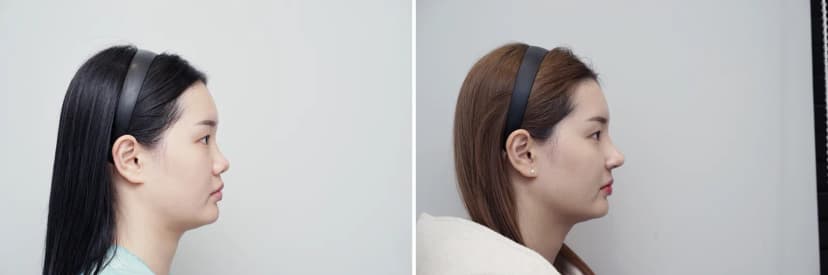
Example case (bulbous tip, short nose): side profile before surgery (left) and 3 months after (right). Procedures: silicone bridge implant, tip with septal and donor rib cartilage, bulbous tip refinement, short-nose correction, osteotomy, columella and nasolabial angle adjustment. Results vary between individuals; swelling, bruising, asymmetry and infection are possible risks. Shared with the patient's consent.
Materials used at TIANA
| Material | Where it is used | What to know |
|---|---|---|
| Silicone implant | Bridge | Gives an even line; can be removed or replaced later |
| Septal cartilage | Tip, small bridge changes | Taken from inside your nose; the amount is limited |
| Ear cartilage | Tip | Small, curved pieces that help with shaping |
| Rib cartilage (your own or donated) | Tip support, bridge in revisions | Larger amount; used when the septum is small or already used |
| Dermis (your own) | Bridge, cover over thin skin | Soft tissue that adds a little height or padding |
| Fascia | Bridge, cover over thin skin | A thin layer of your own tissue that smooths the line |
Which combination you need is decided after I examine your nose and review the 3D-CT. Most noses need two or three of these, not one.
Who a nose implant suits, and who should use cartilage only
The implant question is really a skin question. The table below is how I think it through in consultation.
| Your situation | Nose implant | Cartilage or your own tissue only |
|---|---|---|
| Low bridge, average or thick skin | Often a good fit for height and an even line | Possible, but may need a lot of rib cartilage |
| Thin skin over the bridge | The edge may show over time | Usually the safer choice |
| You only want the tip refined | Not needed | Tip work alone |
| Earlier implant with redness, shifting or contracture | Usually not a new implant straight away | Rebuilding with your own tissue is often discussed |
| You prefer no implant at all | Not used | Dermis, fascia or cartilage can add height |
Doctor's note
In consultation, patients often bring a reference photo with a very tall bridge. The question I ask is how much height their skin can cover comfortably. A slightly lower bridge that the skin covers well usually looks more natural and causes fewer problems later.
This is also why skin thickness sets a ceiling on height. More on that is in how skin limits Korean nose bridge height. I explain how implant height is chosen, and which side effects to watch for, in this video (the video is in Korean).
Wondering which type your nose is?
Share your front, 45-degree and side photos — the surgeon will tell you which procedures your nose would actually need. No cost, no obligation.
Ask which procedure fits meHow long does a nose implant last?
A silicone implant does not dissolve or wear out, and there is no set date when it has to come out. Many people keep the same implant for many years without any trouble.
What changes is the tissue around it. That is why I tell patients to think of a nose implant as something to keep an eye on over the years, not something to forget.
What can change over the years
- The capsule. The body forms a thin layer of tissue around any implant. Usually it stays soft. If it thickens and tightens, called capsular contracture, it can pull the tip upwards and make the nose look shorter and feel stiff.
- The skin. Skin over the bridge tends to thin with age. An outline that was invisible at 30 can become visible later, especially over a tall implant.
- The position. An implant that was not stable from the start can drift to one side, so the bridge looks crooked.
- Calcification. Around an older implant, parts of the capsule can harden. This is often seen on CT and is dealt with if the implant is removed.
Signs worth an examination: redness or shine over the bridge, an edge you can see, the implant moving when pressed, the tip being pulled up, or pain and swelling that keep coming back. Not every sign is urgent, but each is worth checking rather than waiting.
Nose implant risks to know before surgery
The American Society of Plastic Surgeons lists swelling, bruising, asymmetry, infection and the possible need for revision among rhinoplasty risks. With an implant, a few more are worth knowing by name:
- Show-through: the edge or outline is visible under the skin, most often with thin skin or a tall implant.
- Shifting: the implant moves off the midline and the bridge looks tilted.
- Capsular contracture: the tissue around the implant tightens and pulls the nose shorter.
- Infection: redness, swelling and pain over the implant, which may need the implant to come out.
- Extrusion: the implant pushes through the skin, usually where the skin is thinnest, which is why it is kept out of the tip.
These happen in a small number of cases, but you should hear about all of them before you agree to surgery. What lowers the chance is mostly planning: height matched to the skin, the implant kept on the bridge, and a shape carved to sit flat on your own bone.
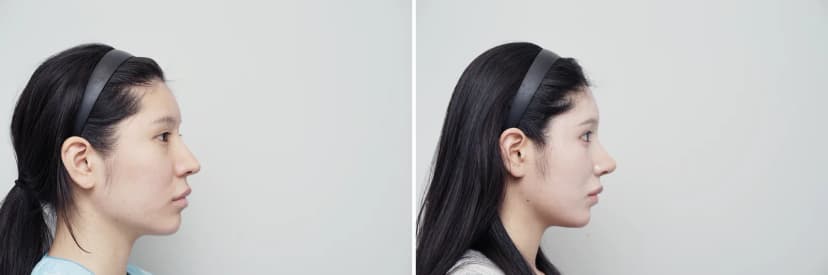
Example case (revision rhinoplasty): side view before surgery (left) and 2 weeks after (right). Procedures: revision rhinoplasty, silicone bridge implant, tip with septal and donor rib cartilage, hump reduction, osteotomy, drooping-tip correction. Results vary between individuals; swelling, bruising, asymmetry and infection are possible risks. Shared with the patient's consent.
Nose implant removal and replacement
Nose implant removal is a revision operation, and there are three common paths. Which one fits depends on the skin, the capsule and why the implant is coming out.
- Removal only. The bridge goes back down. If a capsule has contracted, the nose may not return exactly to how it looked before the first surgery.
- Replacement with a new implant. This can work when the skin and tissue are healthy and the problem was mainly the old shape or height.
- Rebuilding with your own tissue. After infection, contracture or with thin skin, the bridge is often rebuilt with rib cartilage, dermis or fascia instead. In some cases I advise letting the tissue settle before rebuilding.
TIANA also treats noses after surgery elsewhere. If you are planning a revision trip, revision rhinoplasty surgeons in Korea and how many days to plan covers the timing, and rib cartilage rhinoplasty recovery, day by day explains the chest side of rebuilding. More bridge articles are collected in all flat nose and low bridge articles.
Recovery and nights in Seoul
Recovery after a nose implant with cartilage tip work follows the same timeline as most rhinoplasty at TIANA.
| Milestone | Usual timing |
|---|---|
| Splint off and outer stitches out | Around day 7 |
| Inner stitches out | Around day 14 |
| Major swelling settles | 1 to 2 weeks |
| Looks natural to others | Around 3 to 4 weeks |
Plan about 7 to 14 nights in Seoul, and at least 7. High-concentration oxygen care is used after surgery to help swelling settle, and recovery differs between people.
If you fly home around day 7, you leave with a referral letter and a surgery certificate so a local doctor can remove the inner stitches.

Example case (bulbous tip, long nose): front view before surgery (left) and 2 weeks after (right). Procedures: silicone bridge implant, tip with septal and donor rib cartilage, bulbous tip refinement, long-nose correction, osteotomy. Results vary between individuals; swelling, bruising, asymmetry and infection are possible risks. Shared with the patient's consent.
How the bridge, tip and nostrils are planned together is on TIANA's English rhinoplasty page.
Summary
- In Korean rhinoplasty, a nose implant usually means a silicone dorsal implant on the bridge, with cartilage for the tip.
- It suits a low bridge with enough skin to cover it. Thin skin, tip-only changes or a troubled earlier implant point towards cartilage or your own tissue.
- The implant itself does not wear out. The skin and capsule around it change, so watch for redness, a visible edge, shifting or a tip being pulled up.
- Risks include show-through, shifting, capsular contracture, infection and extrusion. Height matched to the skin lowers them.
- Nose implant removal can mean removal only, a new implant, or rebuilding with rib cartilage, dermis or fascia.
Send five photos on WhatsApp (front, both 45-degree angles and both side profiles) and tell me whether you already have an implant. You'll get a free reply in English about the likely scope and how the quote is worked out. When you come to Seoul, I examine your nose, 3D-CT maps the bone and cartilage, and we decide together which materials suit you.
Frequently asked questions
Q1How long does a nose implant last?
A silicone implant does not dissolve or wear out, so there is no fixed date when it must come out. What changes over the years is the tissue around it, such as thinning skin or a tightening capsule, so have it checked if the nose starts to look or feel different.
Q2Can a nose implant be removed or replaced?
Yes, through revision surgery. The implant can be taken out alone, replaced with a new one if the tissue is healthy, or replaced with your own tissue such as rib cartilage, dermis or fascia. The choice depends on the skin, the capsule and why it is being removed.
Q3Is a silicone nose implant put in the tip?
No. At TIANA the implant sits on the bridge only. The tip is shaped and supported with cartilage, because constant pressure from an implant on thin tip skin is one of the ways an implant can push through the skin.
Q4Can I have a nose implant if my skin is thin?
Sometimes, but the height has to stay modest and the implant may need a layer of your own tissue over it. With very thin skin, raising the bridge with dermis, fascia or cartilage alone is often the safer choice. This is decided after examination and 3D-CT.
Q5How many nights should I stay in Seoul?
Plan about 7 to 14 nights, and at least 7. The splint and outer stitches usually come off around day 7 and the inner stitches around day 14. If you fly home around day 7, you leave with a referral letter and a surgery certificate.
Thank you for reading to the end.
Send 5 photos (front, 45-degree and side) on WhatsApp for a free photo consultation. We reply in English with the likely scope of surgery and how the estimate is worked out.
Send my photos on WhatsAppThis article is general information about elective cosmetic surgery and is not a diagnosis. Results and recovery vary between individuals. Before-and-after photos are published with patient consent; surgery carries risks such as swelling and bruising and requires downtime. Final procedures and fees are decided after examination.