Seoul Plastic Surgery Interpreter: Do You Need One?
Worried you'll nod along at a rhinoplasty consultation without catching half of what's said, and wondering whether you need a Seoul plastic surgery interpreter?
By the end of this guide, your questions about rhinoplasty should turn into a clear next step.
Send 5 photos (front, 45-degree and side) on WhatsApp and we will reply in English with a free first assessment: the likely scope of surgery and how the estimate is worked out.
Send my photos on WhatsAppRead this before you hire anyone or book a flight, and find more in our travel guide.
You'll learn what review threads get right and wrong about interpreters, which surgical methods the consultation will cover, what decides the cost, and what each day of the visit looks like. With that, you can decide whether you need someone beside you in the room, and which plan fits your nose and your budget.
Hello, I'm Dr. Choi Hang-seok, Head Surgeon at TIANA Plastic Surgery in Gangnam, Seoul.
TIANA is a nose-only clinic: rhinoplasty and revision rhinoplasty, nothing else. Consultations are held in English, WhatsApp replies come in English, and I handle you one-to-one from the consultation through surgery and aftercare.
I'm writing this because many people plan a nose operation abroad around finding an interpreter, when the harder question is whether they'll leave the consultation able to explain their own plan back.
If English is your language, you don't need to hire an interpreter to consult here. You need a plan you understand well enough to repeat in your own words before surgery.
If language is the worry, start in writing. Send five photos of your nose (front, 45-degree and side views) on WhatsApp, along with the one phrase you're afraid will get lost, such as “I don't want it to look done.”
Do you need a Seoul plastic surgery interpreter for rhinoplasty?
Not for English here. The consultation itself is in English, so a third person in the room is optional. Bringing a friend or partner is still sensible for another reason: two people remember a consultation better than one, especially the day after a long-haul flight.

The group I think about most is people who speak some Korean at home. The temptation is to get by in Korean. Kitchen Korean and surgical Korean are different languages, though. Words like osteotomy, septal extension or rib cartilage are hard to follow in a second language even when everyday conversation feels easy. Hold the consultation in the language you think in, and let your relative take notes rather than translate.
What gets lost when a consultation is relayed
The medical terms are rarely the problem. “Osteotomy” and “septal cartilage” have exact equivalents, and a trained interpreter can carry them. The words that slip are the aesthetic ones: “natural”, “a little smaller”, “not too high”. Passed through a third person, each of these gets rounded toward what that person thinks it means.
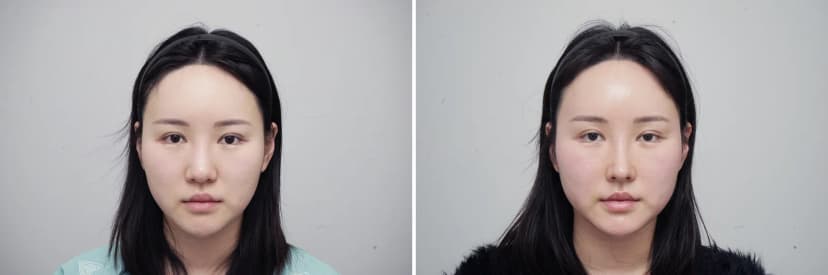
Example case (hump nose, bulbous tip): front view before surgery (left) and 2 weeks after (right). Procedures: silicone bridge implant, tip with septal and donor rib cartilage, hump reduction, bulbous tip refinement, drooping-tip correction, columella and nasolabial angle adjustment. Results vary between individuals; swelling, bruising, asymmetry and infection are possible risks. Shared with the patient's consent.
On a nose, that rounding matters. Very small differences change the whole impression of a face, and that is the reason I operate only on noses. A tip set a couple of millimetres higher than you pictured is not something a follow-up email can fix.
The US Centers for Disease Control and Prevention lists language and communication among the things to weigh before having care abroad, because misunderstandings about your care are a real risk (CDC, Medical Tourism). Their point applies whether or not an interpreter is present.
Doctor's note
What I trust more than any adjective is a picture. If you bring a reference photo, I compare it with your bone structure and set the range we can reach without forcing it. Raising only the tip, for example, tends to make it look separate from the rest of the face, so I design the bridge and tip together. That conversation works in any language, because we're both pointing at the same face.
Wondering which type your nose is?
Share your front, 45-degree and side photos — the surgeon will tell you which procedures your nose would actually need. No cost, no obligation.
Ask which procedure fits meYour consultation day and the days after, step by step
Here is the sequence the clinic's English pages describe, with one question worth asking at each step. Plan on 7 to 14 nights in Seoul, at least 7.
| When | What happens | Worth asking |
|---|---|---|
| Before you fly | Photos on WhatsApp; the reply in English explains the likely scope and how the estimate is worked out | “What else might my nose need beyond the part I'm worried about?” |
| Day 1 | In-person consultation and tests if needed; 3D-CT maps bone and nasal structure; design and cost confirmed before surgery | “Which tissue will support my tip, and why?” |
| Next day on | Nasal packing out, swelling check, prescriptions and aftercare guidance | “Which medicine is for what, and when do I stop it?” |
| Around day 7 | Progress check; splint and outer stitches come off (timing varies and is confirmed at surgery) | “What should I avoid on the flight home?” |
| Around day 14 | Inner stitches out; if you fly home on day 7, you get a referral letter and surgery certificate for a local clinic | “Who removes them at home, and what do I bring?” |
Opening hours shape day 1 more than people expect. The clinic is open weekdays 10:00 to 19:00 and Saturdays 10:00 to 16:00, and closed on Sundays and public holidays. Land on a Saturday evening and your consultation can't happen until Monday, so count that night in your stay.
Say you're 48, you grew up in Los Angeles hearing Korean at home, and the hump on your bridge has become more noticeable with age. You plan to bring your older sister because her Korean is better. My advice would be to keep the consultation in English and give your sister a different job: write down what is said about the hump, the osteotomy, and whether the tip needs work at all. Before you come, write three words for what you don't want. If “sharp”, “pinched” or “operated” is on that list, say it at the start, because it tells me more than any reference photo of a celebrity.
If you're wondering what the nights between those visits look like, I've written about the recovery room and your hotel room in Seoul.
When your dates are taking shape, send your landing date and return flight on WhatsApp with a side photo taken in daylight, and ask how many nights your scope is likely to need.
Which methods will the consultation talk about?
Knowing the names in advance is the best preparation for any consultation, in any language. Which one fits you comes down to your bone structure and your concern, not to what is in fashion.
- Tip plasty works on the tip alone: minimal-incision tip work, tip surgery without an implant, or tip support with cartilage. I've explained it in more detail in what tip plasty involves in Korea.
- Full rhinoplasty designs the bridge and tip as one profile, usually a bridge implant plus tip support. It comes up when the bridge is also low.
- Hump reduction and osteotomy smooth a bump on the bridge or narrow a wide bony bridge.
- Septal extension and columella work change tip length and the angle between nose and lip.
- Alar reduction narrows wide nostrils.
- Revision rhinoplasty rebuilds a nose after surgery elsewhere, including contracture, often with rib cartilage.
The material is a separate conversation. Options include a silicone implant and your own tissue: septal, ear or rib cartilage, donor rib cartilage, dermis and fascia. Each has its own strengths and limits, so expect to hear why one suits your skin and history better than another.
What do reviews say about interpreters in Seoul clinics?
Three claims come up again and again in public threads. Each is partly right.
“Big clinics have interpreters on hand, so language is solved.” An interpreter solves vocabulary. It doesn't stop aesthetic words from getting rounded, as above. The test is simple: at the end, can you explain your own plan back in a few sentences? If not, whether or not a Seoul plastic surgery interpreter was in the room, ask again.
“The plan grew once I was there.” I can't speak to anyone else's consultation. In general, a plan grows when what is necessary isn't kept separate from what is possible. My own position is to recommend only the scope your nose needs, and to confirm it at the exam so you don't discover after flying home that the scope was too small. Ask plainly which part is needed and which part is optional.
“You can settle everything over chat before you fly.” Partly. Photos show the likely scope. Skin thickness, how much cartilage is available and what the bone looks like need an exam and 3D-CT. If you're comparing several clinics, the questions in how to choose a clinic for eye and nose surgery in Seoul are a useful checklist.
What decides the cost of your nose surgery?
TIANA doesn't publish a fixed menu price, because two noses that look alike can need very different surgery. These are the factors that move the figure:
- Scope. Tip only, bridge and tip together, or hump reduction with osteotomy.
- Your nose. How much of your own cartilage is available and how thick your skin is.
- Primary or revision. Rebuilding after an earlier operation is a different job.
- Material. A silicone implant, your own cartilage or donor rib cartilage.
- Nights in Seoul. Not part of the surgical fee, but part of your budget: 7 to 14 nights.
A plan that looks cheaper at first can end up costing more, in money and in trips, if it needs revising. The TIANA rhinoplasty page for foreigners describes how the quote is worked out. To get a figure for your own case, ask on WhatsApp what it would cost for your nose, and attach your five photos.
Risks and side effects to know
The common reactions are temporary: swelling, bruising around the eyes, a blocked nose while the packing is in, and a numb tip. Swelling goes down at a different pace for each person. The American Society of Plastic Surgeons notes that while early swelling settles within weeks, the final contour can take up to a year to refine (ASPS, Rhinoplasty recovery). Over those months, the tip is usually the last part to settle; I've covered that in your nose tip after rhinoplasty in Seoul.
As general medicine, it's usually wiser to wait if you have an active skin infection on or near the nose, are pregnant or breastfeeding, take blood thinners that a doctor hasn't cleared you to pause, or have a medical condition that isn't under control. A trip shorter than 7 nights is also a reason to wait. Whether surgery suits you, and in what scope, is decided after the in-person examination.
If something feels wrong after you're home, such as a fever, spreading redness, bleeding that won't stop, or sudden pain or difficulty breathing, go to a local doctor or urgent care first and take your referral letter and surgery certificate with you. Then message the clinic on WhatsApp with photos. If a result needs correcting later, revision is part of what this clinic does.
If you want to see how real noses changed and how many months after surgery each photo was taken, browse TIANA's rhinoplasty case gallery before your consultation.
What to send before you book
Send the five photos (front, 45-degree and side) on WhatsApp with one question: “Which part of my nose does the plan need to change, and which part can stay as it is?” One message is enough, and you can ask questions before booking anything. When you come to Seoul, 3D-CT maps your nasal structure, I examine your nose with you in English, and I recommend the scope that fits your face.
Frequently asked questions
Q1Is the consultation at TIANA in English or through an interpreter?
The clinic's English pages state that consultations are in English and that WhatsApp replies come in English. You can still bring a friend or relative to help you take notes.
Q2How many nights should I plan to stay in Seoul?
Plan on about 7 to 14 nights, at least 7. The splint and outer stitches come off around day 7 and the inner stitches around day 14. Exact timing varies and is confirmed at surgery.
Q3What happens if I fly home on day 7?
Around day 7 you have a progress check, and the splint and outer stitches come off; the exact timing varies and is confirmed at surgery. The inner stitches normally come off around day 14, so if you fly home on day 7 you're given a referral letter and a surgery certificate so a clinic at home can remove them. Bring both to that appointment.
Q4Does TIANA also do eyelid or facial contouring surgery?
No. TIANA is a nose-only clinic and performs only rhinoplasty and revision rhinoplasty. Eyelid surgery, facial contouring and liposuction are not offered. If your question is about your nose, you can send five photos (front, 45-degree and side) on WhatsApp for a consultation, and the reply comes in English.
Q5Can I ask questions before I decide to book surgery?
Yes. You can send photos and questions on WhatsApp first, and decide about booking afterwards.
Thank you for reading to the end.
Send 5 photos (front, 45-degree and side) on WhatsApp for a free photo consultation. We reply in English with the likely scope of surgery and how the estimate is worked out.
Send my photos on WhatsAppThis article is general information about elective cosmetic surgery and is not a diagnosis. Results and recovery vary between individuals. Before-and-after photos are published with patient consent; surgery carries risks such as swelling and bruising and requires downtime. Final procedures and fees are decided after examination.