Korea Revision Rhinoplasty Surgeons? Cost, Reviews, Days
Comparing Korea revision rhinoplasty surgeons and afraid a second operation won't fit the leave you have?
By the end of this guide, your questions about rhinoplasty should turn into a clear next step.
Send 5 photos (front, 45-degree and side) on WhatsApp and we will reply in English with a free first assessment: the likely scope of surgery and how the estimate is worked out.
Send my photos on WhatsAppRead this before you fix your dates.
You'll know what decides the cost, what reviews get right and wrong, which methods fit which first-surgery problem, and how many days to plan in Seoul. Then you can tell which plan suits your nose, your budget and your calendar.
Hello, I'm Dr. Choi Hang-seok, Head Surgeon at TIANA Plastic Surgery in Seoul.
Every patient I see comes in about a nose. TIANA performs revisions after surgery at other clinics, including contracture, and I stay with you 1:1 from consultation to aftercare.
I wrote this because many people plan a revision on the calendar of a first surgery, then find the swelling has its own schedule.
Plan about 7 to 14 nights in Seoul, with at least 7. The splint and outer stitches come off around day 7 and the inner stitches around day 14, with timing confirmed at surgery.
If your dates are the sticking point, send 5 photos (front, 45-degree and side) on WhatsApp with your leave window, and ask, "Would these dates work for a nose like mine?" You'll have one clear question on the table, tied to your actual calendar.
Why a revision heals on its own clock
A first rhinoplasty works in tissue that has never been cut. A revision works through scar. The skin may be thinner in one place and stiffer in another, blood supply has already been disturbed, and the cartilage you'd normally borrow from the septum may be gone.

So the swelling usually lingers longer than it did the first time, especially at the tip. The American Society of Plastic Surgeons notes that even after a routine rhinoplasty, the contour can take up to a year to fully refine. Your trip covers the stitches and the splint. The result arrives at home, slowly.
That changes what you should look for when you compare Korea revision rhinoplasty surgeons. Reputation matters less to your spreadsheet than a clear answer to three questions: what tissue is left, where it would come from, and who you'd contact once you've flown back. These checks for choosing a rhinoplasty surgeon in Korea go further.
Your days in Seoul, one stage at a time
Here is how the stay generally runs. The clinic milestones are TIANA's. The rest is general medicine, and your own healing may run differently.
- Before surgery. Arrive with time for the exam. 3D-CT maps the bone and nasal structure, which matters more when earlier surgery has changed them. TIANA is open 10:00 to 19:00 on weekdays and 10:00 to 16:00 on Saturdays, and closed on Sundays and public holidays, so count your day 7 and day 14 against that calendar.
- Days 1 to 3. Swelling and bruising build. Your nose feels blocked, you breathe through your mouth, and you sleep with your head raised. If rib cartilage was taken, your chest is sore as well. Keep these days empty.
- Days 4 to 6. Bruises begin to change color and short walks are usually fine. Most people look more swollen than they expected.
- Around day 7. The splint and outer stitches come off. This is the earliest point to fly, and you'd go with a referral letter and surgery certificate. Your nose will still look swollen.
- Days 8 to 14. If you stay, the inner stitches come out around day 14. Extra nights also leave room if something needs a second look before a long flight.
- Back home. Visible swelling falls over the first weeks. Firmness and fine definition keep changing for months, so a tip that looks heavy at week four isn't a verdict.
Say your first surgery was six years ago, you have a silicone implant that has shifted, and you can get 10 days off. I would treat that as workable if your own tissue can do the job, and tight if rib cartilage is likely, since you'd then be healing at two sites. If you have 14 days, take them.
Wondering which type your nose is?
Share your profile and front photos — the surgeon will tell you which procedures your nose would actually need. No cost, no obligation.
Ask which procedure fits meWhich method fits which first-surgery problem?
The problem you have now drives the method, and the method drives how hard those two weeks feel. The TIANA rhinoplasty in Korea page shows the range of noses the clinic treats.
| Your problem now | What usually comes up | What it means for the trip |
|---|---|---|
| Implant shifted or visible | Replacing it, or rebuilding with your own tissue | A donor site may add soreness |
| Short, tight, upturned tip (contracture) | Releasing scar, often rebuilding with rib cartilage | Chest and nose heal together; favor the longer stay |
| Tip drooped or lost support | Cartilage support, sometimes septal extension | Septum may be used up, so ask about the source |
| Hump remains or bones look wide | Hump reduction and osteotomy | Bruising around the eyes is more likely |
The first operation's approach also matters. Scar and altered anatomy can limit what a closed approach reaches, as this look at where closed rhinoplasty stops explains. For that reason, an honest plan may change once the surgeon can see inside your nose.
Doctor's note
A revision is the moment I'm least interested in forcing more change. A nose that has been through surgery has less to give, so I look for the smallest scope that fixes what bothers you and still suits your face. Choosing on price alone can mean more money and more trips if another correction follows.
What reviews get right and wrong about revisions
"Revision always needs rib cartilage" is false. It's often used for contracture, but smaller corrections may be possible with other tissue. "You'll look normal by the time you fly" is rarely true at day 7, when most people still show swelling. "Revision is harder than a first surgery" is true medically, for the reasons above. For more on claims that spread about surgeons, see these myths about whatclinic rhinoplasty surgeons.
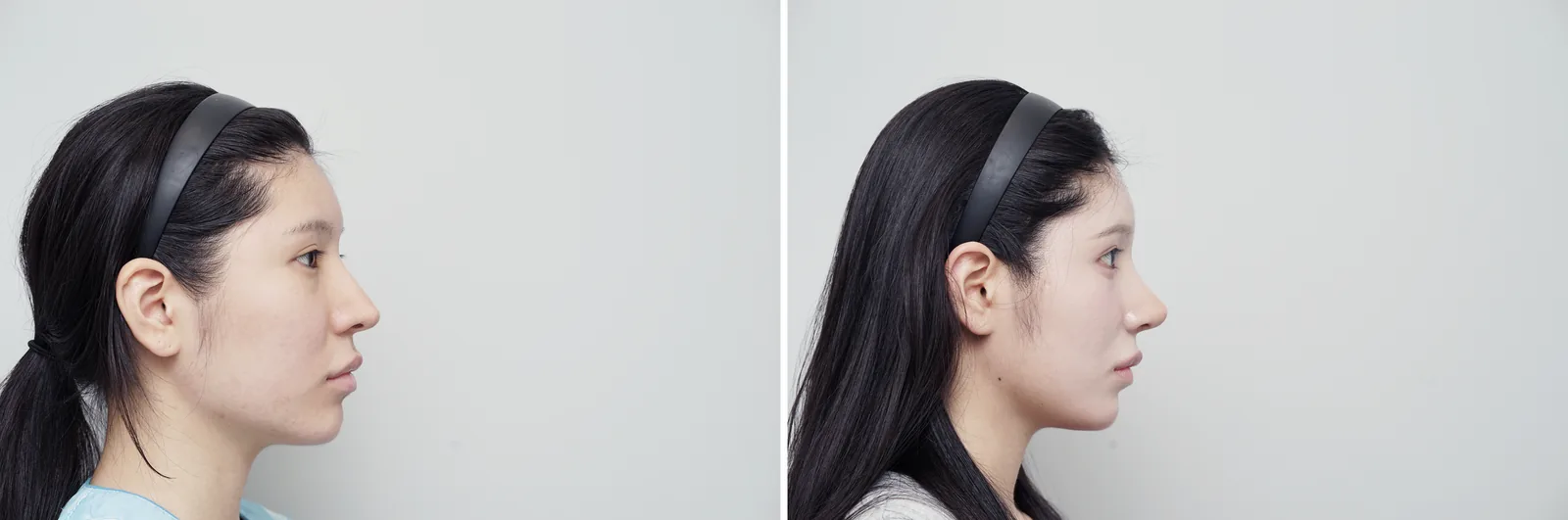
Example case (revision rhinoplasty): side view before surgery (left) and 2 weeks after (right). Procedures: revision rhinoplasty, silicone bridge implant, tip with septal and donor rib cartilage, hump reduction, osteotomy, drooping-tip correction. Results vary between individuals; swelling, bruising, asymmetry and infection are possible risks. Shared with the patient's consent.
Star counts won't tell you how a surgeon handles your particular scar tissue. Ask what they'd do with your nose and what they would refuse to do.
What decides the cost of a revision
The figure moves with the scope of correction, the cartilage available and whether rib or donor tissue is needed, how much contracture you have, your skin thickness, and how many nights you stay. A deeper breakdown is in what sets the cost of a revision in Korea. For your own figure, ask on WhatsApp what it would cost for your case, with your photos and first-surgery details.
Risks and limits to plan around
A revision carries the risks of any rhinoplasty: anesthesia risks, infection, bleeding, breathing difficulty, numbness, skin discoloration, and a result you may not be happy with. Scar tissue adds its own: contracture can return, thin skin can show irregularities, and another operation can't be ruled out. Results vary between individuals.
As general guidance, surgeons usually prefer to hold off on a revision until about a year after the last operation, unless there's an urgent problem such as infection or an exposed implant. Active infection, pregnancy, uncontrolled bleeding problems and continued smoking are also reasons to delay.
Once you're home, go to a local doctor the same day for fever, spreading redness, worsening pain on one side, or heavy bleeding. Leg swelling, chest pain or shortness of breath after your flight is an emergency. The CDC's medical tourism guidance advises arranging follow-up care and keeping copies of your records, so identify a plastic surgeon or ENT doctor at home before you leave. Carry your referral letter and surgery certificate to that visit.
To test this part of your plan, add your home city and a daylight side photo to your WhatsApp message and ask, "If I fly on day 7, what should my doctor at home know?" You'll know what to line up before your flight.
If you want to see how real noses changed and how many months after surgery each photo was taken, browse TIANA's rhinoplasty case gallery before your consultation.
What to send next
If you're still weighing Korea revision rhinoplasty surgeons, send your 5 photos on WhatsApp with the year of your last surgery, any operative notes you have, and one question: "What would it cost for my case, and how many nights should I keep open?" One message is enough, and you can ask before booking anything. When you come to Seoul, I examine your nose with 3D-CT and recommend the revision that fits what's left to work with.
Frequently Asked Questions
Q1How long after my first rhinoplasty can I have a revision?
Many surgeons prefer about a year so swelling and scar can settle, unless there is an urgent problem such as infection or an exposed implant. Tell the surgeon the exact date of your last operation.
Q2Can a different surgeon correct surgery done elsewhere?
Yes. TIANA performs revision rhinoplasty after surgery elsewhere, including difficult cases such as contracture. Your operative notes help if you have them, but many people don't, and 3D-CT shows the bone and nasal structure.
Q3Could I split a revision across two trips?
Removing an implant and rebuilding later is sometimes considered in general practice, usually when there is infection. Most planned revisions are done in one operation, so ask whether your case would need a second visit before you budget your leave.
Q4Can I consult in English before I travel?
Yes. Message in English on WhatsApp and send your photos; the reply comes in English and explains the likely scope of surgery and how the estimate is worked out.
Q5Will my nose look finished when I land at home?
Usually not. Expect visible swelling on the flight, with definition improving over months. It helps to avoid big events in the first weeks and to take photos in the same light so you can compare them over time.
Thank you for reading to the end.
Send 5 photos (front, 45-degree and side) on WhatsApp for a free photo consultation. We reply in English with the likely scope of surgery and how the estimate is worked out.
Send my photos on WhatsAppThis article is general information about elective cosmetic surgery and is not a diagnosis. Results and recovery vary between individuals. Before-and-after photos are published with patient consent; surgery carries risks such as swelling and bruising and requires downtime. Final procedures and fees are decided after examination.