Korea Revision Rhinoplasty Doctors? Cost, Reviews, Days
Comparing Korea revision rhinoplasty doctors and afraid a second operation abroad could end in a third?
By the end of this guide, your questions about rhinoplasty should turn into a clear next step.
Send 5 photos (front, 45-degree and side) on WhatsApp and we will reply in English with a free first assessment: the likely scope of surgery and how the estimate is worked out.
Send my photos on WhatsAppRead this before you book a flight.
You'll know what decides the cost, which review claims hold up, which methods a revision can call for and how many days to plan. That lets you judge which doctor and which trip fit your nose and your budget.
Hello, I'm Dr. Choi Hang-seok, Head Surgeon at TIANA Plastic Surgery in Gangnam, Seoul, and a board-certified plastic surgeon in Korea.
TIANA does rhinoplasty and revision rhinoplasty, nothing else, and that includes surgery after another clinic and contracture. I handle you 1:1 from consultation to surgery and aftercare, and 3D-CT imaging maps your bone and nasal structure before surgery.
I wrote this because people often choose a revision doctor first and plan the days last, then find their flight leaves before the inner stitches come out.
Korea revision rhinoplasty doctors should be judged on how they assess what's left inside your nose and what a rebuild would need. For the trip, plan about 7 to 14 nights in Seoul, at least 7.
Write down the one thing about your first surgery that worries you most. Then send five photos (front, 45-degree and side) on WhatsApp with that one question.
What should you ask Korea revision rhinoplasty doctors first?
A first rhinoplasty starts with untouched cartilage and skin that moves freely. A revision starts with scar tissue, cartilage that may already have been used, and skin that may have tightened. So the first thing I want to know is what was put in and what was taken out.

If you can get the operative record from your first surgeon, request it before you travel. If you can't, write down the year, whether you were told about an implant, and whether cartilage came from your ear or septum. Then put these questions to every doctor on your list:
- If my septal cartilage was already used, where would tip support come from?
- What can't change in my nose because of my skin or scarring?
- Who examines me, who operates, and who sees me afterward?
- How many nights do you want me in Seoul, and what happens if I leave on day 7?
The answers give you something you can line up side by side, and they tell you more than a gallery can. If your background shapes what you want from the result, my piece on myths about ethnic rhinoplasty doctors in Korea covers that separately.
Which methods can a revision call for?
Which method fits comes from your bone structure and your concern, and trends have no place in that choice. These are the pairings that usually come up:
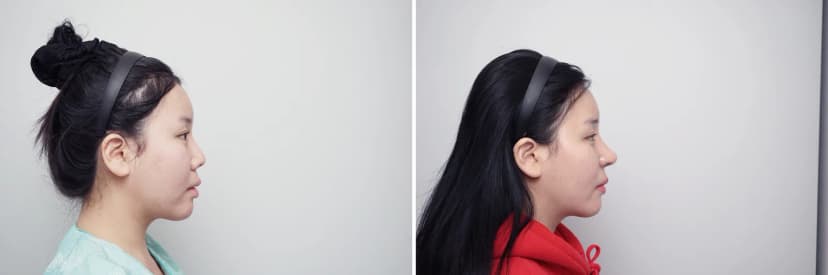
Example case (revision rhinoplasty): side view before surgery (left) and 2 weeks after (right). Procedures: revision rhinoplasty, silicone bridge implant, tip with septal and donor rib cartilage, bulbous tip refinement, short-nose correction, osteotomy. Results vary between individuals; swelling, bruising, asymmetry and infection are possible risks. Shared with the patient's consent.

| What's bothering you | What's usually discussed |
|---|---|
| Contracture, with a tight or pulled-up nose | A rebuild, often with rib cartilage |
| An earlier bridge you're unhappy with | Silicone implant or your own tissue (ear, septal or rib cartilage, dermis, fascia) |
| A remaining bump or wide bony bridge | Hump reduction and osteotomy |
| A short or upturned tip | Septal extension and columella work |
Rib cartilage can be your own or from a donor. Taking your own generally adds a small wound on the chest to care for, and any rib graft carries some risk of warping. I weigh that against how much support the nose needs, because a tip rebuilt on too little cartilage may not hold its shape under scarred skin.
I also keep the scope to what the nose needs. A revision goes better without forcing more change, and I would rather compare your reference photo with your anatomy and set a range we can reach.
Wondering which type your nose is?
Share your front, 45-degree and side photos — the surgeon will tell you which procedures your nose would actually need. No cost, no obligation.
Ask which procedure fits meWhat reviews get right and wrong
Three claims turn up again and again in forum threads about revision surgery. Here is how they hold up medically.
"Revision is harder than a first surgery." True. Scar tissue makes the layers harder to separate, and there's often less cartilage to work with.
"Rib cartilage always warps." Overstated. Warping is a known risk, which is why it belongs in the conversation, but it doesn't happen to everyone who has rib cartilage.
"You'll see the final shape when the splint comes off." False. The American Society of Plastic Surgeons says initial swelling eases within a few weeks, and that a nose can take up to a year to fully refine. Skin that has been operated on before can settle more slowly, so a verdict in week two tells you little.
How many days should a revision trip take?
Plan about 7 to 14 nights in Seoul, at least 7. The splint and outer stitches come off around day 7, and the inner stitches around day 14. That timing varies and is confirmed at surgery, so book a flight you can change.
Lay your arrival and exam on the calendar too. The clinic is open 10:00 to 19:00 on weekdays and 10:00 to 16:00 on Saturdays, and closed on Sundays and public holidays. Land on a Saturday night and the earliest exam is Monday.
Say you live in Toronto, you had a silicone implant six years ago, your tip has been getting shorter, and you have 12 nights of leave. A tip that keeps shortening raises the question of contracture, and if rib cartilage comes up, you'd have a chest wound to look after as well. Twelve nights clears the splint removal but falls short of the inner stitches. In your place I'd try to stretch the leave to 14 nights, or ask before booking how the inner stitches would be handled. There's more on how these days add up in my post on revision rhinoplasty surgeons and trip days.
Who looks after you once you're home?
If you fly home on day 7, you get a referral letter and a surgery certificate. Find a local plastic surgeon or ENT doctor before you leave and ask whether they'll see you with those papers. The CDC's advice on medical tourism also covers arranging follow-up care at home and the added blood clot risk of flying after surgery. The timing of that flight is covered in when you can fly home after closed rhinoplasty, and the same questions apply to a revision.
Send your possible travel dates and your home city on WhatsApp, and ask how many nights you should hold for a revision like yours.
What decides the cost of a revision?
TIANA doesn't publish a fixed menu price, because two similar-looking noses can need very different surgery. For a revision, these move the cost most:
- The scope: tip only, bridge and tip, or a full rebuild
- How much cartilage is available, which affects where new support has to come from
- How thick your skin is
- Whether it's a revision at all, and how much was done before
Your own side of the budget is the nights in Seoul, which follow from that scope. A lower quote that later needs correcting adds both cost and another trip, so read any estimate alongside its scope. A deposit only comes up when you book surgery.
The TIANA page for foreign rhinoplasty patients has quick answers on nights and deposits, and my post on what sets revision cost in Korea goes further into the factors. To get a figure for your case, ask on WhatsApp what it would cost, and include your photos.
The hard part of a revision
Risks and side effects to know
Swelling, bruising and a stuffy nose are common in the first weeks. The American Society of Plastic Surgeons lists the wider risks: infection, poor wound healing, breathing difficulty, numbness, a septal perforation, skin discoloration and an appearance you're unhappy with, which can mean further surgery. Korea revision rhinoplasty doctors can't remove those risks, and scarred skin can limit how far a shape can change. Results vary between individuals.
As a general rule, you may need to wait or skip surgery if:
- Your last nose surgery was recent, since many surgeons prefer to wait about a year unless something urgent is happening
- You have an active infection or an inflamed area on the nose
- You're pregnant or breastfeeding
- You smoke and can't stop around surgery, because smoking slows healing
- You have a medical condition that isn't under control
Once you're home, spreading redness, heat, fever, discharge, an exposed implant or a sudden change in shape all need a doctor promptly. Go to your local doctor with your referral letter and message the clinic as well. Chest pain, sudden shortness of breath or a swollen leg after the flight is an emergency, so call emergency services.
Doctor's note
Your fear of a third operation makes sense to me. A nose changes the face with tiny differences, and that's why I operate only on noses. If your last surgery was a few months ago and the shape is still shifting, I'd tell you not this trip, because I can't plan around a nose that hasn't settled.
If you want to see how real noses changed and how many months after surgery each photo was taken, browse TIANA's rhinoplasty case gallery before your consultation.
What to send before you book anything
Start with what you know about your first surgery: the year, the implant or cartilage if you were told, and what has changed since. Add your five photos on WhatsApp and ask what you most need answered, such as whether your tip support would need rib cartilage. You can write in English, and you can ask before booking anything. When you come to Seoul, I examine your nose with 3D-CT and recommend the plan that fits it.
Frequently asked questions
Q1Do I need my old surgery records for a revision in Korea?
They aren't always available, but they help. An operative record can show what was implanted and which cartilage was taken. If you can't get it, write down the year of surgery and whatever you were told about the materials.
Q2Can I fly home on day 7 after revision rhinoplasty?
Seven nights is the minimum to plan for, and the splint and outer stitches come off around day 7. Inner stitches come out around day 14, and the timing varies. If you leave on day 7, you get a referral letter and a surgery certificate to take to a doctor at home.
Q3How long after my first rhinoplasty can I have a revision?
Many surgeons prefer to wait about a year, since swelling and scar tissue are still changing before then. An infection, an exposed implant or a breathing problem can change that timing, so those need a doctor sooner.
Q4Will I always need rib cartilage for a revision?
No. Options include your own ear or septal cartilage, rib cartilage, dermis, fascia and silicone implants. Rib cartilage often comes up for contracture or when little other cartilage is left. Which combination suits you is decided after examination and 3D-CT.
Q5Can I talk to TIANA in English?
Yes. You can message in English on WhatsApp, and the reply comes in English.
Thank you for reading to the end.
Send 5 photos (front, 45-degree and side) on WhatsApp for a free photo consultation. We reply in English with the likely scope of surgery and how the estimate is worked out.
Send my photos on WhatsAppThis article is general information about elective cosmetic surgery and is not a diagnosis. Results and recovery vary between individuals. Before-and-after photos are published with patient consent; surgery carries risks such as swelling and bruising and requires downtime. Final procedures and fees are decided after examination.