Rhinoplasty Side Effects: Normal, Slow, or Call Now
Back home after a nose job in Seoul, with a 10-hour flight between you and your surgeon, how do you know whether what you're feeling is normal?
By the end of this guide, your questions about rhinoplasty should turn into a clear next step.
Send 5 photos (front, 45-degree and side) on WhatsApp and we will reply in English with a free first assessment: the likely scope of surgery and how the estimate is worked out.
Send my photos on WhatsAppMost rhinoplasty side effects are expected and fade on their own: swelling, bruising, a blocked nose, a numb or firm tip. A few need a doctor the same day: bleeding that won't stop with pressure, fever with spreading redness, or a nose that gets more blocked and painful instead of less.
Hello, I'm Dr. Choi Hang-seok, Head Surgeon at Tiana Plastic Surgery in Seoul and a plastic surgery specialist.
Tiana treats noses only, and I see you one to one from the consultation through surgery and aftercare, with an anesthesiologist on staff. If you fly home on day 7, before the inner stitches are due, I give you a referral letter and a surgery certificate so a doctor at home can remove them.
If you're still working out whether your leave covers the healing, send five photos of your nose and your travel dates on WhatsApp, and ask which part of the recovery has to happen in Seoul.
What's normal in the first two weeks?
Yes, it hurts, mostly as pressure and a dull ache across the middle of the face for the first few days. Pain that keeps climbing is not the usual pattern. Swelling and bruising around the eyes peak early and then fade, the nose feels blocked because its lining is swollen, and the cast makes everything feel tight. The gauze inside the nose comes out at the checks in the days after surgery.

| What you notice | What's usual | When to call a doctor |
|---|---|---|
| Swelling and bruising | Peaks in the first days, then fades | One side suddenly bigger and tense |
| Blocked nose | Both sides stuffy while the lining heals | Blocked and painful, worse each day |
| Oozing, light bleeding | Pink drainage in the first day or two | Bright red flow that won't stop with steady pressure, sitting up |
| Numb tip or upper lip | Common, returns gradually | Numbness with skin turning dark or very pale |
| Ache | Pressure for a few days | Pain rising after the first days, with fever |
Tiana has high-concentration oxygen care, used after surgery to support recovery from swelling. At home, sleeping with your head raised and not blowing your nose are the two habits that help most in the early days.
The slow ones: tip swelling, numbness and firmness
Some side effects outlast the trip by months. The American Society of Plastic Surgeons notes that while the first swelling goes down within weeks, the nose can take up to a year to refine its final contour. The tip is usually last, and thick skin holds swelling longer, which is why skin sets the limit on how far a bulbous tip can be refined.
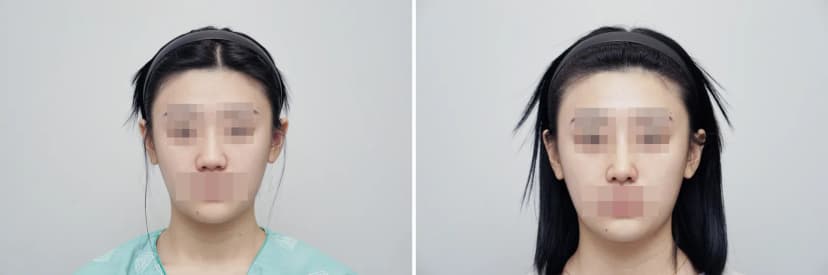
Example case (hump nose, bulbous tip): front view before surgery (left) and 2 weeks after (right). Procedures: silicone bridge implant, tip with septal and donor rib cartilage, hump reduction, bulbous tip refinement, short-nose correction, osteotomy. Results vary between individuals; swelling, bruising, asymmetry and infection are possible risks. Shared with the patient's consent; eyes and mouth are pixelated for privacy.

Numbness of the tip, and sometimes of the upper lip or front teeth, is common while small nerves recover, and it usually returns over months. A tip that feels firm when you press it is also expected for a long while. Neither one means something went wrong, and neither is a reason to judge the shape at week three.
Wondering which type your nose is?
Share your front, 45-degree and side photos — the surgeon will tell you which procedures your nose would actually need. No cost, no obligation.
Ask which procedure fits meWhich signs mean you should call a doctor today?
Bleeding that soaks through gauze and doesn't slow when you sit up and press. A fever with redness spreading across the nose or cheeks, or discharge that smells bad, which can mean infection. A painful bulge inside the nose that blocks both sides, which can be blood collecting on the septum and needs draining soon. Breathing that gets worse each day. Later on, skin over an implant that turns thin, shiny or red.
For any of these, see a local doctor or go to an emergency department first, because a photo on WhatsApp can't replace someone examining you that day. Then message Tiana on WhatsApp with photos and what the local doctor said.
Who looks after you once you're home?
Plan for 7 to 14 nights in Seoul. Around day 7 the cast and the outer stitches come off; the stitches inside the nose are due around day 14. If you leave on day 7, I give you a referral letter and a surgery certificate, and a doctor at home removes the inner stitches. Book that appointment before you fly, with an ENT or plastic surgeon who can also see you if anything in the list above comes up.
Keep a copy of every record you're given. The US Centers for Disease Control and Prevention advises anyone having surgery abroad to carry their medical records and arrange follow-up care at home before traveling. How many nights fit your surgery is covered in how many nights an Asian rhinoplasty trip needs.
If you already have a doctor at home in mind, send their city with your flight dates on WhatsApp, and ask whether day 7 or day 14 suits the surgery you're considering.
Rhinoplasty side effects that come from the design
Some outcomes people call side effects belong to the plan more than to healing: a tip that looks raised apart from the bridge, a nose that sits crooked, a bridge too high for the face, or a scar under the tip. The American Society of Plastic Surgeons lists an unsatisfactory appearance and the possibility of revision surgery among the risks, and the NHS warns that the result may not look the way you expected.
I reduce that risk in the design. If only the tip is raised, it floats away from the rest of the face, so I plan the bridge and tip together and keep the change to what your bone and skin can carry. The method follows the nose. An open approach leaves a small scar on the column between the nostrils, covered in when open rhinoplasty is needed and how the scar heals. A non-incision tip procedure keeps incisions to a minimum and tends to recover faster, though it reaches less.
Men's thicker skin and heavier structure set their own limits, which I go through in five limits for Asian male rhinoplasty. The nose types Tiana treats, from humps to short noses, are on Tiana's English rhinoplasty page.
Doctor's note
Swelling at week two looks alarming in the mirror, and it is usually the nose doing what it should. What I'd rather you weigh before surgery is the design. A nose that blends in with your face gives the healing less to fight, while a dramatic change on thick skin asks more of the tissue than it can always give.
Who should hold off on rhinoplasty?
The general reasons to wait: a nose still growing in the teens; pregnancy or breastfeeding; an active sinus or skin infection; a bleeding disorder, or blood-thinning medicine or supplements that can't be paused safely (ask your own doctor before stopping anything); and smoking you can't give up through healing. Breathing problems from allergy are worth getting under control first. Leave that can't stretch to day 7 in Seoul is a reason to move the dates, since the cast and outer stitches come off then.
Healing differs from person to person. The table and the lists above describe the usual pattern of rhinoplasty side effects, and your local doctor is the right person to say whether your nose is following it.
If you want to see how real noses changed and how many months after surgery each photo was taken, browse TIANA's rhinoplasty case gallery before your consultation.
Your first message
Send a side-view photo of your nose in daylight on WhatsApp, along with the one side effect you're most worried about, whether that's numbness, the scar or flying with swelling. You can ask before booking anything, and if English isn't comfortable for you or a parent, a medical interpreter is provided at no extra charge. In Seoul, the 3D-CT shows me your bone and airway, and that's where I start the design.
Frequently asked questions
Q1Can I fly with swelling, or with the cast still on?
Flying with swelling is generally fine. The change in cabin pressure can make the nose feel fuller and more blocked for a few hours. Most people fly after day 7, once the cast and outer stitches are off, and keep the head upright during the flight.
Q2When can I wear glasses again?
Glasses rest right on the healing bridge, so many surgeons advise avoiding heavy frames for several weeks. Contact lenses, or taping the glasses to the forehead, are the usual workaround. Ask about your own nose at the day-7 visit, since bone work changes the advice.
Q3Is a numb tip a sign of nerve damage?
Usually it is the small sensory nerves recovering from being stretched or cut, and feeling tends to return over months. Lasting numbness is listed among rhinoplasty risks but is uncommon. Numbness with the skin changing color is different and needs a doctor promptly.
Q4Does a non-incision tip procedure have fewer side effects?
It keeps incisions to a minimum, so the recovery burden is lighter and it tends to settle faster. It also changes less, so it suits a tip that needs a small refinement, not a bridge or a hump.
Q5When can I exercise after a nose job?
Gentle walking is usually fine within days. Heavy lifting, hard cardio and anything where the nose could be hit are generally put off for several weeks, because raised blood pressure can bring on swelling or bleeding.
Thank you for reading to the end.
Send 5 photos (front, 45-degree and side) on WhatsApp for a free photo consultation. We reply in English with the likely scope of surgery and how the estimate is worked out.
Send my photos on WhatsAppThis article is general information about elective cosmetic surgery and is not a diagnosis. Results and recovery vary between individuals. Before-and-after photos are published with patient consent; surgery carries risks such as swelling and bruising and requires downtime. Final procedures and fees are decided after examination.