Korea Revision Rhinoplasty: Choose by What Went Wrong
If your first nose job left the tip stiff, pinched or off to one side, how do you tell which Seoul clinic can actually rebuild it?
By the end of this guide, your questions about rhinoplasty should turn into a clear next step.
Send 5 photos (front, 45-degree and side) on WhatsApp and we will reply in English with a free first assessment: the likely scope of surgery and how the estimate is worked out.
Send my photos on WhatsAppKorea revision rhinoplasty how to choose a clinical site: start with what went wrong the first time, then look for a clinic set up to fix that particular problem. A revision is done inside scar, with whatever cartilage the first surgeon left, so no one can fully undo the first operation. What can be reached depends on your skin, your scar and the cartilage you still have.
Hello, I'm Dr. Choi Hang-seok, Head Surgeon at Tiana Plastic Surgery in Gangnam, Seoul, a plastic surgery specialist and a member of the Korean Rhinoplasty Society.
Tiana does rhinoplasty and revision rhinoplasty only, including contracture after surgery at other clinics. I consult you and I operate, one to one through aftercare. An anesthesiologist is on staff for the longer operations revisions tend to be, and the final plan is set in Seoul after a 3D-CT scan.
If you still have the operation record from your first surgery, send it on WhatsApp with five current photos of your nose: front, both 45-degree angles and both sides. The reply comes in English and explains the likely scope and how the estimate is worked out.
What did your first surgery leave behind?
Think of a revision as starting from an inventory. The first operation may have used up most of your septal cartilage, the strip inside the nose that surgeons usually take first for grafts. It may have left a silicone implant that your body has since wrapped in a capsule of scar. And as scar matures it can shrink, pulling the tip upward and making it feel hard, the pattern called contracture.

Each of these changes what's left to work with. When the septum is used up, support has to come from elsewhere: ear cartilage for small, curved grafts, rib cartilage when the nose needs length or strength. The materials I work with at Tiana are silicone implants, ear, septal, rib and donor rib cartilage, and your own dermis, fascia and fat. Rib cartilage is what I turn to when a revision is short on cartilage and in most contracture cases.
Risks and side effects to know
A review of Asian rhinoplasty in Plastic and Reconstructive Surgery Global Open describes how silicone implants can cause problems over the years, including shifting, infection and showing through the skin, and the move toward a patient's own cartilage for the tip. For a revision abroad, that puts the cartilage question ahead of almost every other one.
Korea revision rhinoplasty how to choose a clinical site: match the clinic to the problem
Rankings and photo galleries can't tell you whether a clinic can handle your nose. The problem your first surgery left can, because each one calls for different skills and materials.
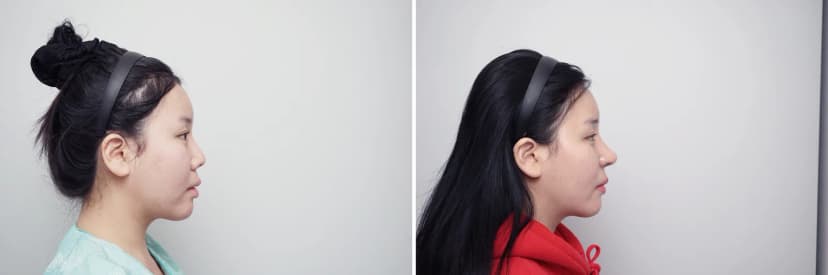
Example case (revision rhinoplasty): side view before surgery (left) and 2 weeks after (right). Procedures: revision rhinoplasty, silicone bridge implant, tip with septal and donor rib cartilage, bulbous tip refinement, short-nose correction, osteotomy. Results vary between individuals; swelling, bruising, asymmetry and infection are possible risks. Shared with the patient's consent.
| What went wrong | What a revision usually needs | What to ask the clinic |
|---|---|---|
| Implant shifted, showing or infected | Removal or replacement, often with your own tissue such as dermis or fascia for cover | Do you remove implants, and what goes in their place? |
| Tip pulled up and hard (contracture) | Scar released and strong support to lengthen, often rib cartilage | Do you take contracture cases, and is rib cartilage an option? |
| Tip narrowed too far, looks pinched | Tip support rebuilt with cartilage grafts | Where does graft cartilage come from if my septum is used up? |
| Hump left behind or bridge crooked | Bone reshaping, sometimes osteotomy | Is the bone imaged before the plan is set? |
| Breathing worse than before | Septum and airway assessed along with the shape | Is function planned together with appearance? |
Every row in that table is on Tiana's menu: revisions of surgery done elsewhere including contracture, hump reduction with bone work, functional rhinoplasty, and cartilage from the ear, septum, rib or a donor rib. You can see the nose types we treat on Tiana's English rhinoplasty page. For a fuller list of questions to put to any surgeon, see what to ask before you choose a revision surgeon.
Wondering which type your nose is?
Share your front, 45-degree and side photos — the surgeon will tell you which procedures your nose would actually need. No cost, no obligation.
Ask which procedure fits meIs it too soon for another operation?
If your last surgery was less than about a year ago, usually yes. Scar keeps remodeling for months, and operating on it while it is still firm and reddish makes the next result harder to predict, which is why many surgeons wait around twelve months. Problems that can't wait are different: an implant showing through the skin or an infection around it needs a surgeon soon.
Inside that window, the useful work is gathering records and photos. I set out the order in revision rhinoplasty step by step, and when to wait before booking, and the timing question on its own in is it too soon for a revision?
Say the first surgeon narrowed your tip too far
Say you're 36, your tip was refined at home four years ago, and it now looks pinched from the front, with the nostril rims notched upward and one side harder to breathe through. You were told at home that there isn't much cartilage left.
Here's how I'd reason about that nose. A pinched tip usually means too much tip cartilage was removed, so the skin has nothing firm to drape over and the rims fall inward. Making it smaller again won't help; it needs support put back with cartilage grafts, and if the septum was already harvested, that means ear or rib. With thin skin, every graft edge can show, so the grafts have to be shaped with soft edges and placed conservatively. The 3D-CT and the exam in Seoul show what's left before any of that is settled.
Doctor's note
A nose changes the whole face through very small differences, which is why I operate only on noses. In a revision that matters even more. I'd rather build what your tissue can carry than chase the reference photo, and I'll tell you when a second attempt should aim for less change, because a third surgery is the outcome I'm planning against.
How long will you need in Seoul?
Plan for 7 to 14 nights. The cast and outer stitches usually come off around day 7, and the stitches inside the nose around day 14. If you need to fly home on day 7, I give you a referral letter and a surgery certificate so a doctor at home can remove the inner stitches.
A revision with rib cartilage adds a second healing spot on the chest, so the longer end of that range tends to suit it; why a revision heals on its own clock goes through the reasons. Tiana is open weekdays 10:00 to 19:00 and Saturdays 10:00 to 16:00, closed Sundays and public holidays, so check where your day 7 lands before you book the return flight.
If your leave is already fixed, send the dates on WhatsApp together with how many years ago the first surgery was, and ask whether 7 nights or 14 is closer to what a revision like yours needs.
Who should wait for a revision, and what can go wrong?
Swelling, bruising, a blocked feeling and a numb tip happen after a revision as well, and they usually take longer to settle because the tissue has been operated on before. The American Society of Plastic Surgeons lists infection, breathing difficulty, poor wound healing, an appearance you aren't happy with and the possibility of further revision among the risks of rhinoplasty. Rib cartilage adds soreness at the chest donor site and a chance that the graft bends slightly as it heals.
Hold off, or rethink the plan, if your last surgery was under a year ago with no urgent problem, if there is an active infection in or around the nose, if you're pregnant, or if you smoke and can't stop through healing, since smoking slows wound healing. A reference photo your anatomy can't reach is a reason to change the goal before the trip.
After you're home, a fever with spreading redness, bleeding that won't stop, or skin over an implant turning thin or red means seeing a local doctor that day, then sending photos and their findings on WhatsApp. How a revision heals varies from person to person, so line up that local doctor before you fly.
If you want to see how real noses changed and how many months after surgery each photo was taken, browse TIANA's rhinoplasty case gallery before your consultation.
What to send first
A photo of your nose from the side in daylight and the name of your first procedure, if you know it, are enough to start. Then ask the question you'd put to any surgeon: how much of my own cartilage is left? You can ask before booking anything. If English isn't your first language, a medical interpreter is provided at no extra charge, and the deposit and how you pay are worked out only after the consultation, so you can raise both in the same WhatsApp chat. In Seoul, the 3D-CT shows me what remains of your septum and nasal bones, and that's where the design starts.
Frequently asked questions
Q1Does Tiana revise noses that were first operated on outside Korea?
Yes. Revisions of surgery done at other clinics, including contracture, are part of what Tiana does. The operation note from the first surgery helps most, because it records what was removed or implanted, which photos can't show.
Q2Will my revision use ear cartilage or rib cartilage?
It depends on how much support the nose needs. Ear cartilage is soft and curved, suited to small tip grafts. Rib cartilage gives length and strength for a contracted or short nose. Donor rib cartilage is also on Tiana's menu, and which one fits is settled at the exam in Seoul.
Q3Can an old implant just be taken out without putting a new one in?
Sometimes. Removing an implant alone usually leaves the bridge lower than it is now, and the skin needs time to settle over it. Your own tissue, such as dermis or fascia, is one way to keep some height without another implant.
Q4How many times can a nose be operated on?
There is no fixed number. It depends on the condition of the nose and how much the tissue has already been through. Each extra operation leaves more scar, so how much a further surgery can safely do is explained after the exam.
Thank you for reading to the end.
Send 5 photos (front, 45-degree and side) on WhatsApp for a free photo consultation. We reply in English with the likely scope of surgery and how the estimate is worked out.
Send my photos on WhatsAppThis article is general information about elective cosmetic surgery and is not a diagnosis. Results and recovery vary between individuals. Before-and-after photos are published with patient consent; surgery carries risks such as swelling and bruising and requires downtime. Final procedures and fees are decided after examination.