Should I Get a Nose Job? Recovery Days vs Your Leave
Should I get a nose job if all I have is a week or ten days of leave, or will I end up back at work with a splint and two bruised eyes?
By the end of this guide, your questions about rhinoplasty should turn into a clear next step.
Send 5 photos (front, 45-degree and side) on WhatsApp and we will reply in English with a free first assessment: the likely scope of surgery and how the estimate is worked out.
Send my photos on WhatsAppPlan on 7 to 14 nights in Seoul. The splint and outer stitches come off around day 7 and the inner stitches around day 14. So one week covers the minimum, as long as you can live with bruising that may still show for up to three weeks after surgery.
Hello, I'm Dr. Choi Hang-seok, Head Surgeon at TIANA Plastic Surgery in Gangnam, Seoul.
TIANA performs only rhinoplasty and revision rhinoplasty. I see you one-to-one from consultation through surgery and aftercare, so the surgeon who planned your nose is the one who checks it on day 7. Before surgery, 3D-CT maps the bone under your skin, and that shows whether bone work, with the extra bruising it brings, belongs in your plan. An anesthesiologist is on staff. You can write to us in English, and if another language is easier, a medical interpreter is provided at no extra charge.
If your leave dates are already fixed, send them on WhatsApp with one side-profile photo taken in daylight. Then ask whether your nose looks like a tip-only plan or a fuller one, because the answer changes how many nights you should book.
Is a week of leave enough for a nose job?
On paper, yes. Seven nights is the floor I plan around, because the splint and outer stitches come off around day 7. The exact day is confirmed at surgery, so treat seven as the least you can do with, not the goal.

If you fly home on day 7, you leave with a referral letter and a surgery certificate. Book that appointment before you fly to Seoul. A clinic at home with a two-week waiting list is no help when the stitches are due in seven days.
One thing most people miss: count forward from your surgery date on a real calendar. We're open weekdays 10:00 to 19:00 and Saturdays 10:00 to 16:00, and closed on Sundays and Korean public holidays.
Risks and side effects to know
With 14 nights, both sets of stitches come out in Seoul and you get a few quieter days for the bruising to fade before anyone at work sees you. That's the trade: extra nights add hotel bills, a short stay means a local appointment and a more visible face on your first day back. Nights are only one part of the budget.
The quote for the surgery itself depends on the scope, how much cartilage you have, your skin thickness and whether it's a revision, which I explain in how a nose job quote in Korea is put together.
What do your days in Seoul look like, from surgery to the flight home?
In short, this is the general pattern for rhinoplasty recovery. Your own days depend on what was done, but the order rarely changes.
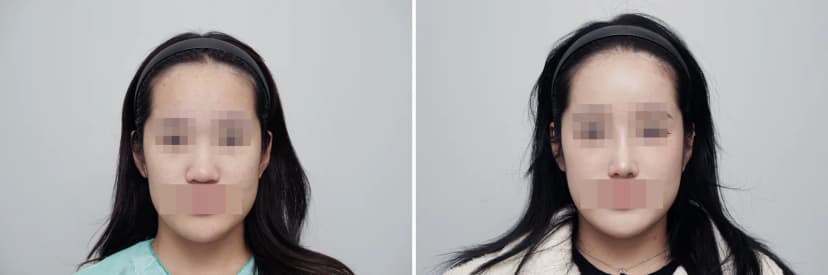
Example case (hump nose, bulbous tip): front view before surgery (left) and 2 weeks after (right). Procedures: silicone bridge implant, tip with septal and donor rib cartilage, hump reduction, bulbous tip refinement, drooping-tip correction, columella and nasolabial angle adjustment. Results vary between individuals; swelling, bruising, asymmetry and infection are possible risks. Shared with the patient's consent; eyes and mouth are pixelated for privacy.
| Days | What's happening | What fits around it |
|---|---|---|
| Day 0 | Surgery; a splint on the outside, sometimes packing inside | Rest at your hotel; have someone walk you back if you can |
| Days 1–3 | Swelling and bruising build, often peaking around day 2 or 3; your nose feels blocked | Sleep with your head raised; short walks near the hotel |
| Days 4–6 | Bruising starts to change color; you feel more like yourself | Cafés and museums at a slow pace; avoid crowds where someone could knock your nose |
| Day 7 | Splint and outer stitches off (day confirmed at surgery) | Earliest day to fly home, with your referral letter and surgery certificate |
| Weeks 3–6 | Bruising usually gone by about week 3; strenuous exercise from weeks 4 to 6 | Ease back into the gym |
| Months 2–12 | Leftover swelling, mostly in the tip | Judge the final shape after this, not before |
The last row is the one people underestimate. The NHS says swelling can take up to six months to go completely. The American Society of Plastic Surgeons notes it can come and go, and look worse in the mornings, for the first year. If you teach an 8 a.m. class, that is when your nose will look puffiest, and by late afternoon it often looks quite different.
Once you've looked at your calendar, send the two or three surgery weeks you could manage on WhatsApp, and ask which of them keeps your day 7 off a Sunday or a public holiday.
Wondering which type your nose is?
Share your front, 45-degree and side photos — the surgeon will tell you which procedures your nose would actually need. No cost, no obligation.
Ask which procedure fits meShould I get a nose job before I know what my nose needs?
Not before you know the scope, because the scope sets your recovery. Work on the tip alone, especially minimal-incision tip work, tends to recover faster. A full rhinoplasty, with a bridge implant plus tip support, is a bigger operation. If a hump has to come down or a wide bony bridge has to be narrowed with osteotomy, the bones are moved, and bruising around the eyes is usually heavier and takes longer to fade.
Which of these fits isn't decided by what's trending. It depends on your bone structure and on what actually bothers you. Raising only the tip, for example, can leave it looking detached from the rest of the face, so I plan the bridge and tip as one profile. You can see which nose types each kind of Korean nose job suits. If your concern is a round, heavy tip, how tip surgery refines a bulbous nose covers that case.
All the procedures we offer are listed on TIANA's English rhinoplasty page.
Say you're 27, teaching English in Tokyo, with a ten-day winter break and a round tip you've disliked since school. If your photos point to tip-only surgery, ten days covers day 7 with three spare days, and the inner stitches can come out at home with the referral letter.
I recommend only the scope you need, and I confirm it at the examination. The point is to make sure you don't discover after flying in that the plan was too small for what you wanted.
Doctor's note
The question "should I get a nose job" really holds two: does my nose need it, and does my calendar allow it. I would rather you wait for a longer break than shrink the plan to fit a short one. A plan that looks cheaper or shorter can turn into a revision, and a revision costs more money and more trips to Seoul than one longer stay.
What can go wrong: bleeding, blocked breathing, a second operation?
The common reactions are temporary: a blocked nose for the first days, swelling, light oozing or nosebleeds early on, a numb-feeling tip, and bruising around the eyes that the NHS says can last about three weeks. The NHS lists less common problems too: lasting breathing difficulty, damage to the cartilage wall between the nostrils, a changed sense of smell and heavy nosebleeds. Like any operation, there is also a small risk of bleeding, a blood clot, infection or an allergic reaction to the anesthetic.
As general medical advice, it is wiser to wait if your nose is still growing (most teenagers), if you have a cold or sinus infection, if you are pregnant, or if you take blood thinners or have a bleeding disorder. Smoking slows healing. The NHS also advises being sure about why you want it and taking time over the decision, and I agree. If you're doing it for someone else, wait.
How fast you heal varies, which is why the day 7 date is confirmed at surgery rather than promised now. If you're home and the bleeding is heavy, you have a fever, or redness and pain are getting worse instead of better, see a local doctor or emergency department with your surgery certificate and referral letter. Then send photos on WhatsApp. If the shape still bothers you once the swelling has settled, TIANA also performs revision rhinoplasty, including after surgery elsewhere and in contracture cases.
If you want to see how real noses changed and how many months after surgery each photo was taken, browse TIANA's rhinoplasty case gallery before your consultation.
Your reference photo is a starting point
Bring the nose you like on your phone. I compare it with your own anatomy and set a range you can reach without forcing it. A reference taken from the same angle as your own side photo is more useful than a filtered front shot. For other people's results, how to read clinic photo galleries explains what the lighting and angles can hide.
Ask one question: with this nose and these dates, are seven nights enough, or should I wait for a longer holiday? The deposit and payment method are settled after the consultation, so you can ask about them in the same chat.
Once you're in Seoul, the 3D-CT shows me whether bone work belongs in your plan, and that decides how many of your nights go to bruising and how many are free for the city.
Frequently asked questions
Q1Can I go sightseeing in Seoul while the splint is on?
Slow sightseeing from around day 4 suits many people: museums, cafés, short walks. Avoid rush-hour subways where someone could bump your nose, bending over, and carrying heavy bags. Keep the splint dry. The NHS puts strenuous exercise at 4 to 6 weeks, so leave hiking for another trip.
Q2What does a doctor at home need to remove my inner stitches?
Bring the referral letter and surgery certificate you leave Seoul with, and book the appointment for around day 14 before you travel. A general practitioner or ENT clinic can usually do it. Ask them ahead whether they will remove stitches placed by another surgeon.
Q3When will I see the final shape of my nose?
Most of the swelling goes within weeks, but the NHS says it can take up to six months to clear completely. The American Society of Plastic Surgeons says the contour can keep refining for up to a year. The tip settles last, and it often looks fuller in the mornings.
Q4What if English isn't my first language?
You can message in English on WhatsApp. If another language is easier for you, a medical interpreter for your language is provided at no extra charge, so the consultation and the aftercare instructions are in words you understand.
Q5If I'm unhappy afterwards, how soon can it be corrected?
Many surgeons wait until the swelling has settled, often months, before judging whether a revision is needed, because a swollen tip can change a lot. TIANA performs revision rhinoplasty, including after surgery at other clinics and in contracture cases.
Thank you for reading to the end.
Send 5 photos (front, 45-degree and side) on WhatsApp for a free photo consultation. We reply in English with the likely scope of surgery and how the estimate is worked out.
Send my photos on WhatsAppThis article is general information about elective cosmetic surgery and is not a diagnosis. Results and recovery vary between individuals. Before-and-after photos are published with patient consent; surgery carries risks such as swelling and bruising and requires downtime. Final procedures and fees are decided after examination.