Open Rhinoplasty in Korea: When It's Needed, Scar
Has a surgeon told you your nose "needs to be done open," and now you're wondering what that means for the scar and the trip? This guide explains open rhinoplasty from the surgeon's side of the table.
By the end of this guide, your questions about rhinoplasty should turn into a clear next step.
Send 5 photos (front, 45-degree and side) on WhatsApp and we will reply in English with a free first assessment: the likely scope of surgery and how the estimate is worked out.
Send my photos on WhatsAppThe short answer: open rhinoplasty is nose surgery that adds one small incision across the columella, the strip of skin between your nostrils. That cut lets the surgeon lift the skin of the tip and see the cartilage directly. It is usually chosen when the tip needs real support or rebuilding, and the small columella scar is the trade for that view.
Hello, I'm Dr. Choi Hang-seok, Head Surgeon at TIANA Plastic Surgery in Gangnam, Seoul.
TIANA performs only rhinoplasty and revision rhinoplasty. I handle each patient one-to-one, from consultation through surgery, anesthesia and aftercare. Before surgery, 3D-CT imaging shows the bones, septum and airway, which helps decide whether your nose needs an open or a closed approach.
What is open rhinoplasty?
Open rhinoplasty is a way of reaching the inside of the nose, not a separate kind of result. The surgeon makes incisions inside the nostrils and joins them with a short cut across the columella. The skin over the tip can then be folded up, a little like lifting a hood.
With the skin lifted, the tip cartilages, the septum and the lower bridge are in plain view. That matters because many tip changes depend on stitching cartilage grafts in exact positions, millimeter by millimeter.
In closed rhinoplasty, every incision stays inside the nostrils. The surgeon works through a narrower tunnel, partly by direct view and partly by feel. If you want the closed side of the story, six common myths about closed rhinoplasty in Korea covers it.

Why does the open approach give a better view?
The tip is the most detailed part of the nose. Its shape comes from two small curved cartilages, the strength of the septum behind them and the thickness of the skin on top.
When the surgeon can see all of that at once, three things become easier:
- Checking symmetry: both sides of the tip can be compared directly before anything is fixed
- Placing grafts precisely: a strut, a tip graft or an extension can be stitched exactly where it is needed
- Building support that lasts: grafts fixed under direct view are less likely to shift as the nose heals
Doctor's note
I don't choose open because it is "more thorough" in general. I choose it when the plan for your tip depends on stitching cartilage in a precise position. If your nose doesn't need that, I'd rather not add the columella incision.
Wondering which type your nose is?
Share your front, 45-degree and side photos — the surgeon will tell you which procedures your nose would actually need. No cost, no obligation.
Ask which procedure fits meWhen is open rhinoplasty needed, and when is closed enough?
In open vs closed rhinoplasty, the incision follows the plan, not the other way round. A useful way to think about it: is your tip a shape problem or a support problem? Light reshaping can often be done closed. Adding strength, length or rebuilt structure usually points to open.
| What your nose needs | Typical work | Usual approach |
|---|---|---|
| Low bridge only | Bridge implant or cartilage on the bridge | Often closed |
| Small hump or wide bony bridge | Hump reduction, osteotomy | Often closed |
| Tip that needs light refinement | Small cartilage changes | Can be closed |
| Short or upturned nose | Septal extension graft to bring the tip down | Usually open |
| Round tip under thick skin | Cartilage support built into the tip | Usually open |
| Tip support rebuilt with rib cartilage | Rib cartilage grafts (own or donated) | Usually open |
| Revision after earlier surgery or contracture | Scar release, new cartilage, sometimes implant removal | Usually open |
| Crooked tip or septum pulling the nose sideways | Septum straightening and support | Often open |
This is a general pattern, not a rule. Two noses with the same label can need different approaches, which is why the decision is made after examination.
Septal extension and tip support
A septal extension graft is fixed to the end of the septum to project, lengthen or angle the tip. It has to be straight and firmly stitched, so it is almost always placed through an open approach.
Rib cartilage
When septal or ear cartilage isn't enough, rib cartilage (the patient's own or donated) can be carved into grafts. Large or multiple grafts need room and a clear view. More on healing is in rib cartilage rhinoplasty recovery.
Revision and crooked noses
A nose that has been operated on before often has scar tissue, thin cartilage or contracture. The surgeon needs to see what is left before rebuilding it. A crooked nose is similar when the tilt starts in the septum or the tip; crooked nose surgery and its limits explains which layer is usually responsible.
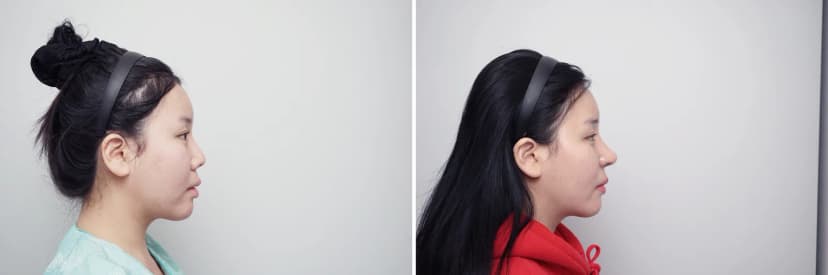
Example case (revision rhinoplasty): side view before surgery (left) and 2 weeks after (right). Procedures: revision rhinoplasty, silicone bridge implant, tip with septal and donor rib cartilage, bulbous tip refinement, short-nose correction, osteotomy. Results vary between individuals; swelling, bruising, asymmetry and infection are possible risks. Shared with the patient's consent.
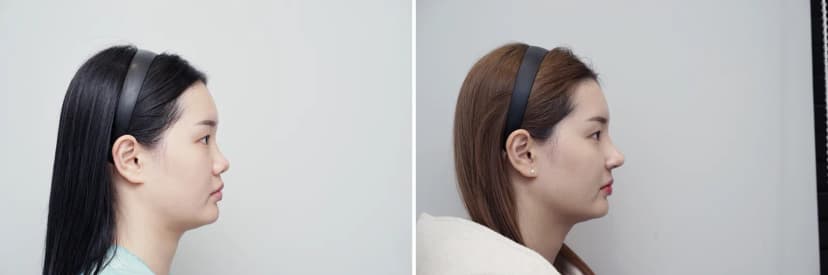
Example case (bulbous tip, short nose): side profile before surgery (left) and 3 months after (right). Procedures: silicone bridge implant, tip with septal and donor rib cartilage, bulbous tip refinement, short-nose correction, osteotomy, columella and nasolabial angle adjustment. Results vary between individuals; swelling, bruising, asymmetry and infection are possible risks. Shared with the patient's consent.
What does the open rhinoplasty scar look like?
The scar is a short line across the narrowest part of the columella. Surgeons often shape it as a small zigzag or step, so it doesn't heal as one straight line that catches the eye.
In most people it settles into a fine line that is hard to notice at a normal distance, especially from the front. It can look pink or slightly raised at first and usually fades over the following months. How it heals depends on your skin type, how carefully the edges are closed and how you look after it.
A few honest points:
- No surgeon can promise the scar disappears. It becomes less visible; it does not vanish.
- Some people scar more. If you have a history of thick or raised scars, tell the surgeon at consultation.
- Aftercare helps. Keep the stitches clean, follow the instructions you're given and protect the area from strong sun while it is still pink.
In consultation, patients often tell me the scar is the thing they fear most. My answer is that the scar is small, but it is real, so it should only be there if the open approach changes your result enough to be worth it.
Open rhinoplasty recovery: stitches, swelling and your stay
Stitches and splint
The stitch schedule is the same as for other rhinoplasty at TIANA. The splint and outer stitches, including the columella stitches, usually come off around day 7. The stitches inside the nose come out around day 14. Timing varies between people and is confirmed at surgery.
Plan on 7 to 14 nights in Seoul, and at least 7. If you fly home around day 7, you leave with a referral letter and a surgery certificate so a local doctor can remove the inner stitches. How long rhinoplasty takes to heal walks through time off work.
Swelling compared with closed
Open rhinoplasty swelling follows the same broad pattern: major swelling tends to settle over 1 to 2 weeks, and the nose usually starts to look natural at around 3 to 4 weeks. After open rhinoplasty, the tip often stays a little fuller for longer than the bridge, because the tip skin was lifted and the tip usually received the most work.
Much of that difference comes from scope rather than the incision itself. A closed bridge-only case and an open case with rib cartilage and septal extension are very different operations, so compare your own plan, not the label.
What are the risks of open rhinoplasty?
Open rhinoplasty carries the general risks of nose surgery, plus a few linked to the columella incision. The American Society of Plastic Surgeons lists the general rhinoplasty risks.
- Swelling, bruising and bleeding
- Infection
- Numbness of the tip, which usually improves over time
- A visible or thickened columella scar
- Slow healing at the edges of the columella incision
- Asymmetry, or grafts that shift or warp as the nose heals
- A blocked feeling while swelling lasts
- The need for revision in some cases
Tell the surgeon about smoking, past nose surgery or injury, and any blood-thinning medicine or supplements. Don't stop prescribed medicine on your own; ask your prescribing doctor.
How TIANA decides between open and closed
For open rhinoplasty in Korea, as anywhere, the approach is the last decision, not the first. I start with what your nose needs: the bridge height, the tip shape and support, the septum, the skin thickness and any earlier surgery.
- Photo or video consultation first. Send five photos on WhatsApp: front, both 45-degree angles and both side profiles. You can also book a free video consultation on Google Meet with an interpreter (Dr. Choi first, then our consultation manager for the quote).
- Examination and 3D-CT in Seoul. At the in-person visit, I examine the nose and 3D-CT shows the bones, septum and airway.
- One plan, explained. I tell you which parts can be done closed, which need open and why. The final plan and quote are given at that visit.
| Question to ask any surgeon | Why it matters |
|---|---|
| Which part of my nose needs open access? | It shows whether the plan is driven by your tip or by habit |
| Is my tip a shape problem or a support problem? | Support work usually points to open |
| Which cartilage will you use? | Septal, ear or rib cartilage changes the scope |
| How will the columella scar be closed and cared for? | Tells you how the incision is planned |
| How long should I stay in Seoul? | Stitch removal around day 7 and day 14 sets your trip |
More articles on approaches and planning are in all Korean rhinoplasty articles, and how the bridge and tip fit into one design is on TIANA's English rhinoplasty page.
Summary
- Open rhinoplasty adds a small columella incision so the tip cartilage can be seen and grafts stitched precisely.
- It is usually chosen for septal extension, rib cartilage, revision, a crooked tip or a tip that needs strong support. A low bridge or small hump can often be done closed.
- The columella scar usually fades to a fine line, but it does not disappear completely.
- Outer stitches come out around day 7 and inner stitches around day 14; plan 7 to 14 nights in Seoul.
- Tip swelling often lasts longer after open surgery, mostly because more tip work was done.
Send five photos on WhatsApp (front, both 45-degree angles and both side profiles) and tell us whether a surgeon has already suggested open rhinoplasty. You'll get a reply in English with the likely scope and how the quote is worked out, and you can book a free Google Meet video consultation from there.
Frequently asked questions
Q1What is open rhinoplasty?
Open rhinoplasty is nose surgery that adds a small incision across the columella, the strip of skin between the nostrils, to the incisions inside the nose. The skin of the tip is then lifted so the surgeon can see the cartilage directly and stitch grafts in exact positions.
Q2Does open rhinoplasty leave a visible scar?
It leaves a short line across the columella. In most people it heals as a fine line that becomes hard to notice at a normal distance over the following months, but no surgeon can promise it disappears. How it heals depends on your skin and on aftercare.
Q3Is open rhinoplasty recovery longer than closed?
The stitch schedule is the same: the splint and outer stitches around day 7 and the inner stitches around day 14. Tip swelling often takes longer to settle after open surgery, mainly because open cases usually involve more tip work. Plan 7 to 14 nights in Seoul, and at least 7.
Q4When is open rhinoplasty better than closed?
Open rhinoplasty is usually chosen when the tip has to be supported, lengthened or rebuilt: septal extension grafts, rib cartilage, revision after earlier surgery or a crooked tip. A low bridge or a small hump can often be treated closed. The decision follows the examination.
Q5Can I find out before I fly whether I need open rhinoplasty?
You can get an early opinion. Send five photos on WhatsApp, or book a free video consultation on Google Meet with an interpreter (Dr. Choi first, then our consultation manager for the quote). The final plan is decided in Seoul after examination and 3D-CT.
Thank you for reading to the end.
Send 5 photos (front, 45-degree and side) on WhatsApp for a free photo consultation. We reply in English with the likely scope of surgery and how the estimate is worked out.
Send my photos on WhatsAppThis article is general information about elective cosmetic surgery and is not a diagnosis. Results and recovery vary between individuals. Before-and-after photos are published with patient consent; surgery carries risks such as swelling and bruising and requires downtime. Final procedures and fees are decided after examination.