Crooked Nose Surgery in Korea: Causes and Limits
Does your nose lean to one side in photos, or does the tip point slightly away from the center of your face? If you're searching for crooked nose surgery, you probably want to know whether it can be fixed and how straight it can really get.
By the end of this guide, your questions about rhinoplasty should turn into a clear next step.
Send 5 photos (front, 45-degree and side) on WhatsApp and we will reply in English with a free first assessment: the likely scope of surgery and how the estimate is worked out.
Send my photos on WhatsAppThe short answer: crooked nose surgery straightens the part of the nose that is actually off center. That may be the nasal bones, the septum inside the nose or the tip cartilage, and often it is a mix. The realistic goal is a clearly straighter nose, not perfect symmetry.
Hello, I'm Dr. Choi Hang-seok, Head Surgeon at TIANA Plastic Surgery in Gangnam, Seoul.
TIANA performs only rhinoplasty and revision rhinoplasty. I handle each patient one-to-one from consultation through surgery, anesthesia and aftercare. Before surgery, 3D-CT imaging shows the bones, septum and airway, so we can see where the tilt starts.
If you'd like an early opinion, send five photos on WhatsApp: front, both 45-degree angles and both side profiles.
What is a crooked nose?
A crooked nose is a nose whose midline does not run straight from between the eyebrows to the tip. Surgeons often call it a deviated nose. It is a shape problem first, though it can come with a breathing problem.
Think of the nose as three layers stacked from top to bottom:
- The bony pyramid: the nasal bones that form the upper third of the bridge
- The septum: the wall of cartilage and bone that divides the nose and holds up the middle and lower nose
- The tip cartilages: the paired cartilages that shape the tip and nostrils
Any one of these can lean, twist or be uneven. When people ask about crooked nose correction, the first question I answer is which layer is responsible.

What makes a nose look crooked?
The cause decides the surgery. A nose that looks crooked from the outside can have very different problems on the inside.
| Where the tilt starts | What you might notice | What surgery usually addresses it |
|---|---|---|
| Nasal bones shifted | The upper bridge leans to one side; often after an injury | Osteotomy to reposition the bones |
| Deviated septum | The middle or lower nose curves, sometimes in a C or S shape; one side may feel blocked | Septoplasty, plus cartilage support to hold the middle nose straight |
| Uneven tip cartilage | The tip points off center or one nostril looks different | Reshaping or repositioning the tip cartilage, sometimes with grafts |
| A mix of these | The bridge leans one way and the tip another | A combined plan for each layer |
Doctor's note
Many people assume a crooked nose means a broken bone. In consultation I often find the bones are fairly straight and the septum is pulling the lower nose to one side. Straightening only the bones in that case would leave the nose still crooked.
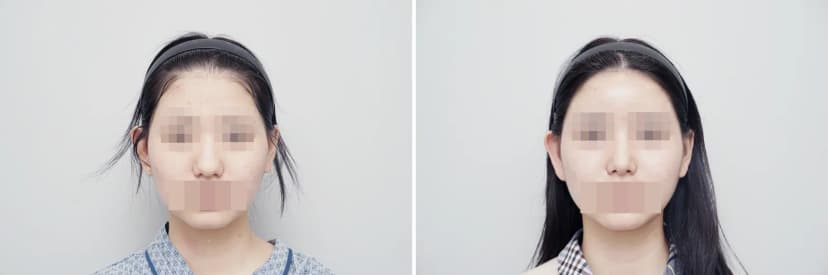
Example case (hump nose, bulbous tip): front view before surgery (left) and 2 weeks after (right). Procedures: silicone bridge implant, tip with septal and donor rib cartilage, hump reduction, bulbous tip refinement, osteotomy, crooked-nose correction. Results vary between individuals; swelling, bruising, asymmetry and infection are possible risks. Shared with the patient's consent; eyes and mouth are pixelated for privacy.
Wondering which type your nose is?
Share your front, 45-degree and side photos — the surgeon will tell you which procedures your nose would actually need. No cost, no obligation.
Ask which procedure fits meInjury or born that way: does it matter?
Both are common. A nose can become crooked after a fall, a sports injury or an accident, or it can grow that way with no clear event.
The cause matters less than what the injury or growth left behind. An old injury often shifts the nasal bones and bends the septum at the same time, so both layers need work. A nose that grew crooked more often involves the septum and the tip cartilage.
If your nose was injured recently, tell the surgeon when it happened. Swelling from a fresh injury hides the real shape, and the timing of surgery is decided after examination.
How does crooked nose surgery work?
Crooked nose surgery is a form of rhinoplasty that targets alignment. The surgeon works on each layer that is off, in an order that lets the result hold.
Bones: osteotomy
When the bony pyramid leans, osteotomy repositions it. The nasal bones are cut in a controlled way and moved toward the midline. The same technique narrows a wide bony bridge and closes the gap after hump reduction, which is why it often appears in hump nose surgery as well.
Septum: septoplasty and support
When the septum is bent, septoplasty straightens it or removes the bent part. Because the septum holds up the middle and lower nose, the surgeon may add cartilage grafts along it to keep it straight while it heals. Spare septal cartilage can also serve as graft material for the tip.
The septum also affects breathing. If one side of your nose is blocked most of the time, deviated septum surgery and breathing explains when an ENT doctor is the better first stop and when the septum is fixed during rhinoplasty.
Tip: cartilage reshaping
A crooked or asymmetric nose tip usually comes from uneven tip cartilages or a septum that pushes the tip sideways. The cartilages can be reshaped, stitched into a more even position or supported with grafts. Cartilage options include septal, ear and rib cartilage (the patient's own or donated).
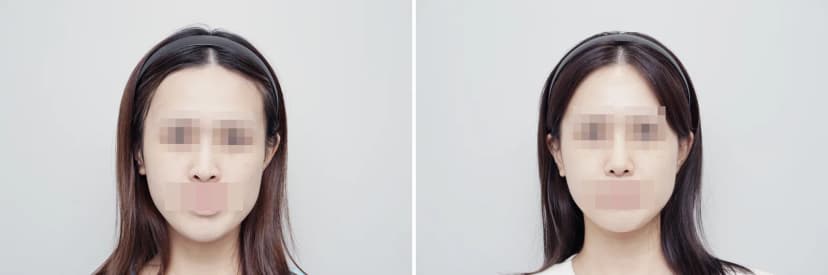
Example case (implant-free rhinoplasty, short nose): front view before surgery (left) and 2 weeks after (right). Procedures: implant-free bridge with septal cartilage, tip with septal and the patient's own rib cartilage, short-nose correction, crooked-nose correction, columella and nasolabial angle adjustment, nostril rim lowering. Results vary between individuals; swelling, bruising, asymmetry and infection are possible risks. Shared with the patient's consent; eyes and mouth are pixelated for privacy.
How straight can a crooked nose get?
This is the most important expectation to set before surgery. Crooked nose surgery can make a clear difference, but it cannot promise a perfectly straight, perfectly symmetrical nose.
There are three reasons:
- Cartilage has memory. A septum that has been bent for years can drift slightly back toward its old shape as it heals.
- Faces are not symmetrical. The cheeks, eyes and jaw are often slightly uneven, which changes how straight the nose looks.
- Healing differs. Swelling settles unevenly at first, and scar tissue forms differently in each person.
In consultation, patients often ask me for a perfectly straight nose. My honest answer is that I aim for a nose that reads as straight at a normal glance and fits your face. A little residual asymmetry is common, and it is not the same as a failed result.
The more layers involved and the stronger the bend, the more likely some asymmetry remains. 3D-CT before surgery helps me explain what is realistic for your nose before you decide.
Is crooked nose surgery right for you?
Use these questions as a quick self-check before you message a clinic.
| Question | Why it matters |
|---|---|
| Does the tilt start at the top, the middle or the tip? | It points to bones, septum or tip cartilage |
| Was your nose ever injured, and when? | Old injuries often involve bones and septum together |
| Is one side blocked most of the time? | The septum may be affecting breathing too |
| Have you had nose surgery before? | Revision changes the plan and the cartilage available |
| Would a clear improvement satisfy you, even if not perfect? | Perfect symmetry is not a realistic target |
If you have had rhinoplasty before and the nose has shifted, the plan follows revision principles. How revision rhinoplasty is planned, step by step explains the order of decisions.
Recovery, risks and revision
Recovery and stitches
Plan on about 7 to 14 nights in Seoul, and at least 7. The splint and outer stitches usually come off around day 7, and the stitches inside the nose around day 14. Major swelling tends to settle over 1 to 2 weeks, and the nose usually starts to look natural at around 3 to 4 weeks.
This varies between people and is confirmed at surgery. If you fly home around day 7, you leave with a referral letter and a surgery certificate so a local doctor can remove the inner stitches. More on planning is in how long to stay in Seoul for rhinoplasty.
Risks
Possible risks include swelling, bruising, bleeding, infection, numbness, a blocked feeling while swelling lasts, residual or recurring asymmetry, and a change in how the tip is supported. The American Society of Plastic Surgeons lists these among rhinoplasty risks.
Tell the surgeon about any past nose injury or surgery, and about blood-thinning medicine or supplements. Don't stop prescribed medicine on your own; ask your prescribing doctor.
Revision
Sometimes the nose drifts again as cartilage heals, or a small asymmetry remains that bothers you. Revision is possible in some cases, but it is planned only after the nose has healed, and how much can be improved depends on the tissue and cartilage left. More articles on this topic are in all crooked nose and septum articles.
How the bridge, tip and septum fit into one design is on TIANA's English rhinoplasty page.
Summary
- Crooked nose surgery works by fixing the layer that is off: the nasal bones, the septum or the tip cartilage.
- Shifted bones are treated with osteotomy, a bent septum with septoplasty and support, and an uneven tip with cartilage reshaping.
- Injury and natural growth can both cause a crooked nose; old injuries often involve more than one layer.
- Expect a clear improvement rather than perfect symmetry; some residual asymmetry is common.
- Plan 7 to 14 nights in Seoul, and at least 7.
Send five photos on WhatsApp (front, both 45-degree angles and both side profiles) and tell us when the tilt started and whether breathing bothers you too. You'll get a reply in English with the likely scope and how the quote is worked out. When you come to Seoul, I examine your nose, 3D-CT maps the bones and septum, and we decide the plan together.
Frequently asked questions
Q1What causes a crooked nose?
A nose looks crooked when one or more of its three layers is off center: the nasal bones at the top, the septum in the middle, or the tip cartilages at the bottom. It can follow an injury or be the way you were born. Often more than one layer is involved.
Q2Can a crooked nose be made perfectly straight?
The realistic goal is a clear improvement, not perfect symmetry. Cartilage has memory and can drift slightly as it heals, and no face is fully symmetrical. A surgeon who promises a perfectly straight result is promising something surgery cannot control.
Q3Does crooked nose surgery also help breathing?
It can, when a deviated septum is part of the cause and is narrowing one airway. Straightening the septum during rhinoplasty may improve airflow as well as shape. If breathing is your only concern, an ENT doctor is usually the right first stop.
Q4Is osteotomy always needed for a crooked nose?
No. Osteotomy, a controlled cut of the nasal bones, is needed when the bony upper part of the nose leans to one side. If the tilt starts in the septum or the tip, the work focuses there instead. 3D-CT helps show which layer is off.
Q5How long should I stay in Seoul after crooked nose surgery?
Plan about 7 to 14 nights, and at least 7. The splint and outer stitches usually come off around day 7, and the inner stitches around day 14. Timing varies between people and is confirmed at surgery.
Thank you for reading to the end.
Send 5 photos (front, 45-degree and side) on WhatsApp for a free photo consultation. We reply in English with the likely scope of surgery and how the estimate is worked out.
Send my photos on WhatsAppThis article is general information about elective cosmetic surgery and is not a diagnosis. Results and recovery vary between individuals. Before-and-after photos are published with patient consent; surgery carries risks such as swelling and bruising and requires downtime. Final procedures and fees are decided after examination.