Korea Revision Rhinoplasty Procedure Steps in Order?
Korea revision rhinoplasty procedure steps in order: if your first nose job left an implant you can see under the skin, or a tip that has slowly turned upward, are you afraid a second surgery abroad will repeat the same mistakes?
By the end of this guide, your questions about rhinoplasty should turn into a clear next step.
Send 5 photos (front, 45-degree and side) on WhatsApp and we will reply in English with a free first assessment: the likely scope of surgery and how the estimate is worked out.
Send my photos on WhatsAppRead this before you book a flight to Seoul.
By the end you'll know which step really comes first in a revision, what decides the cost, which review claims hold up, and what recovery and the flight home look like. That's enough to judge whether this trip fits your nose and your budget, or whether to wait.
Hello, I'm Dr. Choi Hang-seok, Head Surgeon at TIANA Plastic Surgery in Gangnam and a board-certified plastic surgeon in Korea.
TIANA performs only rhinoplasty and revision rhinoplasty, including surgery after another clinic and contracture. I handle you 1:1 from consultation through surgery and aftercare, and 3D-CT imaging maps your bone and nasal structure before anything is planned.
I'm writing this because many people treat a revision as the first operation done again, and plan the whole trip around the surgery date.
In order, a revision goes: your surgical history, a decision on timing, an in-person exam with 3D-CT, a plan that names the material, surgery, early checks, then the splint and outer stitches off around day 7 and the inner stitches around day 14.
If you can, send what you know about your first operation on WhatsApp (roughly when it was, and whether an implant or cartilage was used), plus the one question that worries you most about going again.
Why doesn't a revision start on the operating table?
Because the biggest unknown is what's already inside your nose. After a first rhinoplasty, cartilage may have been removed or moved, an implant may sit inside a capsule of scar tissue, and the skin may have tightened over it.

That inventory shapes every step after it. If septal cartilage was used the first time, there may be little left to borrow, and support has to come from somewhere else: ear cartilage, rib cartilage, dermis or fascia. When I rebuild a nose after surgery at another clinic, especially with contracture, rib cartilage is often what I rebuild it with.
This is also why a surgeon at home and a surgeon in Seoul can look at the same nose and say different things. One may weigh thin, scarred skin and decide the risk is too high; another may see enough tissue to work with. A 'difficult' at home is a reason to ask which tissue is the problem. It isn't a reason to keep looking until someone says yes.
Korea revision rhinoplasty procedure steps in order, from first message to inner stitches
The sequence below follows TIANA's stay plan. The days shown are the usual ones; the timing varies from person to person and is confirmed at surgery.
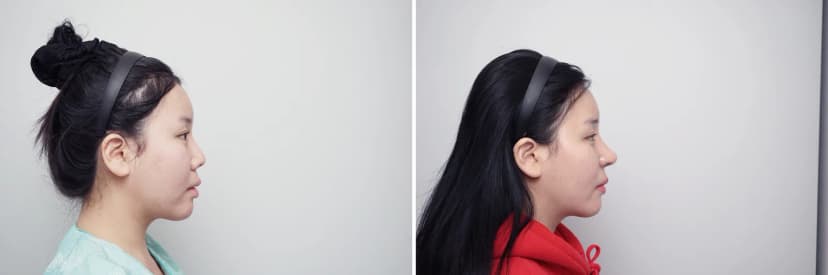
Example case (revision rhinoplasty): side view before surgery (left) and 2 weeks after (right). Procedures: revision rhinoplasty, silicone bridge implant, tip with septal and donor rib cartilage, bulbous tip refinement, short-nose correction, osteotomy. Results vary between individuals; swelling, bruising, asymmetry and infection are possible risks. Shared with the patient's consent.

- Your history and photos. What was done, when, and what has changed since. Five photos: front, 45 degrees and side.
- Timing. Whether the tissue has settled enough to operate on again (the next section covers this).
- Day 1 in Seoul: consultation and exam. A face-to-face consultation, tests where needed and 3D-CT imaging. The design and the cost are confirmed with you, then surgery.
- A plan that names the material. The bridge can be raised with a silicone implant or your own tissue (ear, septal or rib cartilage, dermis or fascia), and tip projection is supported with cartilage. If an old implant is the source of the problem, the plan also says whether it comes out and what replaces it.
- Surgery. What happens in the operating room itself is covered in rhinoplasty procedure steps on surgery day.
- The following days. The gauze inside the nose comes out, swelling is checked, medication is prescribed and you get aftercare instructions.
- Around day 7. The splint and outer stitches come off.
- Around day 14. The inner stitches come out. If you fly home on day 7, you leave with a referral letter and a surgery certificate so the inner stitches can be removed at home.
The clinic is open 10:00 to 19:00 on weekdays and until 16:00 on Saturdays, and closed on Sundays and public holidays. Land on a Saturday evening and your first visit will be Monday.
For a first rhinoplasty, the same days look slightly different from the traveler's side, and the step-by-step trip days for a first rhinoplasty lay them out. In a revision, steps 1, 2 and 4 take longer to get right, and they decide whether step 5 belongs on this trip at all.
Wondering which type your nose is?
Share your front, 45-degree and side photos — the surgeon will tell you which procedures your nose would actually need. No cost, no obligation.
Ask which procedure fits meWhen would I tell you not to book yet?
When the nose hasn't finished healing from the first surgery, when something needs treatment now, or when what you want goes further than your skin and tissue can safely stretch.
Timing first. Swelling and scar tissue keep changing for many months after rhinoplasty. The American Society of Plastic Surgeons notes that it can take up to a year for the nasal contour to fully refine, and many surgeons prefer to wait about that long before revising. A small bump at month five may not be the shape you have at month twelve.
Some problems shouldn't wait for a holiday. An implant pressing through thin skin, redness that won't settle, or drainage from the nose need a doctor soon, usually at home first.
Then there's reach. I compare the reference photo you bring with your anatomy and set only the range your nose can reach without strain. If the photo asks for more height or length than tight, scarred skin can cover, I'd rather tell you that than design a plan that pulls on the tissue.
Say your first rhinoplasty was four years ago with a silicone implant, and over the past year the tip has turned upward, the nose looks shorter, and the skin over the tip feels tight and looks shiny. That pattern makes me think of contracture. The conversation would usually turn to removing the implant and rebuilding length with your own cartilage, often rib, and I'd suggest planning nearer 14 nights than 7. Now say the first surgery was five months ago and what bothers you is a slight asymmetry. I'd ask you to wait and send new photos later, because that shape may still change.
Doctor's note
A revision is usually a second trip and a second budget. That's why I recommend only the scope your nose actually needs, and confirm it at the exam, so you don't find out after flying home that the plan stopped short. A plan that looks cheaper but leads to another correction ends up costing more money and more trips. Waiting a few months can be what saves you a third flight.
If you want a quick overview of how nights, quotes and revisions work before reading further, the short answers on TIANA's English rhinoplasty page cover them.
What decides the cost of a revision?
What has to be rebuilt decides it more than the word 'revision' does.
First, what comes out: removing an old implant and its capsule adds work. Second, what goes in and where it comes from. Septal or ear cartilage, rib cartilage, dermis, fascia and silicone implants each mean a different operation. Third, how much of the nose is involved: the tip alone, the bridge as well, or bone work such as osteotomy for a wide or crooked bridge. Fourth, the state of the tissue, since contracture and thin skin call for slower work. Fifth, your days in Seoul: at least 7 nights and up to 14, with the hotel and time off that come with them.
The final fee is confirmed after examination, because the plan comes from the exam. Photos are enough for a first estimate, though, and planning a revision trip with revision rhinoplasty doctors in Korea covers how flights fit around that. Ask on WhatsApp what it would cost for your case, with your five photos and a line on what the first surgery involved.
What do reviews of revision rhinoplasty in Korea get right?
Some of it. A few claims come up again and again in review threads and forums.
'Revision is harder than the first surgery.' Mostly true. Scar tissue, less cartilage to borrow and skin that has already been lifted once all make the operation slower and the healing less predictable.
'You'll see your final nose when the cast comes off.' Not true. The splint comes off around day 7, but swelling takes much longer to settle, and after a revision the tip is often the last part to settle because of the scar tissue underneath.
'Rib cartilage always warps and leaves a big chest scar.' Partly true. Warping is a known risk of rib grafts and surgeons carve and place them to reduce it, and taking rib does leave a small scar on the chest. Whether you need rib at all depends on what's left in your nose.
A review describes one person's nose at one moment. It can't tell you what your own tissue will allow.
Recovery after a revision, and the flight home
Plan 7 to 14 nights in Seoul, with 7 as the minimum. Swelling settles at a different pace for everyone, so I don't give one fixed recovery period. I guide each person from their progress photos.
In the first week, bruising, puffiness around the eyes and a blocked feeling in the nose are common. Many people feel ready to go out once the splint is off, even though the nose is still swollen. If you're deciding between flying home on day 7 or staying to day 14, planning trip days around a revision walks through both.
Risks and side effects to know
Common, temporary reactions: swelling and bruising for the first weeks, a stuffy nose, some numbness of the tip and, if rib cartilage was taken, soreness at the chest. These usually ease over weeks, with the last tip swelling taking months. The American Society of Plastic Surgeons also lists infection, nosebleeds, breathing difficulty, asymmetry, scarring and the possibility of further surgery, and the NHS notes that a nose may not turn out as expected.
Who should usually wait or skip it for now: anyone whose last nose surgery was recent enough that the tissue is still changing, anyone with an active infection or an implant pressing through the skin, people who are pregnant, and people with uncontrolled medical conditions or bleeding problems. Smoking slows healing, and it's wise to tell the surgeon about any blood-thinning medicine. Suitability is decided at the in-person exam.
If something appears after you fly home, such as fever, spreading redness, increasing pain or heavy bleeding, see a doctor near you promptly and bring your referral letter and surgery certificate. The CDC's medical tourism guidance also suggests keeping copies of your records and arranging follow-up care at home before you travel.
Before you message, take your five photos in daylight, including a straight side view, and add the month and year of your last surgery. Then ask the question that matters most for timing: is my nose settled enough to revise now?
If you want to see how real noses changed and how many months after surgery each photo was taken, browse TIANA's rhinoplasty case gallery before your consultation.
Your first message, and what to put in it
You don't need a full medical file to start. One message on WhatsApp with your travel window and whatever you remember about the first operation is enough, you can write in English, and you can ask before booking anything. When you come to Seoul, I examine your nose in person with 3D-CT and recommend the scope that fits it.
Frequently asked questions
Q1How long after my first rhinoplasty should I wait before a revision?
Many surgeons prefer to wait about a year, because swelling and scar tissue keep changing for months and the shape you dislike now may still shift. Problems such as an implant pressing through the skin or signs of infection are different and need a doctor soon, usually at home first.
Q2Will I need rib cartilage for a revision?
Not always. If septal cartilage is still available, or ear cartilage, dermis or fascia is enough, rib may not be needed. Revisions after surgery elsewhere, especially with contracture, are often rebuilt with rib cartilage. Which material suits you is decided after 3D-CT and a full consultation.
Q3Can an old implant be removed and replaced in the same operation?
Often the implant is removed and the nose rebuilt in one operation. When there is active infection, many surgeons remove the implant first and rebuild later, once the tissue has calmed down.
Q4How many nights should I stay in Seoul for a revision?
Plan on about 7 to 14 nights, at least 7. The splint and outer stitches usually come off around day 7 and the inner stitches around day 14. If you fly home on day 7, you get a referral letter and a surgery certificate so the inner stitches can be removed at home.
Q5Can I message the clinic in English?
Yes. You can write in English on WhatsApp and send your photos there. The reply comes in English.
Thank you for reading to the end.
Send 5 photos (front, 45-degree and side) on WhatsApp for a free photo consultation. We reply in English with the likely scope of surgery and how the estimate is worked out.
Send my photos on WhatsAppThis article is general information about elective cosmetic surgery and is not a diagnosis. Results and recovery vary between individuals. Before-and-after photos are published with patient consent; surgery carries risks such as swelling and bruising and requires downtime. Final procedures and fees are decided after examination.