How Long Does Rhinoplasty Take to Heal? Stay & Swelling
How long does rhinoplasty take to heal when your leave is fixed, part of it has to be spent in Seoul, and you're back on camera at work the week after?
By the end of this guide, your questions about rhinoplasty should turn into a clear next step.
Send 5 photos (front, 45-degree and side) on WhatsApp and we will reply in English with a free first assessment: the likely scope of surgery and how the estimate is worked out.
Send my photos on WhatsAppIf you're counting leave days on a calendar right now, the day-by-day table and the section on looking presentable for work are the two to check first.
Four things heal on different clocks after nose surgery: the stitches, the bruising, the swelling and the final shape. Knowing which clock matters for your job, and how many nights of it must be spent in Seoul, tells you whether one block of leave is enough.
Hello, I'm Dr. Choi Hang-seok, Head Surgeon at TIANA Plastic Surgery in Gangnam, Seoul.
We do rhinoplasty and revision rhinoplasty only. I see each patient one-to-one from consultation through surgery and aftercare, 3D-CT imaging maps the bone and nasal structure before surgery, and an anesthesiologist is on staff. A medical interpreter for your language is provided at no extra charge.
The usual planning mistake is treating "healed" as one date, then booking the return flight for the day the swelling is supposed to be gone.
The outer stitches and splint come off around day 7 and the inner stitches around day 14; for many people most bruising fades within about two weeks, and the final shape keeps refining for up to a year. In Seoul, that means 7 to 14 nights.
If your leave is already approved, send photos of your nose on WhatsApp (which five photos to take) with the first and last days of that leave, and ask which part of your nose your goal would involve. You can write in English, and you can ask before booking anything.
Four kinds of healing, four different clocks
The answer to "how long does rhinoplasty take to heal" has four parts, because four different things are healing at once.

The stitches are the quickest. Outer stitches and the splint come off around day 7, and the inner stitches around day 14. After that, the skin surface is closed and you no longer have anything on your face that marks you as just operated on.
Risks and side effects to know
Bruising usually sits around the eyes and lower lids. In many people it turns yellow in the first week and is mostly gone by the end of the second, and it tends to be heavier and slower when bone has been cut.
Swelling is the slow one. Most of the visible puffiness goes down over the first few weeks, but a thin layer stays, especially over the tip. The American Society of Plastic Surgeons notes that initial swelling subsides within weeks, while the new contour can take up to a year to fully refine. That last stage is the fourth clock, the final shape, and it runs mostly after you've flown home.
What happens in Seoul, day by day
| Day | At the clinic | How you'll probably feel |
|---|---|---|
| Around day 7 | Splint and outer stitches removed | First look at the new shape, still full and puffy |
| Around day 14 | Inner stitches removed | Many people can go out with little visible sign |
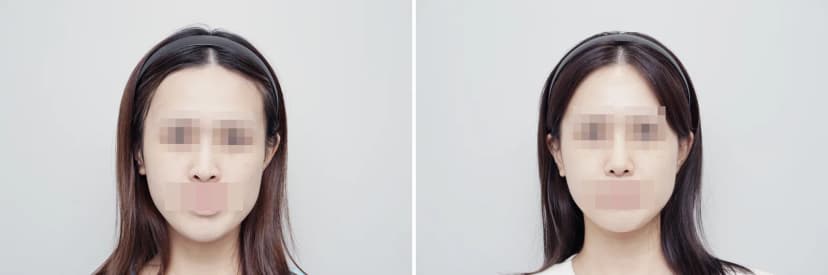
Example case (implant-free rhinoplasty, short nose): front view before surgery (left) and 2 weeks after (right). Procedures: implant-free bridge with septal cartilage, tip with septal and the patient's own rib cartilage, short-nose correction, crooked-nose correction, columella and nasolabial angle adjustment, nostril rim lowering. Results vary between individuals; swelling, bruising, asymmetry and infection are possible risks. Shared with the patient's consent; eyes and mouth are pixelated for privacy.
The exact days are confirmed at surgery and differ a little between people. If your leave won't stretch to day 14, flying home at day 7 is possible: you take a referral letter and a surgery certificate, and a doctor at home removes the inner stitches. Plan on at least 7 nights either way; how long to stay in Seoul after a Korean rhinoplasty weighs 7 nights against 14 in more detail.
Wondering which type your nose is?
Share your front, 45-degree and side photos — the surgeon will tell you which procedures your nose would actually need. No cost, no obligation.
Ask which procedure fits meWhen will you look normal enough for work?
For most desk jobs, the question that matters is whether a colleague would notice.
What was done changes this more than anything. If a hump is reduced and the bones are narrowed with osteotomy, bruising tends to be heavier and last longer. Tip work often bruises less but keeps the tip swollen longer. Minimal-incision tip procedures tend to recover faster. The open-or-closed question gets a lot of attention, but how much bone and cartilage work is involved usually matters more; where closed rhinoplasty stops being an option explains that line.
Say you have 15 days of leave, a hump you want gone, and a client presentation on camera on day 17. I'd only plan the flight right after the day-7 visit if stitch removal at home is already booked. With osteotomy in the plan, I'd assume a trace of yellow under the eyes on day 17, which concealer usually covers by then. If that presentation can't move, starting surgery a few days earlier in your leave buys more margin than anything you can do afterward.
Doctor's note
I don't give a fixed recovery period, because swelling settles at a different pace in every nose; once you're home, I guide you from your progress photos. The one thing I'd ask is that you don't judge the result at week three. The nose is still full, the tip still blunt, and that's simply the timetable of swelling, not the outcome.
If you already know the day you need to look like yourself again, put it in your WhatsApp message with one side-profile photo taken in daylight, and ask whether bone work is likely to be part of a plan like yours.
How long does rhinoplasty take to heal if the tip is the main change?
Longer than the bridge, at least for the final stage. Skin over the tip is usually thicker than over the bridge, and thick skin holds swelling and blurs definition for months after the bridge already looks settled.
I design the tip together with the bridge, because a tip raised on its own tends to look detached from the rest of the face. The trade-off is that the tip is where you'll be watching recovery the longest. If your skin is thick, expect the tip to keep refining well into the second half of the first year.
If you're unsure whether your skin type changes what's worth doing at all, whether rhinoplasty in Seoul works for your nose goes through those limits, and TIANA's English page shows the nose types we treat, from humps and round tips to short noses and revisions.
Months two to twelve, back home
In short, this is the long stretch, and you'll spend it at home. Most surgeons ask you to keep heavy glasses off the bridge for several weeks, avoid contact sports and anything that could knock the nose for longer, and sleep with your head slightly raised in the early weeks.
Swelling is often worse in the morning and after salty meals, long flights or crying, then eases through the day. Take a photo once a month, same light and same angle, so you're comparing like with like instead of reacting to one puffy morning. Those photos are also what you'd send on WhatsApp if you have a question about how the shape is settling.
If you want to see how real noses changed and how many months after surgery each photo was taken, browse TIANA's rhinoplasty case gallery before your consultation.
When healing isn't going to plan
Some things are expected: swelling, bruising, a blocked nose while the inside heals, a numb or stiff tip, and light oozing of blood in the first days. These usually fade over weeks, though tip numbness can last longer.
Other things are not part of normal healing. The American Society of Plastic Surgeons lists risks including bleeding, infection, poor wound healing, breathing difficulty, skin discoloration, a hole in the septum, and an appearance you're unhappy with that may need further surgery. Each nose sets its own pace, so use these as warning signs rather than a timetable.
Who should wait before booking: anyone with an active cold, sinus infection or skin infection around the nose, anyone pregnant or breastfeeding, anyone who recently injured the nose, and smokers who can't stop for several weeks around surgery. If you take blood-thinning medication, talk to the doctor who prescribes it before you plan anything.
If, after flying home, you have bleeding that won't stop with gentle pressure, a fever, redness spreading over the nose, or a tip that turns dark or pale, see a local doctor the same day, then send photos on WhatsApp with a note of what they said.
Your first message can be one line: the change you want, in your own words.
Frequently asked questions
Q1When can I wear glasses again after rhinoplasty?
Many surgeons ask you to keep glasses from resting on the bridge for several weeks, especially if bone was narrowed. Contact lenses, or taping light frames to the forehead, are common workarounds; ask at the day-7 visit what suits your nose.
Q2When can I go back to the gym?
Light walking is usually fine within days. Most surgeons suggest holding off strenuous exercise for a few weeks, because it raises blood pressure in the face, and keeping away from contact sports or anything that could hit the nose for longer.
Q3Can I fly home before day 7?
Plan on at least 7 nights in Seoul. The splint and outer stitches come off around day 7, and if you fly at that point you take a referral letter and surgery certificate so a doctor at home can remove the inner stitches.
Q4Does healing take longer after a revision?
Often, yes. Scar tissue from the first surgery and thinner or tighter skin can keep swelling around longer, particularly at the tip, so the final shape after a revision usually takes longer to show.
Q5Why does my nose look bigger in the morning?
Fluid collects in the face overnight while you lie flat, so swelling is commonly worse on waking and eases through the day. Sleeping with your head slightly raised in the early weeks tends to help.
Thank you for reading to the end.
Send 5 photos (front, 45-degree and side) on WhatsApp for a free photo consultation. We reply in English with the likely scope of surgery and how the estimate is worked out.
Send my photos on WhatsAppThis article is general information about elective cosmetic surgery and is not a diagnosis. Results and recovery vary between individuals. Before-and-after photos are published with patient consent; surgery carries risks such as swelling and bruising and requires downtime. Final procedures and fees are decided after examination.