Does Rhinoplasty Last Forever? Bone, Cartilage and Tip
Does rhinoplasty last forever, or will the nose you fly home with slowly slide back toward the old one?
By the end of this guide, your questions about rhinoplasty should turn into a clear next step.
Send 5 photos (front, 45-degree and side) on WhatsApp and we will reply in English with a free first assessment: the likely scope of surgery and how the estimate is worked out.
Send my photos on WhatsAppThe structural changes stay: bone and cartilage that are removed or reshaped don't grow back. What keeps changing, slowly and for everyone, is the living tissue around them, so the tip can settle lower with age and an implant or graft can need attention years later.
Hello, I'm Dr. Choi Hang-seok, Head Surgeon at TIANA Plastic Surgery in Seoul.
I operate only on noses, and I stay with you one to one from the first consultation through surgery and aftercare, so the surgeon who picks the material for your bridge is the one who answers for it later. Before surgery, a 3D-CT scan maps your bone and nasal structure, and an anesthesiologist is on staff for the operation itself.
If you're weighing an implant against your own cartilage, send a front, 45-degree and side photo of your nose on WhatsApp and ask which material would suit a nose like yours for the long run. You can write in English, and a medical interpreter for your language is provided at no extra charge at the consultation.
What actually stays put after rhinoplasty?
The question "Does rhinoplasty last forever?" has two halves, and they get different answers. The first half is the framework. When a hump is shaved down, that bone is gone. When the bony side walls are cut and brought inward (osteotomy), they heal in the new position, much like a set fracture. Cartilage trimmed from a round tip doesn't regenerate.

The second half is the cover: skin, the soft tissue under it, and the scar tissue that forms as you heal. Scar tissue keeps contracting for months. The American Society of Plastic Surgeons notes that it can take up to a year for the new contour to fully refine, so the nose you see at month two is not yet the nose you'll live with. Thick skin hides fine detail and tends to soften a sharp tip over time.
Thin skin shows every edge underneath, including the edge of an implant.
Then there's support. A tip that was narrowed but not supported can lose some projection as the skin pulls on it over the years. That's the part of a rhinoplasty most likely to look different at 45 than it did at 30, and it depends heavily on how much structure was built in to hold the tip up.
Silicone, ear, septal or rib: which one holds its shape longest?
No single material wins on every count. Each one ages in its own way, and the right choice is the one that fits your skin and bone.

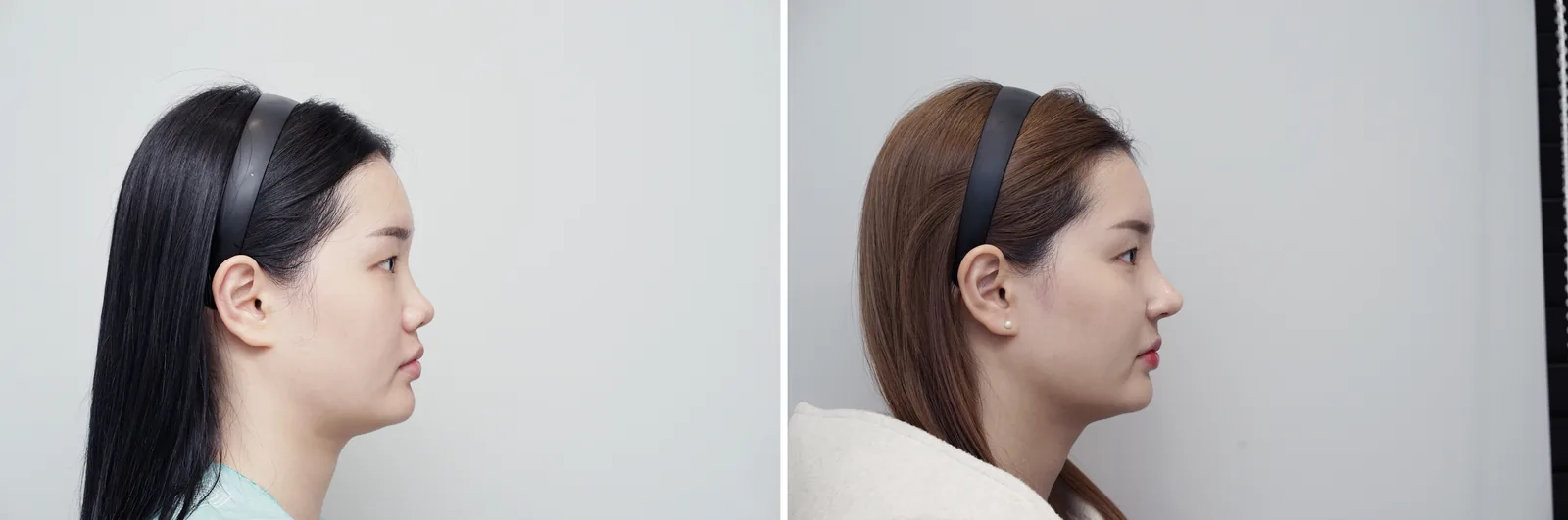
Example case (hump nose, bulbous tip): front view before surgery (left) and 1 month after (right). Procedures: silicone bridge implant, tip with septal and donor rib cartilage, hump reduction, bulbous tip refinement, short-nose correction, columella and nasolabial angle adjustment. Results vary between individuals; swelling, bruising, asymmetry and infection are possible risks. Shared with the patient's consent.

| Material | Usually used for | Over the years |
|---|---|---|
| Silicone implant | Raising the bridge | Doesn't dissolve; the body forms a capsule around it. It can shift, show through thinning skin, or tighten around the tip |
| Septal cartilage | Tip support, small grafts | Your own tissue, so it integrates; supply is limited and often used up after an earlier surgery |
| Ear cartilage | Shaping and softening the tip | Your own tissue; curved and pliable, so it shapes well but supports less |
| Rib cartilage (yours or donor) | Strong tip support, rebuilding in revisions | Plenty of material; it can warp in the first months, and your own rib leaves a small chest scar |
| Dermis or fascia | Covering the bridge, smoothing contour | Soft cover over an implant or grafts; some volume may be lost as it settles |
A review of Asian rhinoplasty in Plastic and Reconstructive Surgery Global Open describes the trade-off most surgeons weigh: silicone gives a predictable bridge line but carries long-term risks such as infection, displacement and extrusion, while your own cartilage avoids a foreign body but is harder to carve, and rib cartilage in particular can warp.
I don't choose a material by what's popular this year. Your bone structure and the specific thing that bothers you decide it. Raising only the tip on a low bridge makes the nose look stuck on, so a low nose usually needs the bridge and tip designed together, and the material for each part is chosen with you before surgery.
Say you have thin skin and want a much higher bridge
Say you're 34, the skin over your bridge is thin enough that the bone line shows in photos, and your reference picture has a tall, straight bridge. A tall silicone implant under thin skin is the combination most likely to show its edges as the skin thins further with age. In that situation I would lean toward a lower height, covering the implant with dermis or fascia, or building with your own cartilage.
I would also tell you plainly that the height you could keep for decades is lower than the one in your reference photo.
Thread nose lifts run on a shorter clock
Ask "does rhinoplasty last forever?" next to a thread nose lift and the gap is clear. Dissolvable threads are absorbed, so the lift they give is generally measured in months, and repeating it becomes part of the plan. TIANA doesn't list thread lifts. The least invasive options here are tip surgery without an implant and minimal-incision tip work, and minimal-incision procedures tend to recover faster.
Whether either is enough for your nose, or whether rhinoplasty is the right tool for it at all, is a question I cover in when rhinoplasty works and where its limits are.
Wondering which type your nose is?
Share your front, 45-degree and side photos — the surgeon will tell you which procedures your nose would actually need. No cost, no obligation.
Ask which procedure fits meRhinoplasty after 20 years: what usually changes
Ageing changes every nose, operated on or not. Skin gets thinner, the ligaments that hold the tip loosen, and the tip tends to drop a little and look longer. On a nose with an implant, thinner skin can make its outline easier to see at 55 than it was at 35. Bone work and a straightened bridge rarely change.
Two choices at the first surgery matter most here: building real support under the tip, and picking an implant height for the skin you'll have in 20 years. Not smoking and protecting the skin from sun damage help the cover over the structure age more slowly.
Here's the step most people skip. Keep the operative record that says exactly what is in your nose (implant type, which cartilage, taken from where), and take one side-profile photo in daylight at the one-year mark. If you ever see a surgeon about a change 15 years from now, those two things answer the first questions they'll ask.
Doctor's note
The question I'd rather answer is what your nose will look like at 55. A nose designed to blend in with your face ages along with it. A dramatic change that only worked on young, tight skin is the kind that tends to need a second trip, and a revision costs more money and more flights than staying in the right range the first time.
When does a nose need a second operation?
Many noses never do. These are the changes worth getting checked:
- an implant that moves when you press it, or has drifted to one side
- redness, shine or thinning skin over the implant
- a tip that is being pulled upward and feels firm, which can be contracture
- breathing that has become harder through one side
- a new bump or dent appearing within the first year
A revision is a different operation from a first rhinoplasty. There's scar tissue, the septum may already have been used, and rebuilding often calls for rib cartilage. I perform revision rhinoplasty after surgery done elsewhere, including contracture cases. If you're already at that point, the order of steps in a revision rhinoplasty and when to wait explains why timing matters.
If you have an implant from years ago and the tip has started to look tighter or more upturned, send one side photo taken in daylight with the year of that first surgery, and ask whether what you see looks like ageing skin or the implant itself.
Swelling, warping and infection: the risks to weigh
In the first weeks, swelling, bruising around the eyes and a blocked nose are expected. The tip is usually the last part to settle. How quickly each person's swelling goes down varies, which is why TIANA doesn't give one fixed period. If the first days are your main worry, how much rhinoplasty hurts, day by day covers them.
The less common risks the American Society of Plastic Surgeons lists include infection, poor wound healing, difficulty breathing through the nose and an appearance you're unhappy with, any of which can lead to a revision. With rib cartilage, warping in the early months is a known risk. With an implant, infection or shifting can show up long after surgery.
As general medical practice, it's usually better to wait if your nose is still growing (teenagers), if you have an active skin or sinus infection, if you're pregnant, or if you had nose surgery recently and the tissue hasn't settled.
If you're home and notice redness that spreads, warmth, discharge, fever or a sudden change in shape, see a doctor locally that day and bring your surgery certificate. Send a photo on WhatsApp as well, so the record of what happened stays with the clinic that operated.
What moves the cost of a longer-lasting result?
A few things set the figure for your nose:
- Scope: tip only, bridge and tip together, or bone work added for a hump or a wide bridge.
- Material: an implant versus your own cartilage; taking rib cartilage adds a second surgical site.
- First surgery or revision: a revision means working through scar tissue and often rebuilding support.
- Your nose itself: how much cartilage is available and how thick the skin is.
- Nights in Seoul: your stay is part of the total cost of the trip.
A plan that looks cheaper but leaves the tip unsupported can mean more cost and more flights later. Ask on WhatsApp what it would cost for your nose, with the same three photos, and ask about the deposit and payment method in that message too, since both are settled after the consultation.
If you want to see how real noses changed and how many months after surgery each photo was taken, browse TIANA's rhinoplasty case gallery before your consultation.
Your nights in Seoul, and who checks the nose once you're home
Plan on about 7 to 14 nights in Seoul, at least 7. The splint and outer stitches come off around day 7 and the inner stitches around day 14; the exact timing is confirmed at surgery. If you fly home around day 7, you leave with a referral letter and a surgery certificate, so a doctor at home can take out the inner stitches.
For how other overseas patients usually split those nights, see nights and follow-up for foreigners having rhinoplasty in Korea, and for the procedures and materials in one place, the TIANA rhinoplasty overview for international patients.
The longest-lasting nose is usually the one planned around your own skin and cartilage. Send the reference photo of the nose you like, next to a side photo of your own, on WhatsApp, and ask how much of that look your skin could carry over the long run. You can ask before booking anything. Once you're in Seoul, the 3D-CT scan shows the bone and structure your new nose will rest on, and that's what we choose the material from, together.
Frequently asked questions
Q1Can the hump grow back after rhinoplasty?
Bone that has been removed doesn't regrow. In the first year, healing bone or scar tissue can occasionally leave a small irregularity along the bridge. It usually shows once the swelling has gone down, which is why changes are judged at around a year.
Q2Does a silicone nose implant have to be replaced after a set number of years?
There is no fixed expiry date. An implant is generally replaced or removed when there's a problem, such as shifting, skin thinning over it, infection or contracture. It isn't swapped on a schedule.
Q3Is ear cartilage or rib cartilage better for a tip that holds up?
They do different jobs. Ear cartilage is curved and soft, so it suits shaping and small grafts. Rib cartilage is stronger and plentiful, so it suits strong tip support and revisions where the septum is already used, but it can warp in the early months.
Q4How soon after rhinoplasty can I wear heavy glasses?
Heavy frames rest right on the bridge while the bones and tissue are still settling. Ask at your stitch-removal visit when it is safe to wear them, and ask whether you should tape them to your forehead or switch to contact lenses until then.
Q5I had an implant rhinoplasty 15 years ago. Can it be redone with my own cartilage?
Often, yes. Removing an old implant and rebuilding with your own tissue is a common reason for revision. Rib cartilage is frequently used when the septum was taken in the first surgery. The operative record from your first surgery helps with planning, so look for it before you travel.
Thank you for reading to the end.
Send 5 photos (front, 45-degree and side) on WhatsApp for a free photo consultation. We reply in English with the likely scope of surgery and how the estimate is worked out.
Send my photos on WhatsAppThis article is general information about elective cosmetic surgery and is not a diagnosis. Results and recovery vary between individuals. Before-and-after photos are published with patient consent; surgery carries risks such as swelling and bruising and requires downtime. Final procedures and fees are decided after examination.