Korea Revision Rhinoplasty Procedure Steps Video: Days?
Searched "Korea revision rhinoplasty procedure steps video", watched an old implant come out and new cartilage go in, and still can't tell whether your second nose surgery fits inside one school holiday?
By the end of this guide, your questions about rhinoplasty should turn into a clear next step.
Send 5 photos (front, 45-degree and side) on WhatsApp and we will reply in English with a free first assessment: the likely scope of surgery and how the estimate is worked out.
Send my photos on WhatsAppIf your break dates are fixed and the flight isn't booked yet, the sections on nights and the day-7 flight will matter more to you than any footage.
How a revision trip to Seoul runs from arrival to the last stitches, how many nights to plan, whether day 7 is a workable day to fly, and who looks after your nose once you're home: those four answers decide whether this break works or the next one is the better bet.
Hello, I'm Dr. Choi Hang-seok, Head Surgeon at TIANA Plastic Surgery in Gangnam, Seoul, and a board-certified plastic surgeon in Korea.
TIANA does rhinoplasty and revision rhinoplasty only, including noses first operated on at another clinic and cases with contracture. I see you one-to-one from consultation through surgery and aftercare, 3D-CT imaging maps your bone and nasal structure before surgery, and an anesthesiologist is on staff. A medical interpreter for your language is provided at no extra charge.
Most procedure videos stop when the last stitch goes in, which is exactly the moment a traveler's planning should start.
For a revision in Seoul, plan on 7 to 14 nights. Consultation, any tests and surgery come at the start; the splint and outer stitches come off around day 7, and the inner stitches around day 14. If you have to leave at day 7, you fly with a referral letter and a surgery certificate so the inner stitches can be removed at home.
If you're weighing this break against the next one, send five photos of your nose (front, 45-degree and side) on WhatsApp with your holiday dates, and ask whether a revision like yours fits inside them. One set of photos is enough to start, and you can ask before booking anything.
Korea revision rhinoplasty procedure steps video: what the edit leaves out
Most results for "Korea revision rhinoplasty procedure steps video" show the operating room in order: the incision, lifting the skin, removing or adjusting what the first surgery left, shaping cartilage, rebuilding support, and the splint going on.

If you'd like those operating-room steps in words, I've set them out in what happens in the operating room during rhinoplasty.
What no edit can show is the part you'll actually live through as a traveler. There's no jet lag in the footage, no gauze inside the nose the next morning, no hotel room with a splint on your face, and no calendar. A video also can't show why the surgeon chose that graft for that nose. In a revision, the plan is built around what the first operation left behind: an implant that has shifted, scar tissue that has tightened around it, or a septum that has already given up cartilage.
If you'd like to see the clinic on camera first, TIANA's English page links to our videos on YouTube, including the clinic and the surgeon's explanations. Treat any footage, ours included, as a way to understand the steps, not as a preview of your own nose.
Is it too soon for a revision?
For many people this is the timing question that matters more than flights. Many surgeons prefer to wait around a year after the first rhinoplasty before revising it, because swelling and soft scar tissue can hide the shape the nose will finally settle into.
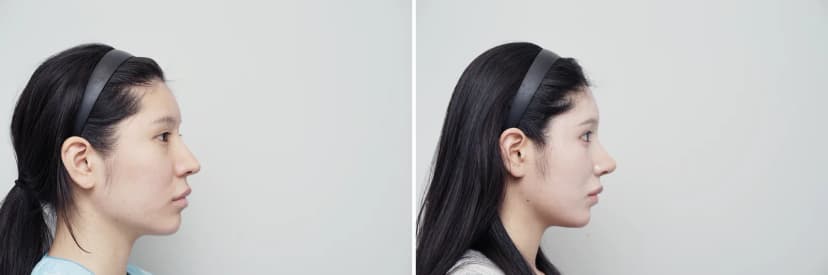
Example case (revision rhinoplasty): side view before surgery (left) and 2 weeks after (right). Procedures: revision rhinoplasty, silicone bridge implant, tip with septal and donor rib cartilage, hump reduction, osteotomy, drooping-tip correction. Results vary between individuals; swelling, bruising, asymmetry and infection are possible risks. Shared with the patient's consent.

Operating on tissue that is still changing means aiming at a moving target. There are exceptions: an implant pressing against thin skin, redness that won't settle, or signs of infection are reasons not to wait for the calendar. A review of Asian rhinoplasty in Plastic and Reconstructive Surgery Global Open describes implant complications, including contracture, and the role of the patient's own cartilage when the nose has to be rebuilt.
Doctor's note
If your first surgery was less than a year ago and nothing is going wrong, I'd rather you use this break to send photos and plan than to fly in for surgery. A nose changes the face through very small differences, and those small differences are exactly what a revision is trying to get right. What I want to help you avoid is a third operation because the second one was planned on swelling.
The tip deserves its own mention. If your first surgery was on a round tip and the skin there is thick, a second operation has less room to change the outline than most people expect; choosing a clinic for bulbous tip surgery explains why skin thickness sets that limit.
Wondering which type your nose is?
Share your front, 45-degree and side photos — the surgeon will tell you which procedures your nose would actually need. No cost, no obligation.
Ask which procedure fits meHow many nights does a revision need in Seoul?
Plan on at least 7 nights and up to 14. Here is how the stay usually runs, with what each step means for your plans.
| When | What happens at the clinic | What it means for you |
|---|---|---|
| Day 1 | In-person consultation, tests if needed, design and cost confirmed, then surgery | Arrive the day before and keep this day empty |
| The following days | Gauze inside the nose removed, swelling checked, medication prescribed, aftercare instructions | Stay close to the clinic; short walks only |
| Around day 7 | Splint and outer stitches removed | The earliest point to fly home, with paperwork |
| Around day 14 | Inner stitches removed | Fly on or after this day if your break allows |
The exact days are confirmed at surgery and shift a little between people. The clinic is open 10:00 to 19:00 on weekdays and 10:00 to 16:00 on Saturdays, and closed on Sundays and public holidays, so check which weekday your day 7 and day 14 land on before you book.
A revision can add pieces a first surgery didn't have. If cartilage is taken from the ear or a rib, you're healing in two places, and a rib donor site usually means chest soreness on top of the nose for the first days. For the general order of a first-time trip, Korea rhinoplasty procedure steps in order walks through it; a revision follows the same skeleton with more planning at the front.
Can you fly home on day 7?
Yes, if your break allows nothing longer. Once the splint and outer stitches are off around day 7, you can fly with a referral letter and a surgery certificate, and a doctor at home removes the inner stitches.
Before you leave home, find a clinic or family doctor who will remove them, and book that appointment for roughly a week after you land. Staying to day 14 has its own advantage: the inner stitches come out at the clinic where you had the surgery, and you spend the second week of swelling close to it.
Say your break is 12 days, your first rhinoplasty was four years ago with a silicone implant, and the tip now looks pinched and turned up. On paper, 12 days covers day 7. Before you count on it, I'd think about two things.
First, a pinched, upturned tip over an implant often means the tissue has tightened, and correcting that can need more cartilage than the septum still holds, so a rib or donor rib graft may come into the plan. Second, a 12-day window leaves no slack if day 7 lands on a Sunday. With a plan like that, I'd only suggest the day-7 flight if the stitch removal at home is already booked, and I'd keep the return ticket changeable.
If your window looks like that, message on WhatsApp with the month of your first surgery, what was used if you know it (implant, cartilage or both) and your return-flight date, and ask whether day 7 or day 14 is the safer exit for your nose.
Who looks after your nose once you're home?
You leave with the referral letter and surgery certificate if you fly at day 7. Keep copies of everything, including what was done and what was used, because a doctor at home will ask.
The U.S. Centers for Disease Control and Prevention advises medical travelers to carry copies of their records and to plan follow-up care at home before they go. Swelling after a revision settles at its own pace, so I don't give one fixed recovery period; once you're home, I guide you from your progress photos. Tip swelling is usually the last to go, and the American Society of Plastic Surgeons notes the new contour can take up to a year to fully refine.
If something feels wrong after you've flown home, such as bleeding that won't stop, a fever, or redness spreading across the nose, see a local doctor the same day. Then send photos and a note of what that doctor said on WhatsApp.
If you want to see how real noses changed and how many months after surgery each photo was taken, browse TIANA's rhinoplasty case gallery before your consultation.
Risks of a second surgery, and who should wait
Every rhinoplasty carries risks. The American Society of Plastic Surgeons lists breathing difficulty, poor wound healing, skin discoloration, a hole in the septum, and an appearance you're unhappy with, which can lead to further surgery.
In a revision, scar tissue from the first operation makes the work slower and the skin less forgiving, and the cartilage supply is often smaller. Common temporary reactions are swelling, bruising around the eyes, a blocked nose while the inside heals, and a numb tip; these usually ease over weeks, while the tip's final outline takes much longer.
Who should wait or reconsider: anyone less than about a year from the first surgery without a pressing problem, anyone with an active infection in or around the nose, anyone pregnant or breastfeeding, and smokers who can't stop for several weeks around surgery, since smoking slows wound healing. Each nose heals at its own pace, and how far a second surgery can go is set by the skin and tissue that remain.
If you're still comparing surgeons, revision rhinoplasty surgeons in Korea covers what to ask before you commit. Once your dates are close to fixed, ask about the deposit and payment method on WhatsApp too; both are settled after the consultation, so you can raise them before agreeing to anything.
If one part of this post made you rethink your dates, ask about that part on WhatsApp; a single line with the month of your first surgery is enough to begin. When you arrive in Seoul, the first thing I look at on the 3D-CT is what the first surgery left behind in the bone and septum, because that decides how much there is to rebuild with.
Frequently asked questions
Q1What decides the cost of a revision rhinoplasty in Korea?
Mainly what needs correcting (bridge, tip or both), whether an old implant comes out or is replaced, where the support cartilage comes from (septal, ear, rib or donor rib), whether contracture is involved, and how many nights you stay in Seoul. Ask on WhatsApp what it would cost for your case, with your photos and the month of your first surgery.
Q2What happens if my day 7 or day 14 falls on a Sunday?
The clinic is closed on Sundays and public holidays, and Saturday hours end at 16:00. Count forward from your surgery date before you book flights, and leave a spare day so a closed day doesn't push your splint removal past your departure.
Q3Do I need to speak Korean for a revision in Seoul?
No. You can write in English on WhatsApp before you travel, and a medical interpreter for your language is provided at no extra charge during your visit.
Q4Does every revision need rib cartilage?
No. Septal, ear, rib or donor rib cartilage, your own dermis or fascia, and silicone implants are all options. Which one suits you depends on what the first surgery used up and how much support the tip needs, and it is chosen after examination with 3D-CT.
Q5Can I sightsee during the stay?
Short, quiet walks are usually fine after the first few days. Most surgeons advise avoiding crowds where your nose could be bumped, saunas, alcohol and strenuous exercise while the splint is on, so save the busier sightseeing for after day 7.
Thank you for reading to the end.
Send 5 photos (front, 45-degree and side) on WhatsApp for a free photo consultation. We reply in English with the likely scope of surgery and how the estimate is worked out.
Send my photos on WhatsAppThis article is general information about elective cosmetic surgery and is not a diagnosis. Results and recovery vary between individuals. Before-and-after photos are published with patient consent; surgery carries risks such as swelling and bruising and requires downtime. Final procedures and fees are decided after examination.